
Ask questions which are clear, concise and easy to understand.
Ask QuestionPosted by Aakash Skd 8 years, 4 months ago
- 0 answers
Posted by Priyanshu Bordoloi 8 years, 4 months ago
- 1 answers
Vidhi Jain 8 years, 4 months ago
Posted by Shivani Thakur 8 years, 4 months ago
- 0 answers
Posted by Tehzeeb Alam 8 years, 4 months ago
- 0 answers
Posted by Arnav Singh 8 years, 4 months ago
- 2 answers
Sourabh Thakur 8 years, 4 months ago
Dharmendra Kumar 8 years, 4 months ago
Real Numbers is a set of rational and irrational numbers.
Posted by Chirag Mohan 8 years, 4 months ago
- 0 answers
Posted by Jishan Khan 8 years, 4 months ago
- 2 answers
Rashmi Bajpayee 8 years, 4 months ago
{tex}{{\sin \left( {{\rm{A}} - {\rm{B}}} \right)} \over {\cos {\rm{A}}\cos {\rm{B}}}} + {{\sin \left( {{\rm{B}} - {\rm{C}}} \right)} \over {\cos {\rm{B}}\cos {\rm{C}}}} + {{\sin \left( {{\rm{C}} - {\rm{A}}} \right)} \over {\cos {\rm{C}}\cos {\rm{A}}}}{/tex}
= {tex}{{\sin {\rm{A}}\cos {\rm{B}} - \cos {\rm{A}}\sin {\rm{B}}} \over {\cos {\rm{A}}\cos {\rm{B}}}} + {{\sin {\rm{B}}\cos {\rm{C}} - \cos {\rm{B}}\sin {\rm{C}}} \over {\cos {\rm{B}}\cos {\rm{C}}}} + {{\sin {\rm{C}}\cos {\rm{A}} - \cos {\rm{C}}\sin {\rm{A}}} \over {\cos {\rm{C}}\cos {\rm{A}}}}{/tex}
= {tex}\eqalign{ & {{\sin {\rm{A}}\cos {\rm{B}}\cos {\rm{C}} - \cos {\rm{A}}\sin {\rm{B}}\cos {\rm{C}} + \cos {\rm{A}}\sin {\rm{B}}\cos {\rm{C}} - \cos {\rm{A}}\cos {\rm{B}}\sin {\rm{C}} + \sin {\rm{C}}\cos {\rm{A}}\cos {\rm{B}} - \cos {\rm{B}}\cos {\rm{C}}\sin {\rm{A}}} \over {\cos {\rm{A}}\cos {\rm{B}}\cos {\rm{C}}}} \cr & \cr} {/tex}
= {tex}{0 \over {\cos {\rm{A}}\cos {\rm{B}}\cos {\rm{C}}}}{/tex}
= 0
Hence proved
Posted by Yash Pandey 8 years, 4 months ago
- 0 answers
Posted by Solanki Priyanshi 8 years, 4 months ago
- 0 answers
Posted by Aditya Vardhan 8 years, 4 months ago
- 0 answers
Posted by Aviral Kushwaha 8 years, 4 months ago
- 0 answers
Posted by Ravi Rajwade 8 years, 4 months ago
- 0 answers
Posted by Tushar Aggarwal 8 years, 4 months ago
- 0 answers
Posted by Abhi Shek 8 years, 4 months ago
- 1 answers
Posted by Aditya Baghel 8 years, 4 months ago
- 0 answers
Posted by Amit Sah 8 years, 4 months ago
- 0 answers
Posted by Utk Gupta 8 years, 4 months ago
- 0 answers
Posted by Tehzeeb Alam 8 years, 4 months ago
- 1 answers
Posted by Sarbani Thakur 8 years, 4 months ago
- 0 answers
Posted by Khilesh Sahu 8 years, 4 months ago
- 0 answers
Posted by Sumit Prakash 8 years, 4 months ago
- 0 answers
Posted by Ayush Sharma 8 years, 4 months ago
- 0 answers
Posted by Ritik Goyal 8 years, 4 months ago
- 0 answers
Posted by Sumit Singh 8 years, 4 months ago
- 0 answers
Posted by Kim Jetelela 8 years, 4 months ago
- 0 answers
Posted by Himanshu Galgat 8 years, 4 months ago
- 1 answers
Govind Singh 7 years, 11 months ago
Let ABCD is the trapezium and h is the height which is required to be found.
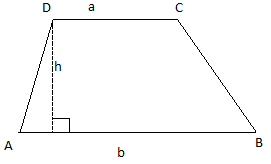
Let AB=11 cm, CD=6 cm and AB is parellel to CD.
Let distance between foot of perpendicular h and A is X.
So distance between B and foot of 2nd perpendicular from C=11–6-x=5-x.
There are 2 rt. angled triangles.
Applying Pythogorous theorem,
For one triangle,
h^2=3^2-x^2 .........(1)
For 2nd triangle,
h^2=4^2-(5-x)^2 ........(2)
From (1)&(2), x=1.8 cm and
required h=2.4 cm
Posted by Shivam Sinha 8 years, 4 months ago
- 0 answers

myCBSEguide
Trusted by 1 Crore+ Students

Test Generator
Create papers online. It's FREE.

CUET Mock Tests
75,000+ questions to practice only on myCBSEguide app
