
Ask questions which are clear, concise and easy to understand.
Ask QuestionPosted by Dev Kathuria 6 years, 7 months ago
- 1 answers
Posted by Satyam Prajapati 6 years, 7 months ago
- 1 answers
Japisher Singh 6 years, 7 months ago
Posted by Vinita Sharma 6 years, 7 months ago
- 2 answers
Pradeep S R 6 years, 7 months ago
Yogita Ingle 6 years, 7 months ago
Dorso- ventrally flattened body means body is flat from both surfaces lower and upper surfaces. This type of body is found in flatworms.
When an animal or plant / its organ is compressed along its dorsal ( upper ) and ventral ( lower ) side , it is called Dorsiventrally flattened . ( Also called Dorsoventrally flattened )
Such an animal ( plant organ like leaf ) shows good length as well as breadth but has not much of ' thickness ' .
Posted by Sumitra Hansdah 6 years, 7 months ago
- 1 answers
Yogita Ingle 6 years, 7 months ago
Dinoflagellates :
- They are mostly marine.
- They have a cell wall with stiff cellulose plates on the outer surface.
- They are always photoautotrophic.
- They have two flagella, one transverse and one longitudinal.
Euglenoids : .
- They are freshwater forms found in stagnant water.
- They have no cell wall, but pellicle which give shape and flexibility to body.
- They may be photoautotrophic or heterotrophic.
- They have two flagella and both are anterior.
Posted by Aditya Kumar 6 years, 7 months ago
- 2 answers
Satyam Prajapati 6 years, 7 months ago
Anjali Kumawat 6 years, 7 months ago
Posted by Mohit Sharma 6 years, 7 months ago
- 1 answers
Barath Balaji 6 years, 7 months ago
Posted by Mohit Sharma 6 years, 7 months ago
- 3 answers
Satyam Prajapati 6 years, 7 months ago
Posted by Divyansh Kumar 6 years, 7 months ago
- 4 answers
Posted by Pariya Verma 6 years, 7 months ago
- 2 answers
Posted by Ganesh Thapa 6 years, 7 months ago
- 5 answers
Unnati Pragya 6 years, 7 months ago
Milan Rajput 6 years, 7 months ago
Posted by Saleem Ahmad 6 years, 7 months ago
- 1 answers
Yogita Ingle 6 years, 7 months ago
- Mammals are endothermic vertebrates
- Have hair and fur on the body
- Have mammary glands
- Four chambered hearts
- Have sebaceous (fat secreting glands), sudoriferus (sweat), and scent glands.
- Have heterodont dentation (different types of teeth)
Posted by I -Kmen-Rahmi Tyngkan 6 years, 7 months ago
- 1 answers
Yogita Ingle 6 years, 7 months ago
1) Seminal vesicle : The sperms produced from testes, while the cockroach is still young, are brought by the vasa deferentia into the seminal vesicles for storage. The sperms in the seminal vesicles are glued together in the form of bundles called spermatophores.
(3) Collaterial Glands: There is a pair of white much branched collaterial glands, the left is much larger than the right. Both these glands continue as collaterial ducts which join to form a common duct which opens into the dorsal side of the genital chamber. These are the accessory reproductive glands.
(5) Spermathecae: These are a pair of club-shaped, unequal-sized, one spermathecae being larger than the other, structures. Both the spermathecae unite to form a short common duct which opens into the genital chamber on a small spermathecal papilla. Some workers claim that there is a single spermatheca and it has a lateral caecum.
Posted by Sakshi Chaturvedi 6 years, 7 months ago
- 0 answers
Posted by Sajeetha Vasudevan 6 years, 7 months ago
- 2 answers
Safvan Mirza 6 years, 7 months ago
Arvind Noonia 6 years, 7 months ago
Posted by Preet Ramgharia 6 years, 7 months ago
- 1 answers
Barath Balaji 6 years, 7 months ago
Posted by Sumitra Hansdah 6 years, 7 months ago
- 3 answers
Sajeetha Vasudevan 6 years, 7 months ago
Posted by Dipanshu Patidar 6 years, 7 months ago
- 1 answers
Posted by Nitin Tyagi 6 years, 7 months ago
- 2 answers
Ayush Mishra 6 years, 7 months ago
Posted by Asha Sharma 6 years, 7 months ago
- 1 answers
Yogita Ingle 6 years, 7 months ago
Transport of food material from leaves to other parts of the plant is called translocation. This food may be stored in fruits, stem or roots. The movement of food can be upward as well as downward depending upon the needs of the plants.
The movement of food in the phloem takes place by utilizing energy. The areas where the nutrients are stored is known as sink (e.g. root) and where they originate as source ( leaf). The movement of food is always from the source to the sink. At source i.e leaves, food is prepared in the form of glucose. Glucose is converted into sucrose. Sucrose enters into the phloem at the expense of energy from ATP. A pressure gradient is set up in the phloem with high pressure at source and low pressure at sink. So the phloem sap with food will move from source to the sink. The phloem transports food according to the need of the plant.
Posted by Suplex City ?? 6 years, 7 months ago
- 0 answers
Posted by Nikhil Gautam 6 years, 7 months ago
- 1 answers
Posted by Kuki Reddi 6 years, 7 months ago
- 0 answers
Posted by Astu Rana 6 years, 7 months ago
- 2 answers
Gautam Prajapati 6 years, 7 months ago
Posted by Gaurav Agrahari 6 years, 7 months ago
- 1 answers
Meghna Thapar 5 years, 8 months ago
Graft rejection occurs when the recipient's immune system attacks the donated graft and begins destroying the transplanted tissue or organ. The immune response is usually triggered by the presence of the donor's own unique set of HLA proteins, which the recipient's immune system will identify as foreign. Immune response is responsible for rejection of kidney graft because the person's immune system detects that the antigens on the cells of the organ are different or not "matched." Mismatched organs, or organs that are not matched closely enough, can trigger a blood transfusion reaction or transplant rejection.
Posted by Mahima Khatri 6 years, 7 months ago
- 1 answers
Sia ? 6 years, 7 months ago
A racemose Inflorescence: In racemose type of inflorescences the main axis continues to grow, the flowers are borne laterally in an acropetal succession. Acropetal succession means that older flowers are at the base and younger flowers are near the apex.
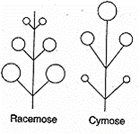
Cymose inflorescence: In the cymose type of inflorescence the main axis terminates in a flower, hence is limited in growth. The flowers are borne in a basipetal order. In basipetal succession older flowers are at the apex and younger flowers are near the base
Posted by Anterpal Singh 6 years, 7 months ago
- 1 answers
Sia ? 6 years, 7 months ago
Albugo is a genus of plant-parasitic oomycetes. Those are not true fungi, although many discussions of this organism still treat it as a fungus.
Posted by B Kaushik 6 years, 7 months ago
- 5 answers
Posted by Armani Manocha 6 years, 7 months ago
- 0 answers
Posted by Armani Manocha 6 years, 7 months ago
- 0 answers
Posted by Sagar Lakra 6 years, 7 months ago
- 0 answers

myCBSEguide
Trusted by 1 Crore+ Students

Test Generator
Create papers online. It's FREE.

CUET Mock Tests
75,000+ questions to practice only on myCBSEguide app

Yogita Ingle 6 years, 7 months ago
Meiosis involves two sequential cycles of nuclear and cell division, but only a single cycle of DNA replication. Meiosis is divided into meiosis I and meiosis II.
1Thank You