
Ask questions which are clear, concise and easy to understand.
Ask QuestionPosted by Aman Kumar 5 years, 7 months ago
- 1 answers
Posted by Divakar Verma 5 years, 7 months ago
- 1 answers
Gaurav Seth 5 years, 7 months ago
The French Revolution in 1789 was an influential event that marked the age of revolutions in Europe. The major outcome of the revolution was the formation of a constitutional monarchy and a sizeable reduction in the royal and feudal privileges.
It paved the way for the achievement of bigger goals of national identity and national pride, which can be aptly called nationalism.
The revolutionaries referred to France as la patrie or the fatherland, where all citizens, known as le citoyen, enjoyed equal rights under the constitution. The revolutionaries tried to establish a collective French identity for the people by adopting French flag, composing nationalistic songs and hymns, discouraging the use of regional dialects and adopting French as the common language of France.
The French Revolution had its impact on the administration as well.
- A body of active citizens, elected the Estates General and renamed it the National Assembly.
- A centralised administrative system was created formulating uniform laws for all French citizens.
- All internal custom duties and dues were abolished.
- A uniform system of weights and measures was adopted.
The metric system was founded by France in 1791. The French revolutionaries also took it upon themselves to help other European countries to overcome autocracy and form nations. The French armies were welcomed by European countries like Holland, Belgium, Switzerland and Italy in the 1790s.
After the French Revolution emerged a famous historic personality and warrior, Napoleon Bonaparte. He introduced several effective administrative changes like the civil code of 1804 introduced by Napoleon also known as the Napoleonic code.
As per this code:
- The privileges enjoyed by the noblemen and clergy on the basis of birth were abolished.
- Equality before law and the right to property was secured.
- The feudal system was abolished and the peasants were freed from serfdom and the payment of dues to the manor owner.
- The businessmen and small producers of goods felt that uniform laws, standardised weights and a common national currency could facilitate free trade across Europe.
- Guild restrictions were removed and transport and communication systems were improved.
The countries under the French rule soon realised that their political freedom that had been lost.
Higher taxes, forced enrolment of people into the French army and censorship overshadowed the positive administrative changes brought about by Napoleon, and led to his downfall.
Posted by Yash Kaushik 5 years, 7 months ago
- 2 answers
Yogita Ingle 5 years, 7 months ago
Sri Lanka has the more better performance regarding the human development than India. Sri Lanka is the island of the nation of south India in the Indian ocean.
Posted by Tsering Gombu 5 years, 7 months ago
- 2 answers
Yogita Ingle 5 years, 7 months ago
Marquis de Lafayette is known as the hero of two worlds.
This man has recently been in the news too much.
This man was an awkward provincial, unsuited for the life of a courtier.
The life which he thought or wanted for himself was a life of military glory.
Posted by Abc Xyz 5 years, 7 months ago
- 1 answers
Yogita Ingle 5 years, 7 months ago
Political parties fill political offices and exercise political power. Parties do so by performing a series of functions mentioned below:
- Parties contest elections.
- Parties put forward different policies and programmes and the voters choose from them.
- Parties play a decisive role in making laws for a country.
- Parties form and run governments.
- Those parties that lose in the elections play the role of opposition to the parties in power, by voicing different views and criticising the government for its failures or wrong policies.
- Parties shape public opinion.
- Parties provide people access to government machinery and welfare schemes implemented by governments.
Posted by Abc Xyz 5 years, 7 months ago
- 2 answers
Md Shami Akhatar 5 years, 7 months ago
Yogita Ingle 5 years, 7 months ago
The relation or union between persons or families contracted by intermarriage. In international law. A union or association of two or more states or nations, formed by league or treaty, for the joint prosecution of a war, or for their mutual assistance and protection in repelling hostile attacks. The league or treaty by which the association is formed. The act of confederating, by league or treaty, for the purposes mentioned. If the alliance is formed for the purpose of mutual aid in the prosecution of a war against a common enemy, it is called an “offensive” alliance. If it contemplates only the rendition of aid and protection in resisting the assault of a hostile power, it is called a “defensive” alliance. If it combines both these features, it is denominated an alliance “offensive and defensive.”
Posted by Abc Xyz 5 years, 7 months ago
- 1 answers
Yogita Ingle 5 years, 7 months ago
A Political Party is a group of people who come together to contest elections and hold power in the government. They agree on some policies and programmes for the society with a view to promote the collective good. Parties reflect fundamental political divisions in a society. Thus a party is known by which part it stands for, which policies it supports and whose interests it upholds. A political party has three components:
- The leaders
- The active members
- The followers
Posted by Abc Xyz 5 years, 7 months ago
- 2 answers
Yogita Ingle 5 years, 7 months ago
The opposition party plays a very important role in a democracy as
(i) It acts as pressure group.
(ii) It mobilises the government.
(iii) It keeps a check on the working of the ruling party.
(iv) It puts different views in the Parliament and criticise the government for its failures or wrong policies.
Posted by Monika Rajan 5 years, 7 months ago
- 2 answers
Gaurav Seth 5 years, 7 months ago
Answer: (a) Nationalism is a feeling that combines all the people of the nation into a single unit. It is a powerful sentiment that binds people together in a common bond beyond their communal, lingual, caste or religious differences. In all the colonies of the world, the imperialist power exploited the people socially, religiously, economically and politically.
- Colonization affected people’s freedom, and nationalist sentiments surged during the process of struggle against imperial domination.
- The sense of oppression and exploitation became a common bond for people from different walks of life, and this resulted in the growth of nationalist ideals.
- Although each class or group of people felt that they were being oppressed under colonialism, the effects of colonialism were felt differently.
- People started uniting against the colonialism which strengthened the sense of nationalism further.
Thus, the growth of nationalism in the colonies is linked to anti-colonial movements.
For more click on the given link:
<a href="https://mycbseguide.com/blog/ncert-solutions-for-class-10-social-science-history-nationalism-in-india/">https://mycbseguide.com/blog/ncert-solutions-for-class-10-social-science-history-nationalism-in-india/</a>
Posted by Divya Chouhan 5 years, 7 months ago
- 1 answers
Posted by Piyush Soni 5 years, 7 months ago
- 1 answers
Gaurav Seth 5 years, 7 months ago
The growth of population increased the demand of food grains in Britain. The landed aristocracy pressurised the government to restrict the import of corn into the country. These laws came to be known as the Corn Laws. The promulgation of the Corn Laws further pushed up the prices of food grains. The industrialists and urban dwellers were unhappy with the Corn Laws which resulted in the government abolishing the laws. After the abolition of the Corn Laws, imported food flooded the British markets. British agriculture was not able to compete with imports. This resulted in the abandonment of cultivation in many agricultural fields of Britain. Many farmers migrated to urban centers in search of employment opportunities.
Posted by Anupama ?? 5 years, 7 months ago
- 2 answers
Tanisha Yadav 5 years, 7 months ago
Amrita Kumari 5 years, 7 months ago
Posted by Palak Kumari 5 years, 7 months ago
- 3 answers
Tanisha Yadav 5 years, 7 months ago
Posted by Srinidhi T 5 years, 7 months ago
- 0 answers
Posted by Puranjay Vyas 5 years, 7 months ago
- 2 answers
Pravin Yedage 5 years, 7 months ago
Md Shami Akhatar 5 years, 7 months ago
Posted by Megha Kulagod 5 years, 7 months ago
- 1 answers
Amrita Kumari 5 years, 7 months ago
Posted by Asmita Belapurkar 5 years, 7 months ago
- 2 answers
Dhanshree Mane 5 years, 7 months ago
Megha Kulagod 5 years, 7 months ago
Posted by Muskan Kumari 5 years, 7 months ago
- 2 answers
Asmita Belapurkar 5 years, 7 months ago
Posted by Akhil Rajesh 5 years, 7 months ago
- 2 answers
Rishi Kishore 5 years, 7 months ago
Posted by Tripura * 5 years, 7 months ago
- 1 answers
Yogita Ingle 5 years, 7 months ago
(i) Gandhiji called for a country wide Hartal on 6th April, 1919. But he was arrested.
(ii) There were disturbances in Delhi, Ahmedabad and Punjab. In Amritsar, two popular leaders, Dr. Satyapal and Dr. Saif- ud-din Kitchlew, were arrested. The people took out a procession in Amritsar to protest against these arrests, and demanded the release of their leaders.
(iii) A public meeting was announced for the 13th April, 1919, at the Jallianwala Bagh, Amritsar against the arrest of the leaders.
(iv) General Dyer marched there and killed more than 1,000 people.
(v) As the news of the Jallianwalla Bagh spread, crowds took to the streets in many North Indian towns. There were strikes, clashes with the police and attacks on government buildings.
Posted by Zohaa Siddiqui 5 years, 7 months ago
- 2 answers
Megha Kulagod 5 years, 7 months ago
Posted by Prashant Tiwari 5 years, 7 months ago
- 1 answers
Zohaa Siddiqui 5 years, 7 months ago
Posted by Punit Pandey 5 years, 7 months ago
- 1 answers
Gaurav Seth 5 years, 4 months ago
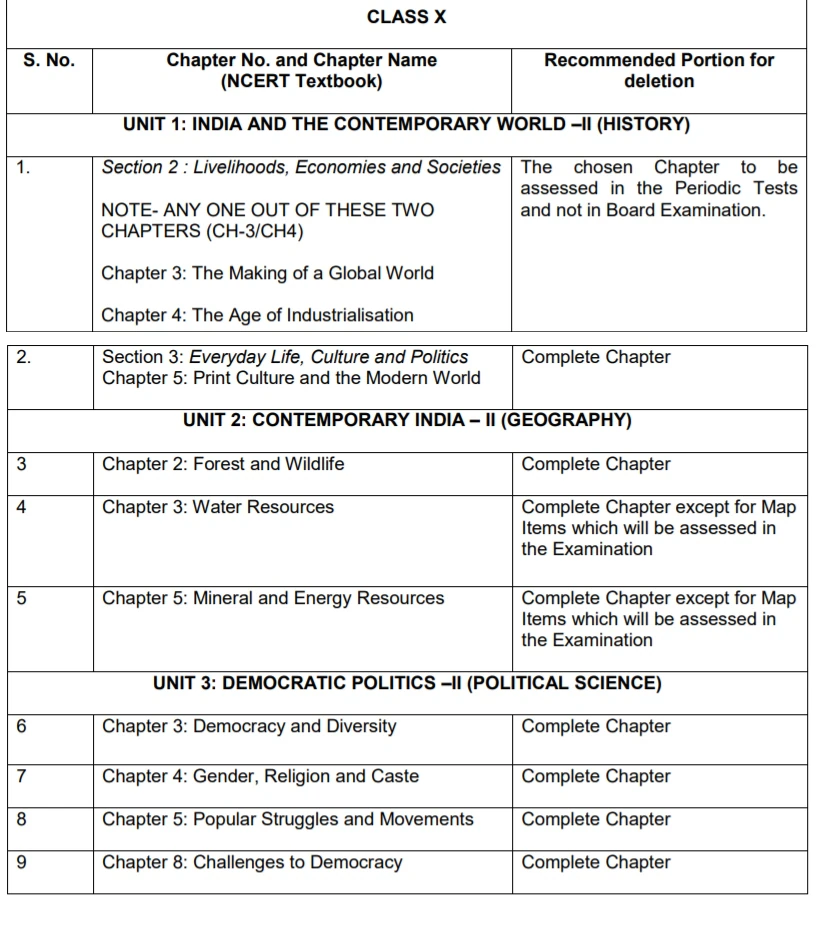
HRD Minister Ramesh Nishank announced a major CBSE syllabus reduction for the new academic year 2020-21 on July 7 which was soon followed by an official notification by CBSE on the same.
Considering the loss of classroom teaching time due to the Covid-19 pandemic and lockdown, CBSE reduced the syllabus of classes 9 to 12 with the help of suggestions from NCERT.
The CBSE syllabus has been rationalized keeping intact the learning outcomes so that the core concepts of students can be retained.
Deleted syllabus of CBSE Class 10 Social Science
c
Posted by Harsh Gartan 5 years, 7 months ago
- 1 answers
Gaurav Seth 5 years, 5 months ago
The factors affecting the location ofindustry’are grouped into physical and human factors.
Physical Factors:
(i) Availability of Raw materials The factory needs to be close to the location of raw material if they are heavy and bulky to transport. For example, iron and steel industry is located near the source of raw material.
(ii) Water Source Water is an important factor that
determines the location of industries. Water is required for various industrial processes. River water and waterfalls can also be used to generate hydroelectricity.
(iii) Climate Climate plays a significant role in establishment of industries. Harsh climate is not much suitable for industries. Extremely hot, humid, dry or cold climate is not very conducive for industries. For example, cotton textile industry requires humid climate because thread breaks in dry climate.
Human Factors:
(i) Labour A large and cheap labour force is required for labour-intensive and manufacturing industries. High-tech industries have to be located where suitable skilled workers are available.
(ii) Capital This is the money that is invested to start a business. The amount of capital will determine the size and location of the factor.
(iii) Government Policies Industrial development is encouraged in some areas and restricted in others. Industries that are located in depressed areas may receive financial incentives and assistance from the government in the form of low rent and tax rates.
<button aria-label="like this post" title="like this post"></button>
<button aria-label="share a link to this post" data-post-number="2" data-share-url="/t/explain-any-three-factors-effecting-the-localisation-of-industries-with/16356/2" title="share a link to this post"></button></nav> </section> <section> </section> </article>Posted by Abhi Pandat Ji #Vvip# 5 years, 7 months ago
- 0 answers

myCBSEguide
Trusted by 1 Crore+ Students

Test Generator
Create papers online. It's FREE.

CUET Mock Tests
75,000+ questions to practice only on myCBSEguide app

Gaurav Seth 5 years, 7 months ago
(i) Government adopted majoritarian measure to establish Sinhala Supremacy. In 1956, an Act was passed to recognise Sinhala as the only official language thus disregarding Tamil.
(ii) The governments followed preferential politics that favoured Sinhala applicants for university positions and government jobs.
(iii) A new Constitution stipulated that the state shall protect and foster Buddhism.
(iv) Sri Lankan Tamils felt that none of the major political parties led by the Buddhist Sinhala leaders were sensitive to their language and culture.
(v) As a result, the relations between the Sinhala and Tamil communities strained overtime and it soon turned into a Civil War.
1Thank You