
Ask questions which are clear, concise and easy to understand.
Ask QuestionPosted by Maahin Singh 5 years, 7 months ago
- 3 answers
Gaurav Seth 5 years, 7 months ago
- A kidney is composed of an enormous number of uriniferous tubules. They are also known as nephrons or renal tubules or kidney tubules.
- Nephrons are the structural and functional units of the kidney.
- Each kidney is formed of about 1 million nephrons.
- Nephrons are held together by a connective tissue.
Structure of nephron:
- Each nephron is made of a glomerulus and a renal tubule.
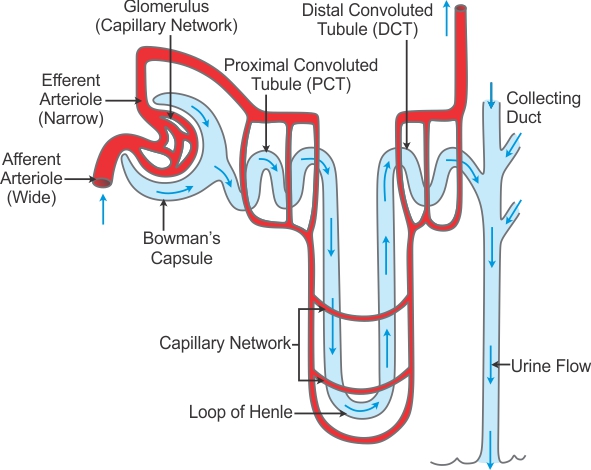
Glomerulus:
- It is a tuft of anastomosing blood capillaries formed by the fine branches of the
afferent arteriole. - These capillaries of the glomerulus again unite to form the efferent arteriole.
- The afferent arteriole is wider than the efferent arteriole.
- The afferent arteriole brings blood into the glomerulus, while the efferent arteriole collects blood from the glomerulus.
Renal Tubule:
The renal tubule comprises the following regions:
Bowman’s Capsule
- The Bowman’s capsule lies in the cortex.
- It is a thin double-walled, cup-like depression.
- It is the blind end of the nephron.
- The glomerulus is located in the concave depression of the Bowman’s capsule.
- The Bowman’s capsule and the glomerulus together are called Malpighian Capsule or Renal Capsule.
- The outer layer of the Bowman’s capsule is made of flattened epithelial cells.
- The inner layer is in close contact with the glomerulus and bears special cells called podocytes.
- Podocytes have many feet-like processes called pedicels and minute slit-like pores called slit pores.
Proximal Convoluted Tubule (PCT)
- PCT lies in the cortex.
- It is also known as the first convoluted tubule.
- The Bowman’s capsule continues into the PCT.
- It is lined with a layer of columnar epithelial cells.
- The columnar cells are with numerous microvilli to increase the surface area of absorption.
Loop of Henle
- It lies in the medulla.
- It is U-shaped.
- It is not convoluted.
- It has a descending limb and an ascending limb.
- Each limb has a thick region towards the cortex and a thin region towards the medulla.
- Thick regions are lined with columnar epithelial cells.
- Thin regions are lined with flat epithelial cells.
Distal Convoluted Tubule (DCT)
- It lies in the cortex.
- Its short terminal part is called a collecting tubule.
- The collecting tubule opens into the collecting duct.
- DCT in lined with ciliated columnar epithelial cells.
- The collecting duct receives the contents of many renal tubules.
- The collecting duct is a larger duct which receives collecting tubules of several nephrons.
- Collecting ducts pass into the renal medulla and join with each other to form the ducts of Bellini.
- The ducts of Bellini run through the renal pyramids and open into calyces.
- All calyces open into the pelvis.
- From the pelvis, urine is carried to the urinary bladder through the ureters.
Posted by Jatin Chaudhary 5 years, 7 months ago
- 5 answers
Meghna Thapar 5 years, 7 months ago
Sodium gets its name from the English word soda. This is because Sir Humphry Davy used caustic soda when isolating the element. The symbol Na comes from the Latin word natrium. Sodium is an important nutrient for health. It plays a vital role in nerve and muscle function and helps your body maintain normal fluid balance. Sodium is used as a heat exchanger in some nuclear reactors, and as a reagent in the chemicals industry. But sodium salts have more uses than the metal itself. The most common compound of sodium is sodium chloride (common salt). It is added to food and used to de-ice roads in winter.
Posted by Thakkar Manan 5 years, 7 months ago
- 1 answers
Meghna Thapar 5 years, 7 months ago
The term "magnetic effects of current " means that " a current flowing in a wire produces a magnetic field round it ". the magnetic effect of current was discovered by Oersted found that a wire carrying a current was able to deflect a magnetic needle. Moving magnetic fields pull and push electrons. Metals such as copper and aluminum have electrons that are loosely held. Moving a magnet around a coil of wire, or moving a coil of wire around a magnet, pushes the electrons in the wire and creates an electrical current.
Posted by Ankush Dey Dey 5 years, 7 months ago
- 1 answers
Yogita Ingle 5 years, 7 months ago
Acids are chemical substances which readily produce H⁺ ions when dissolved in aqueous solutions and are corrosive or sour when tasted and can neutralize alkalis and turns blue litmus to red colour.
Posted by Ankush Dey Dey 5 years, 7 months ago
- 1 answers
Dk Dev 5 years, 7 months ago
Posted by Bharat Kohli 5 years, 7 months ago
- 1 answers
Meghna Thapar 5 years, 7 months ago
The expression of magnetic force id defined as F = CIL Sin theta. (a) Hence, as the current, I in the conductor increases, the force also increases. (b) As the length of the conductor, L increases, the force on the conductor also increases proportionately. A current-carrying conductor placed in a magnetic field experiences a force. When current establishes in the conductor, it gets displaced which verifies the existence of a force on the conductor.
Posted by Virender Singh 5 years, 7 months ago
- 3 answers
Yogita Ingle 5 years, 7 months ago
(i) When zinc is added to the solution of iron sulphate, the colour of iron sulphate solution changes. It is because zinc is more reactive than iron, therefore, it displaces iron from its solution of iron sulphate and a grey precipitate of iron and a colourless solution of zinc sulphate is formed.
(ii) Zn + FeSO4 → ZnSO4 + Fe
Bharat Kohli 5 years, 7 months ago
Posted by Jai Agrawal 5 years, 7 months ago
- 1 answers
Meghna Thapar 5 years, 7 months ago
Efflorescence is the loss of water (or a solvent) of crystallization from a hydrated or solvated salt to the atmosphere on exposure to air. ... The water, with the salt now held in solution, migrates to the surface, then evaporates, leaving a coating of the salt. Example is Gypsum (CaSO4. Efflorescence is a deposit of salts, usually white, formed on a surface, the substance having emerged in solution from within either concrete or masonry and subsequently precipitated by evaporation.
Posted by Ishita ???✨✨✨ 5 years, 7 months ago
- 1 answers
Meghna Thapar 5 years, 7 months ago
When an acid reacts with metal, a salt and hydrogen are produced: acid + metal → salt + hydrogen An example: nitric acid + calcium → calcium nitrate + hydrogen The salt that is produced depends upon which acid and which metal react. When base reacts with metal, it produces respective salt and hydrogen gas. The presence of hydrogen gas is confirmed by a pop sound that is produced by hydrogen gas when it comes in contact with fire. Sodium hydroxide gives hydrogen gas and sodium zincate when reacts with zinc metal.
Posted by Pradeep Gupta 5 years, 7 months ago
- 1 answers
Meghna Thapar 5 years, 7 months ago
Atmospheric refraction is the phenomenon of bending of light on passing through the Earth’s atmosphere. The reason for this occurrence is that the upper layers of the Earth’s atmosphere are rarer compared to the lower layers.
On account of atmospheric refraction of light,
- The stars seem higher than they actually are.
- The Sun appears to rise 2 minutes before and set 2 minutes later, increasing the apparent length of the day by 4 minutes.
- The Sun appears oval at sunrise and sunset, but appears circular at noon.
- The stars twinkle and planets do not.
Posted by Aparna Mohan 5 years, 7 months ago
- 2 answers
Akash Panchal 5 years, 7 months ago
Gaurav Seth 5 years, 7 months ago
- Double circulation is a process during which blood passes twice through the heart during one complete cycle. This type of circulation is found in amphibians, reptiles, birds, and mammals. However, it is more prominent in birds and mammals as in them the heart is completely divided into four chambers – the right atrium, the right ventricle, the left atrium, and the left ventricle.
The movement of blood in an organism is divided into two parts:
(i) Systemic circulation
(ii) Pulmonary circulation
- Systemic circulation involves the movement of oxygenated blood from the left ventricle of the heart to the aorta. It is then carried by blood through a network of arteries, arterioles, and capillaries to the tissues. From the tissues, the deoxygenated blood is collected by the venules, veins, and vena cava, and is emptied into the left auricle.
- Pulmonary circulation involves the movement of deoxygenated blood from the right ventricle to the pulmonary artery, which then carries blood to the lungs for oxygenation. From the lungs, the oxygenated blood is carried by the pulmonary veins into the left atrium.
Hence, in double circulation, blood has to pass alternately through the lungs and the tissues.
- Significance of double circulation:
The separation of oxygenated and deoxygenated blood allows a more efficient supply of oxygen to the body cells. Blood is circulated to the body tissues through systemic circulation and to the lungs through the pulmonary circulation.
Posted by Moran Manab 5 years, 7 months ago
- 1 answers
Gaurav Seth 5 years, 7 months ago
When lead(II) nitrate is heated, it breaks down into yellow colour lead (II) oxide, colourless gas of oxygen and brown colour nitrogen dioxide. The chemical equation for the above reaction is,
2Pb(NO₃)₂ → 2PbO + 4NO₂ + O₂
Posted by Bobby Rawat 5 years, 7 months ago
- 1 answers
Gaurav Seth 5 years, 6 months ago
Laboratory Preparation of Hydrogen:
Hydrogen is prepared in the laboratory by the action of the dilute hydrochloric acid or dilute sulphuric acid on granulated zinc.
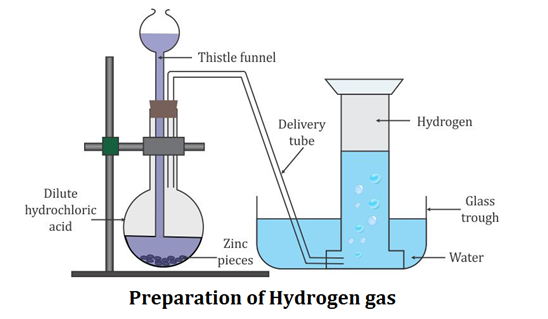
Use of Granulated Zinc
Granulated zinc contains an impurity like copper which acts as a positive catalyst. A positive catalyst increases the rate of a chemical equation. This is the reason why granulated zinc is preferred over pure zinc for the laboratory preparation of hydrogen gas.
Reaction:
|
Metal + Dilute acid → Salt + Hydrogen
Zn + 2HCl → ZnCl2 + H2 ↑ Zn + H2SO4 → ZnSO4 + H2 ↑ |
Collection of Gas: Hydrogen gas is collected by downward displacement of water.
Posted by Raghav Sharma 5 years, 7 months ago
- 5 answers
?? ??? 5 years, 7 months ago
Posted by Aj K 5 years, 7 months ago
- 2 answers
Student ✍️✍️✍️ 5 years, 7 months ago
Binay Sharma 5 years, 7 months ago
Posted by Prince Raja 5 years, 7 months ago
- 3 answers
Student ✍️✍️✍️ 5 years, 7 months ago
Shubham Kumar 5 years, 7 months ago
Posted by Vikram Patidar 5 years, 7 months ago
- 1 answers
Meghna Thapar 5 years, 7 months ago
Chloride is one of the most important electrolytes in the blood. It helps keep the amount of fluid inside and outside of your cells in balance. It also helps maintain proper blood volume, blood pressure, and pH of your body fluids. ... Most of the chloride in your body comes from the salt (sodium chloride) you eat. Chloride is an electrolyte that helps balance the amount of fluid inside and outside of cells. It also helps maintain blood volume, blood pressure, and the pH of body fluids.
Posted by Mohit Vilangil 5 years, 7 months ago
- 2 answers
Amit Kumar Chaurasia 5 years, 7 months ago
Amit Kumar Chaurasia 5 years, 7 months ago
Posted by Aravind .S 5 years, 7 months ago
- 2 answers
Posted by Sandeep S 5 years, 7 months ago
- 5 answers
Posted by Kartavya Dhaka 5 years, 7 months ago
- 1 answers
Gaurav Seth 5 years, 7 months ago
Crushed egg shell has composition CaCO3 reacts with acid and gives gas CO2 which turns lime water (Ca(OH)2) milky by producing CaCO3 again. The acid in given options is HCl.
CaCO3+2HCl→CaCl2+CO2+H2O
Ca(OH)2+CO2→CaCO3+H2O
Posted by Saniya Khan 5 years, 7 months ago
- 1 answers
Gaurav Seth 5 years, 7 months ago
Resistance
Resistance is a property of conductor due to which it resists the flow of electric current through it. Component that is used to resist the flow of electric current in a circuit is called resistor.
Potential difference: The difference in the amount of electric potential energy between two points in an electric circuit is called ELECTRIC POTENTIAL DIFFERENCE.
Posted by Bhuvana Elango 5 years, 7 months ago
- 1 answers
Gaurav Seth 5 years, 7 months ago
When exposed to air many metals will slowly react with oxygen in the atmosphere to form metal oxides and magnesium is one of those metals. Like rusting in case of iron, with magnesium, the oxide layer forms a white coating on the outside of the metal that will slow down or interfere with the burning process. Rubbing with sand paper helps to remove this oxide layer due to which burning speeds up.
Posted by Deepika A 5 years, 7 months ago
- 1 answers
Gaurav Seth 5 years, 7 months ago
Elements are placed in reactivity series in decreasing order of reactivity. The higher the metal in the series, the more reactive it is and can replace elements present below them.
Zinc is found below sodium and thus it cannot replace sodium from its aqueous solution.
Posted by Harsh Kumar 5 years, 7 months ago
- 1 answers
Rohan Dubey 5 years, 7 months ago
Posted by Danish Ahmed 5 years, 7 months ago
- 1 answers
Rohan Dubey 5 years, 7 months ago
Posted by Abrar Ahmad 5 years, 7 months ago
- 2 answers
Richa Shree 5 years, 7 months ago
Posted by Lakhvinder Singh 5 years, 7 months ago
- 1 answers
Yogita Ingle 5 years, 7 months ago
A chemical equation can give more informations in the following ways:
- The physical state of the reactants and products can be indicated by putting (s) for solid, (l) for liquid, (g) for gas and (aq) for aqueous state.
- Evolution or absorption of heat during the reaction can be denoted by adding or subtracting a heat term on the product side.
- Temperature, pressure and catalyst can be indicated above the arrow (→ or =) separating the reactants and products.
- Concentration of reactants and products are indicated by adding word (dil) for dilute and (cone) for concentrated before their formulae.
- By the sign → or
information about irreversible and reversible reactions can be obtained.
Posted by Shalish Singhal 5 years, 7 months ago
- 1 answers
Araib Khan 5 years, 7 months ago
Posted by Abhishek Chaurasiya 5 years, 7 months ago
- 0 answers

myCBSEguide
Trusted by 1 Crore+ Students

Test Generator
Create papers online. It's FREE.

CUET Mock Tests
75,000+ questions to practice only on myCBSEguide app

Tarannum Jahan 5 years, 7 months ago
0Thank You