
Ask questions which are clear, concise and easy to understand.
Ask QuestionPosted by Himanshu Kumar 5 years, 7 months ago
- 2 answers
Yogita Ingle 5 years, 7 months ago
The production of new organism from the existing organism of the same species is called reproduction.
Reproduction is essential for the survival of species on this earth. The process of reproduction ensure continuity of life on earth. Reproduction give rise to more organism with the same basic characteristics as their parents.
Types of Reproduction
There are two main methods of reproduction in living.
- asexual reproduction.
- Sexual reproduction.
Posted by Sanika Walimbe 5 years, 7 months ago
- 2 answers
Yogita Ingle 5 years, 7 months ago
The position of the man is at the apex of most of the food chain because in a food chain The Apex position is mostly taken by carnivorous animals and in a normal food chain herbivores are the producers some small organisms are the second consumers and some much larger animals are the third consumers but we comes at the last.
Posted by Rahul Yadav 5 years, 7 months ago
- 2 answers
Student ✍️✍️✍️ 5 years, 7 months ago
Abhishek Sardiwal 5 years, 7 months ago
Posted by Manish Saini 5 years, 7 months ago
- 1 answers
Yogita Ingle 5 years, 7 months ago
Many, but not all, fish kills in the summer result from low concentrations of dissolved oxygen in the water. Fish, like all other complex life forms, need oxygen to survive. They get theirs in the form of oxygen gas dissolved in the water. That's why it's important to have an aeration device, a bubbler, in your home aquarium.
Warm water holds less dissolved oxygen than cold water, so summer is the time when fish can have a hard time getting enough oxygen. Other organisms use oxygen, too, including the algae that grow in the summer and bacteria that degrade organic matter. During the day, the algae produce oxygen through photosynthesis, but at night, when photosynthesis stops, they and other organisms keep respiring, using up oxygen.
Posted by Bhavana Ng 5 years, 7 months ago
- 1 answers
Anmol Genius 5 years, 7 months ago
Posted by Aman Jyoti 5 years, 7 months ago
- 3 answers
Khush Kaur 5 years, 7 months ago
Yogita Ingle 5 years, 7 months ago
A combination reaction is a general category of chemical reactions. It may be defined as a chemical reaction in which two or more substances combine to form a single substance under suitable conditions.
Combination reactions are also known as synthesis, because in these reactions new substances are synthesized.
2 Na(s) + Cl2 (g) → 2NaCl(g)
Namrata Patil 5 years, 7 months ago
Posted by Dheeraj Bhiwale 5 years, 7 months ago
- 1 answers
Twinkle Shamani 5 years, 7 months ago
Posted by Mahi..... ♾ 5 years, 7 months ago
- 2 answers
Sanika Walimbe 5 years, 7 months ago
Posted by Bhavana Ng 5 years, 7 months ago
- 2 answers
Arul Arasan 5 years, 7 months ago
Minu Jha 5 years, 7 months ago
Posted by Mahi..... ♾ 5 years, 7 months ago
- 4 answers
Khush Kaur 5 years, 7 months ago
Hitesh Choudhary 5 years, 7 months ago
Yogita Ingle 5 years, 7 months ago
Endothermic Reactions
The endothermic process is a term that describes a reaction where the system absorbs the energy from its surrounding in the form of heat. Few examples of endothermic process is photosynthesis, evaporating liquids, melting ice, dry ice, alkanes cracking, thermal decomposition, ammonium chloride in water and much more.
Exothermic Reactions
The exothermic reaction is the opposite of an endothermic reaction. It releases energy by light or heat to its surrounding. Few examples are neutralization, burning a substance, reactions of fuels, deposition of dry ice, respiration, solution of sulfuric acid into water and much more.
Posted by Mahi..... ♾ 5 years, 7 months ago
- 3 answers
Student ✍️✍️✍️ 5 years, 7 months ago
Ganga Enterprises 5 years, 7 months ago
Yogita Ingle 5 years, 7 months ago
The inner lining of the small intestine has numerous villi which increase the surface area for absorption. The villi are richly supplied with blood vessels which take the absorbed food to each and every cell of the body.
Posted by Mahi..... ♾ 5 years, 7 months ago
- 1 answers
Yogita Ingle 5 years, 7 months ago
Digestive enzymes such as amylase, lipase, pepsin, trypsin, etc. helps to break the complex food particles into simple ones so that these simple particles can be easily absorbed by the blood and thus transported to all the cells of the body.
Posted by Chirag Dendor 5 years, 7 months ago
- 1 answers
Gaurav Seth 5 years, 7 months ago
Alveoli present in the lungs are covered with blood capillaries so that the exchange of gases can take place between the membranes of the alveoli and the surrounding capillaries. The blood capillaries covering alveoli have a low oxygen and high carbon dioxide concentrations. This allows oxygen to diffuse into the blood and carbon dioxide to diffuse out of the blood.
Posted by Himanshu Jagne 5 years, 7 months ago
- 2 answers
Student ✍️✍️✍️ 5 years, 7 months ago
Gaurav Seth 5 years, 7 months ago
Holozoic Nutrition: In holozoic nutrition, the digestion of food follows after the ingestion of food. Thus, digestion takes place inside the body of the organism. Holozoic nutrition happens in five steps, viz. ingestion, digestion, absorption, assimilation and egestion.
Posted by Confusion ??? Master ??? 5 years, 7 months ago
- 2 answers
Yogita Ingle 5 years, 7 months ago
Water is very necessary for photosynthesis. An experiment to show water is necessary for photosynthesis is given below:
Every plants need water for photosynthesis to make their food(glucose ). Plants absorb water through their roots. Then from roots, by their special part called xylem, water is taken up to their leaves where photosynthesis occur. Then from leaves food is distributed to different parts of the plant. So like that if plants do get water then there could be no more food produce and if there would be no more food produce then it means that there would be no more process called photosynthesis. So water is very important for photosynthesis.
Gaurav Seth 5 years, 7 months ago
(i) Water is used to transport the metabolic products from one part to the other where they are needed. So it acts as a vehicle for the transportation.
(ii) water is an electron source of photosynthesis.In this process six water molecules combine with six carbon molecules to form, oxygen and glucose.
(iii) Water is evaporated through the stomata present on the leaves. It cools the plant in the hot sunny days.
(iv) Water is necessary to maintain turgidity i.e. the pressure of water in the cells of plants which is important for the survival of plant else it will wilt. It is also required for the growth as it expands the plant cells.
(v) Water regulates the opening and closing of stomata, which in turn regulates transpiration and photosynthesis.
Posted by Confusion ??? Master ??? 5 years, 7 months ago
- 1 answers
Yogita Ingle 5 years, 7 months ago
Requirements : A potted plant with variegated leaves - for example, Croton or money plant (variegated leaves are partly green and partly white), rice paper, pencil, white paper sheath, beaker, test tube, 70% alcohol, KL solution, water bath.
Method : Keep the potted plant with variegated leaves in dark for three days so that the leaves become free from starch. Then place the plant in bright sun light for about 6 hours. Take a variegated leaf of the potted plant kept in bright sunlight. Trace the outline of leaves and its variegated parts on the tracing paper (the variegated leaves show pale yellow spots in green leaves. These areas indicate the absence of chlorophyll). Dip the leaf in boiling water for a few minute. Now boil the leaf in 70% alcohol till it decolorizes. Now dip the leaf in boiled water to make the leaf soft. Take out the leaf and stain with iodine (KL) solution. Observe the change in colour.
Observation : The blue colour appears only in those parts of leaf which were green in colour. The blue colour will not appear in variegated parts. This shows that starch formation takes place only in green (chlorophyll containing) parts of the leaf. Thus, the chlorophyll is essential for photosynthesis.
Posted by Confusion ??? Master ??? 5 years, 7 months ago
- 2 answers
Aman Jyoti 5 years, 7 months ago
Yogita Ingle 5 years, 7 months ago
To prove the necessity of sunlight in photosynthesis following steps need to do
- Take a plant with destarched leaf.
- Leaf is partially covered with black paper on which a design is cut.
- Expose this plant to sunlight for few hours and perform a starch test with iodine solution.
Observation-
- Covered leaf part shows brown colouration.
- Exposed leaf shows blue-black colour.
Result- Starch is present in the exposed leaf.
Conclusion- Leaf exposed to sunlight give iodine test, proving that sunlight is necessary for photosynthesis.
Posted by Confusion ??? Master ??? 5 years, 7 months ago
- 1 answers
Yogita Ingle 5 years, 7 months ago
Aim: To show that carbon dioxide is necessary for photosynthesis
Procedure:
- Take a plant with destarched leaves.
- Insert one of its leaves in a conical flask containing potassium hydroxide.
- Leave the plant in sunlight.
- After a few hours, test the particular leaf and some other leaf of the same plant for the presence of starch.
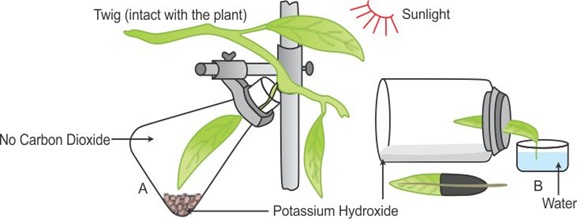
Observation:
The leaf which was inserted in the conical flask stains brown, and the other leaf which is exposed to sunlight turns blue-black.
Inference:
Potassium hydroxide in the flask absorbs carbon dioxide; thus, due to the absence of CO2, the leaf fails to produce starch which proves that carbon dioxide is necessary for photosynthesis.
Posted by Madhura Dighikar 5 years, 7 months ago
- 1 answers
Gaurav Seth 5 years, 7 months ago
Variations are beneficial for the survival of the species. Populations of organisms fill well-defined places, or niches, in the ecosystem, using their ability to reproduce. However, niches can change because of reasons beyond the control of the organisms and could even wipe out the entire population. However, if some variations were to be present in a few individuals in these populations, there would be some chance for them to survive.
For example - If there were a population of bacteria living in temperate waters and suppose the water temperature were to be increased by global warming. Most of these bacteria would die, but the few heat resistant variants would survive and grow further. Variation is thus useful for the survival of species over time.
Posted by Vinay Kumar 5 years, 7 months ago
- 1 answers
Dannish Arulraj 5 years, 7 months ago
Posted by Nisha Kumari 5 years, 7 months ago
- 1 answers
Yogita Ingle 5 years, 7 months ago
Gonadotropins FSH and LH are secreted by the anterior pituitary. FSH promotes spermatogenesis in the seminiferous tubules and LH promotes androgen production in the interstitial cells (androgens are required for attainment of reproductive maturity in males).
Posted by Student ✍️✍️✍️ 5 years, 7 months ago
- 1 answers
Yogita Ingle 5 years, 7 months ago
| Osmosis | Diffusion |
| It is limited only to the liquid medium. | Occurs in liquid, gas and even solids. |
| Requires a semipermeable membrane. | Do not require a semipermeable membrane. |
| Depends on the number of solute particles dissolved in the solvent. | Depends on the presence of other particles. |
| Requires water for the movement of particles. | Do not require water for the movement of particles. |
| Only the solvent molecules can diffuse. | Both the molecules of solute and solvent can diffuse. |
Posted by Khush Kaur 5 years, 7 months ago
- 2 answers
Posted by Rajkumar Rajkumar 5 years, 7 months ago
- 4 answers
Chandresh Tiwari 5 years, 7 months ago
Gaurav Seth 5 years, 7 months ago
Gypsum is calcium sulphate dihydrate. The chemical formula of gypsum is CaSO ·2H O Plaster of Paris is prepared by heating gypsum to a temperature of 373K.When gypsum is heated to a temperature of 373k ,It loses three-Fourths of its water of crystallisation and forms Plaster of Paris. Properties 1)It is a white powder. 2)It has a very remarkable property of setting into a hard mass on wetting with water. P.O.P. should be stored in a moisture proof container.
Posted by Chhaya Gangwar 5 years, 7 months ago
- 0 answers
Posted by Harsh Sahu 5 years, 7 months ago
- 5 answers
Kunal Dhingra 5 years, 7 months ago
Khush Kaur 5 years, 7 months ago
Yogita Ingle 5 years, 7 months ago
A double decomposition reaction is a type of decomposition reaction in which two constituent reactants interchange positive and negative ions and form two new compounds.
Example
HCl(aq) + NaOH(aq) → NaCl(aq) + HOH(l)
Don Virat 5 years, 7 months ago
Posted by Sūbrāt Rāy 5 years, 7 months ago
- 4 answers
Khush Kaur 5 years, 7 months ago
Rajkumar Rajkumar 5 years, 7 months ago
Yogita Ingle 5 years, 7 months ago
Diffusion is the net movement of molecules of a substance from a region of their higher concentration to a region of their lower concentration. Net movement means there are more molecules moving in one direction than in the opposite direction.
Example: Opening a bottle of perfume in a room will result in the gradual diffusion of the perfume from the region of higher concentration (the bottle) out into the room. Diffusion will continue until the perfume has a more or less uniform concentration throughout the bottle and room.
Shree Ram 5 years, 7 months ago
Posted by Vansh Mundle 5 years, 7 months ago
- 1 answers
Gaurav Seth 5 years, 7 months ago
- Receptors are the sensing molecules or elements which communicate the signal from a ligand to the cell to elicit specific physiological change.
- They are located in the cells, tissues and help to control all most all the body organs.
- The ligand is the one which binds to the receptor and brings in conformational changes to produce a definite effect on the body’s physiology.
- In general, most receptors have endogenous ligands or biomolecules which can trigger a response.
- Most receptors are named based on their endogenous ligands like serotonin receptors, acetylcholine receptors, opioid receptors.
Posted by Confusion ??? Master ??? 5 years, 7 months ago
- 1 answers
Abhishek Sardiwal 5 years, 7 months ago
Posted by Amit Kumar Chaurasia 5 years, 7 months ago
- 3 answers
Deepa S 5 years, 7 months ago
Chandresh Tiwari 5 years, 7 months ago
Tk Srinidhi 5 years, 7 months ago

myCBSEguide
Trusted by 1 Crore+ Students

Test Generator
Create papers online. It's FREE.

CUET Mock Tests
75,000+ questions to practice only on myCBSEguide app

Student ✍️✍️✍️ 5 years, 7 months ago
0Thank You