
Ask questions which are clear, concise and easy to understand.
Ask QuestionPosted by ????Sangamesh???? Hiremath 5 years, 6 months ago
- 4 answers
Anurag Rai 5 years, 6 months ago
Yogita Ingle 5 years, 6 months ago
Ohm’s Law states that the potential difference between two points is directly proportional to the electric current.
This means; potential difference V varies as electric current.
Or, V∝IV∝I
Or, VI=RVI=R-----------(1)
Or, 1I=RV1I=RV
Or, I=VRI=VR----------(2)
Or, V=RIV=RI ----------(3)
Where R is constant for the given conductor at a given temperature and called resistance. Resistance is the property of conductor which resists the flow of electric current through it.
Gaurav Seth 5 years, 6 months ago
OHM’s Law
OHM’s law states that under no same temperature, electric current flowing through an ideal conductor is directly proportional to the potential difference across its ends.
V ∝ I
V = IR, R – Resistance
- Resistance is a property of conductor to resist flow of charge through it. Its SI unit is Ohm (Ω).
R = V/I, 1 Ohm = 1 Volt/ 1 Ampere
- I = V/R denotes that Current is inversely proportional to Resistance. Hence, greater the resistance lesser will be the flow of current and vice-versa.
- A rheostat or a variable resistor is a device or a component which allows changing of resistance in a circuit keeping the voltage same.
- In a conductor, electrons are attracted by the atoms. This is a resistive force which is lower for a good conductor but very high for an insulator. A conductor having some resistance is called a Resistor.
Posted by Daxina Singh 5 years, 6 months ago
- 1 answers
Yogita Ingle 5 years, 6 months ago
Albert Einstein was a German-born theoretical physicist who developed the theory of relativity, one of the two pillars of modern physics. His work is also known for its influence on the philosophy of science
Posted by Khush Kaur 5 years, 6 months ago
- 2 answers
Mansi Mishra 5 years, 6 months ago
Mishri Pabari 5 years, 6 months ago
Posted by Confusion ??? Master ??? 5 years, 6 months ago
- 1 answers
A S 5 years, 6 months ago
Posted by Confusion ??? Master ??? 5 years, 6 months ago
- 1 answers
Gaurav Seth 5 years, 6 months ago
Sodium carbonate IS PREPARED BY by Solvay Process
Sodium carbonate is prepared by passing carbon dioxide through ammonia that gives ammonium carbonate. Subsequently ammonium carbonate is converted to ammonium hydrogen carbonate that reacts with sodium chloride to precipitate out sodium hydrogen carbonate. Sodium hydrogen carbonate later forms sodium carbonate.
2NH3 + H2O + CO2  (NH4)2CO3
(NH4)2CO3 + H2O + CO2 2NH4HCO3
2NH4HCO3 + NaCl NH4Cl + NaHCO3
2NaHCO3 Na2CO3 + CO2 + H2O
Posted by Amit Tanwar 5 years, 6 months ago
- 1 answers
Meghna Thapar 5 years, 6 months ago
Since the ovary of female release one egg every month, therefore, the uterus also prepares every month to receive a fertilised egg. The inner lining of the uterus becomes soft and thick with lots of blood capillaries in it. This preparation is necessary as in case the egg is fertilised by the sperm, it helps to keep the egg and nourish it. If however, the egg is not fertilised, then the thick lining of the uterus is not required and the uterus lining breaks down and comes out through the ****** in the form of blood and mucous. This is called menstruation.
(b) Menstruation cycle in females:
(i) When a girl reaches puberty at the age of 10 – 12 years, the *** hormones released it her blood cause some of the ova in the ovaries to become mature.
(ii) Usually one mature egg is released from the ovary into the oviduct once every 28 days. This is called ovulation.
(iii) Before ovulation, the inner lining of the uterus becomes thick and spongy, and full of blood capillaries, and prepares itself to receive the fertilised egg.
(iv) If the ovum does not get fertilised, then the thick and soft inner lining of the uterus is no longer needed and hence it breaks and the dead ovum comes out from ****** in the form of bleeding called menstruation.
(v) Menstruation usually occurs 14 days after ovulation and usually lasts for 3 to 5 days.
(vi) After menstruation is over, the inner lining of the uterus starts building up again so that it becomes ready to receive the next ovum in case it gets fertilised.
(vii) If the ovum does not get fertilised even now, then the menstruation takes place again and this cycle goes on repeating.
Posted by Sonika Devi 5 years, 6 months ago
- 2 answers
Meghna Thapar 5 years, 6 months ago
Within the lungs, the passage divides into smaller and smaller tubes which finally terminate in balloon-like structures which are called alveoli. The alveoli provide a surface where the exchange of gases can take place. The walls of the alveoli contain an extensive network of blood-vessels. When we breathe in, the ribs are lift up and the diaphragm flattens which increases the size of the chest cavity. Because of this, air is sucked into the lungs and fills the expanded alveoli. The blood brings carbon dioxide from the rest of the body for release into the alveoli, and the oxygen in the alveolar air is taken up by blood in the alveolar blood vessels to be transported to all the cells in the body. During the breathing cycle, when air is taken in and let out, the lungs always contain a residual volume of air so that there is sufficient time for oxygen to be absorbed and for the carbon dioxide to be released.
Yogita Ingle 5 years, 6 months ago
(i) The alveoli are thin walled and richly supplied with a network of blood capillaries to facilitate the exchange of gases between blood and the air filled in alveoli.
(ii) Alveoli have balloon - like structures with thin elastic walls. These provide maximum surface for exchange gases.
Posted by Gurbaj Singh 5 years, 6 months ago
- 2 answers
Sathwik Reddy Lakkireddy 5 years, 6 months ago
Gaurav Seth 5 years, 6 months ago
Download revision notes for Life Processes class 10 Notes and score high in exams. These are the Life Processes class 10 Notes prepared by team of expert teachers. The revision notes help you revise the whole chapter in minutes. Revising notes in exam days is on of the best tips recommended by teachers during exam days.
Click on the given link :
<a href="https://mycbseguide.com/blog/life-processes-class-10-notes-science/#:~:text=CBSE%20Class%2010%20Science%20Revision,maintenance%20are%20called%20life%20process.">https://mycbseguide.com/blog/life-processes-class-10-notes-science/#:~:text=CBSE%20Class%2010%20Science%20Revision,maintenance%20are%20called%20life%20process.</a>
Posted by Sunidhi Singh 5 years, 6 months ago
- 2 answers
Gaurav Seth 5 years, 6 months ago
HRD Minister Ramesh Nishank announced a major CBSE syllabus reduction for the new academic year 2020-21 on July 7 which was soon followed by an official notification by CBSE on the same.
Considering the loss of classroom teaching time due to the Covid-19 pandemic and lockdown, CBSE reduced the syllabus of classes 9 to 12 with the help of suggestions from NCERT.
The CBSE syllabus has been rationalized keeping intact the learning outcomes so that the core concepts of students can be retained.
Deleted syllabus of CBSE Class 10 Science

Posted by Alok Shukla 5 years, 6 months ago
- 1 answers
Posted by Divija Bansal 5 years, 6 months ago
- 1 answers
Meghna Thapar 5 years, 4 months ago
Plaster of paris is calcium sulphate hemihydrates. Its chemical formula is: CaSO4. ½H2O.
It is prepared by heating gypsum to a temperature of 100°C in a kiln; it loses ¾ of its water of crystallisation and forms plaster of paris.
Uses of Plaster of paris:
(i) It is used as a fire proofing material.
(ii) It is used in hospitals for setting fractured bones in the right position to ensure correct healing.
Gypsum is calcium sulphate dihydrate. When gypsum is heated to a temperature of 100 °C, it loses ¾ of its water of crystallisation and forms plaster of paris.
Posted by Shivansh Chaubey 5 years, 6 months ago
- 1 answers
Sanika Walimbe 5 years, 6 months ago
Posted by ?? ? 5 years, 6 months ago
- 2 answers
?? ? 5 years, 6 months ago
Gaurav Seth 5 years, 6 months ago
EXCRETION
- The biological process of removal of harmful nitrogenous metabolic waste from the body is called excretion.
- Unicellular organisms excrete by diffusion and multicellular organisms use specialized organ to perform same function.
Excretion in human beings
- A pair of kidneys, a pair of ureters, a urinary bladder and a urethra constitutes the human excretory system.
- Kidneys are present on either side of the backbone in the abdomen.
- Kidneys produce urine and urine from kidney passes through the ureters into the urinary bladder and remains stored their until it is released through the urethra.
- Urine is produced to filter out waste products from the blood.
- Nephrons are basic structural and functional unit of kidney.
- Cluster of thin walled blood capillaries called glomerulus in the nephron filtrate the urine and each cluster is associated with cup shaped end of a tube called Bowman’s capsule.
- Substances like glucose, amino acids, salts and a major amount of water is selectively reabsorbed from the initial filtrate as the urine flows along the tube.
- Reabsorption depends on the amount of excess water in the body and dissolved waste to be excreted.
- The urine from kidney enters the long tube called ureter.
- Ureter connects the kidney with the urinary bladder and urine from the kidney is passed to urinary bladder and stored in the bladder.
- When the pressure in the expanded bladder leads to the urge to urinate, the urine is passed out through urethra.
Posted by Gaurav Singh 5 years, 6 months ago
- 1 answers
Ayush Kapoor 5 years, 6 months ago
Posted by Gaurav Singh 5 years, 6 months ago
- 1 answers
Posted by Shashank Tiwari 5 years, 6 months ago
- 2 answers
Posted by Arjun Sini 5 years, 6 months ago
- 5 answers
Yogita Ingle 5 years, 6 months ago
Blood absorbs oxygen from air in the lungs. It transports the oxygen to cells throughout the body, and it removes waste carbon dioxide from the cells. In the lungs, the carbon dioxide moves from the blood to the air and is exhaled.
Posted by Shubhang Shrivastav 5 years, 6 months ago
- 0 answers
Posted by Deepamayee Pasayat 5 years, 6 months ago
- 1 answers
Yogita Ingle 5 years, 6 months ago
Photosynthesis definition states that the process exclusively takes place in the chloroplasts through photosynthetic pigments such as chlorophyll a, chlorophyll b, carotene and xanthophyll. All green plants and a few other autotrophic organisms utilize photosynthesis to synthesize nutrients by using carbon dioxide, water and sunlight. The by-product of the photosynthesis process is oxygen.
Posted by Divya Yokar 5 years, 6 months ago
- 1 answers
Yogita Ingle 5 years, 6 months ago
In a crowded city because of high population the pollution level is also very high e.g. Delhi and due to high pollution we can not able to see the clear sky and stars in the night rather than in a village or hill station .
In a village or hill station due to less pollution we we can see the stars more clearly and easily.
Posted by Divija Bansal 5 years, 6 months ago
- 1 answers
Meghna Thapar 5 years, 4 months ago
Bleaching powder is manufactured from chlorine gas.
It is produced by the action of chlorine on dry slaked lime [Ca(OH)2].
Ca(OH)2 + Cl2 → CaOCl2 + H2O
It is represented as CaOCl2
Uses:
- For bleaching cotton and linen in the textile industry and for bleaching wood pulp in the paper industry.
- Used for disinfecting drinking water to make it free of germs.
Posted by Aman Singh 5 years, 6 months ago
- 1 answers
Yogita Ingle 5 years, 6 months ago
- An electrolytic decomposition reaction is a type of decomposition reaction in which the activation energy for decomposition. Example of electrolytic decomposition reaction
- Dissociation of water:2H2O→ 2H2 + O2
Posted by Anupama ?? 5 years, 6 months ago
- 1 answers
Gaurav Seth 5 years, 6 months ago
The twinkling of a star is due to atmospheric refraction of starlight. The starlight, on entering the earth’s atmosphere, undergoes refraction continuously before it reaches the earth. The atmospheric refraction occurs in a medium of gradually changing refractive index. Since the atmosphere bends starlight towards the normal, the apparent position of the star is slightly different from its actual position. The star appears slightly higher (above) than its actual position when viewed near the horizon.
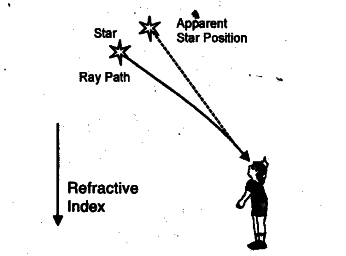
Further, this apparent position of the star is not stationary, but keeps on changing slightly, since the physical conditions of the earth’s atmosphere are not stationary. Since the stars are very distant, they are approximate point-sized sources of light. As the path of rays of light coming from the star goes on varying slightly, the apparent position of the star fluctuates and the amount of starlight entering the eye flickers i.e., the star sometimes appears brighter, and at some other time, fainter, which is the twinkling effect.
The planets are much closer to the earth, and are thus seen as extended sources. If we consider a planet as a collection of a large number of point-sized sources of light, the total variation in the amount of light entering our eye from all the individual point-sized sources will average out to zero, thereby nullifying the twinkling effect.
Posted by Aastha Gupta 5 years, 6 months ago
- 3 answers
Sanika Walimbe 5 years, 6 months ago
Gaurav Seth 5 years, 6 months ago
Saliva is a fluid which is secreted by the salivary glands. It helps in digestion of food by following Ways.
- Saliva contains a digestive enzyme called salivary amylase, which converts carbohydrates in to maltose sugars.
- It cleans the mouth cavity and tends to destroy germs that cause teeth decay. It contains lysozomes which help in destroying the bacteria.
- It moistens and lubricates food which again helps in swallowing.
- It acts as solvent, dissolving some food particles to stimulate taste buds of the tongue.
Anupama ?? 5 years, 6 months ago
Posted by Anupama ?? 5 years, 6 months ago
- 2 answers
Posted by Anupama ?? 5 years, 6 months ago
- 2 answers
Yogita Ingle 5 years, 6 months ago
When white light comes out of the prism, light is spread in a fan shaped beam. This fan shaped beam is termed as a spectrum. Light is said to be dispersed into a spectrum consisting of violet, indigo, blue, green, yellow, orange and red.
Posted by Anupama ?? 5 years, 6 months ago
- 2 answers
Anupama ?? 5 years, 6 months ago
Yogita Ingle 5 years, 6 months ago
Convex lens:
A lens having two spherical surface bulging outwards is called Convex Lens. It is also known as biconvex lens because of two spherical surface bulging outwards.

Concave lens:
A lens having two spherical surface bulging inwards is called Concave Lens. It is also known as biconcave lens because of two spherical surface bulging inwards.
Posted by Vinay Kumar Mangali 5 years, 6 months ago
- 2 answers
Kap Sharma 5 years, 6 months ago
Gaurav Seth 5 years, 6 months ago
Grafting:
Grafting is a horticultural technique used to join parts from two or more plants so that they appear to grow as a single plant. In grafting, the upper part (scion) of one plant grows on the root system (rootstock) of another plant.
In grafting, one plant is selected for its roots, and this is called the stock or rootstock. The other plant is selected for its stems, leaves, flowers, or fruits and is called the scion. The scion contains the desired genes to be duplicated in future production by the stock/scion plant. For successful grafting to take place, the vascular cambium tissues of the stock and scion plants must be placed in contact with each other. Both tissues must be kept alive until the graft has taken, usually a period of a few weeks. Successful grafting requires that a vascular connection takes place between the two tissues.
Grafting is most commonly used for the propagation of trees and shrubs grown commercially. Grafting is limited to dicots and gymnosperms.
Posted by Rounak Anand 5 years, 6 months ago
- 3 answers
Anupama ?? 5 years, 6 months ago
Anmol Genius 5 years, 6 months ago
Posted by Disha Agarwal 5 years, 6 months ago
- 1 answers
Gaurav Seth 5 years, 6 months ago
Considering the loss of classroom teaching time due to the Covid-19 pandemic and lockdown, CBSE reduced the syllabus of classes 9 to 12 with the help of suggestions from NCERT.
The CBSE syllabus has been rationalized keeping intact the learning outcomes so that the core concepts of students can be retained.
Deleted syllabus of CBSE Class 10 Science

myCBSEguide
Trusted by 1 Crore+ Students

Test Generator
Create papers online. It's FREE.

CUET Mock Tests
75,000+ questions to practice only on myCBSEguide app

Karan Bisht 5 years, 6 months ago
1Thank You