
Ask questions which are clear, concise and easy to understand.
Ask QuestionPosted by Rounak Anand 5 years, 5 months ago
- 1 answers
Posted by Shubham Saxena ???? 5 years, 5 months ago
- 1 answers
Meghna Thapar 5 years, 4 months ago
A pyramid of numbers shows the total number of individual organisms at each level in the food chain of an ecosystem. An inverted pyramid of numbers can be found in an ecosystem where the community contains a few producers with a very large biomass that support a larger number of smaller consumers. In this, the energy is maximum at producer level, followed by primary consumer level (herbivores), followed by secondary consumer level (carnivores). The base of the pyramid of number represents the producers in a grassland ecosystem. Thus, the correct answer is 'Always upright.
Posted by Shubham Saxena ???? 5 years, 5 months ago
- 2 answers
Posted by Shubham Saxena ???? 5 years, 5 months ago
- 2 answers
Guddy Kirola 5 years, 5 months ago
Guddy Kirola 5 years, 5 months ago
Posted by Shubham Saxena ???? 5 years, 5 months ago
- 1 answers
Meghna Thapar 5 years, 1 month ago
A natural ecosystem is the result of interactions between organisms and the environment. For example,
an ocean is classified as a marine ecosystem, which consists of algae, consumers and decomposers. A
cycle occurs in this type of ecosystem that begins with algae converting energy via photosynthesis. After
consumers feed on the algae, energy is transferred between the organisms. Once consumers die in this
system, decomposers turn them into organic matter. This process occurs naturally over a period of time,
whereas in an artificial ecosystem, human intervention is required.
An artificial ecosystem is not self-sustaining, and the ecosystem would perish without human assistance.
For example, a farm is an artificial ecosystem that consists of plants and species outside their natural
habitat. Without humans, this ecosystem could not sustain itself. The plants and animals need the help
of humans to eat and survive. Another major difference between a natural ecosystem and artificial
ecosystem is diversity. Natural ecosystems contain more natural factors and organisms. The
relationships between organisms, each other, and the environment in this ecosystem are more complex
than that of artificial ecosystems.
A Garden is an example of an artificial ecosystem made by humans while ponds, lakes and forests are natural ones.
Posted by Sanjeev Kumar 5 years, 5 months ago
- 3 answers
Yangzee Sherpa 5 years, 5 months ago
Yogita Ingle 5 years, 5 months ago
Plasma membrane is a thin membrane that surrounds every living cell, separating it from the external environment around it. The plasma membrane consists of water-soluble substances like nucleic acids, proteins, carbohydrates. Typically, the plasma membrane defines the boundary of a cell. Apart from protecting the constituents of the cell, substances are exchanged through the surface of the plasma membrane.
Posted by Shreyansh Jain 5 years, 5 months ago
- 3 answers
Yogita Ingle 5 years, 5 months ago
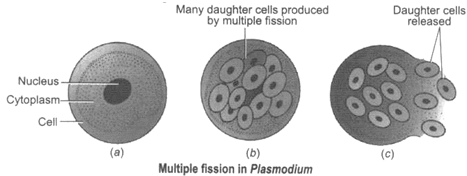
Multiple fission in Plasmodium: It is an asexual mode of reproduction in organisms. Here, the nucleus of the organism divides repeatedly to form a number of equal-sized daughter nuclei and each daughter nuclei breaks away together with a small portion of the cytoplasm.
Sanjeev Kumar 5 years, 5 months ago
Asha Sahu 5 years, 5 months ago
Posted by Aayushi Srivastava 5 years, 5 months ago
- 1 answers
Yogita Ingle 5 years, 5 months ago
No. Resistance is the physical property of a substance because of which it opposes the flow of current i.e. electrons. Resistivity is the physical property of a particular substance which is having particular dimensions.
| Sl. No. | Differentiating Property | Resistance | Resistivity |
| 1 | Definition | Resistance is the physical property of a substance because of which it opposes the flow of current i.e. electrons. | Resistivity is the physical property of a particular substance which is having particular dimensions. |
| 2 | Proportionality | Resistance is directly proportional to the length and temperature while it is inversely proportional to the cross-sectional area of the material. | Resistivity is only proportional to the nature and temperature of the particular material. |
| 3 | Symbol | R | ρ |
| 4 | Formula | R = V/I or, R = ρ(L/A)V = Voltage, I = Current, ρ = Resistivity |
ρ = (R×A)/L R = Resistance, L= Length, A = Cross-sectional area |
| 5 | SI Units | The SI unit of resistance is Ohms | The SI unit of resistivity is Ohms-meter. |
Posted by Shubham Saxena ???? 5 years, 5 months ago
- 4 answers
Shubham Saxena ???? 5 years, 5 months ago
Yogita Ingle 5 years, 5 months ago
Difference between saturated and unsaturated hydrocarbons:
| Saturated hydrocarbons | Unsaturated hydrocarbons |
| Saturated hydrocarbons are the compounds containing only single covalent bonds. These are also known as alkanes. | Unsaturated hydrocarbons are the straight chain compounds containing double or triple covalent bonds. Hydrocarbons with a double bond between carbon atoms are known as alkenes. Hydrocarbons with triple bonds between carbon atoms are known as alkynes. |
| These compounds have more number of hydrogen atoms when compared to its corresponding unsaturated hydrocarbons. | These compounds have less number of hydrogen atoms when compared to its corresponding unsaturated hydrocarbons. |
| These compounds are less reactive. | These compounds are more reactive. |
| These compounds under go substitution reactions. CH4 + Cl2 → CH3Cl + HCl |
These compounds under go addition reactions. Ex: CH2=CH2 + H2 → CH3 - CH3 |
| Saturated hydrocarbons burns with blue flame | Unsaturated hydrocarbons burns with sooty flame |
...... ...... 5 years, 5 months ago
Posted by Shubham Saxena ???? 5 years, 5 months ago
- 3 answers
Sush Bhatane 5 years, 5 months ago
Posted by Krishna Yadav 5 years, 5 months ago
- 1 answers
Priya ✧*。٩(๑˙╰╯˙๑)و✧*。 5 years, 5 months ago
Posted by Shubham Saxena ???? 5 years, 5 months ago
- 4 answers
Kritika Pathak 5 years, 5 months ago
Shubham Saxena ???? 5 years, 5 months ago
Priya ✧*。٩(๑˙╰╯˙๑)و✧*。 5 years, 5 months ago
Posted by Shubham Saxena ???? 5 years, 5 months ago
- 4 answers
Yogita Ingle 5 years, 5 months ago
One side clockwise and one aide anticlockwise. Use right hand thumb rule. U will know the direction of magnetic field. Put ur right thumb in the direction of current. Now observe the direction of fingers it is clockwise or anticlockwise. U will get the direction of the magnetic field
Kritika Pathak 5 years, 5 months ago
Priya ✧*。٩(๑˙╰╯˙๑)و✧*。 5 years, 5 months ago
Posted by Om Prakash 5 years, 5 months ago
- 5 answers
Priya ✧*。٩(๑˙╰╯˙๑)و✧*。 5 years, 5 months ago
Posted by Ritesh Rotash Sahoo 5 years, 5 months ago
- 5 answers
Aparna Kumari 5 years, 5 months ago
Shubham Saxena ???? 5 years, 5 months ago
Avatar ? 5 years, 5 months ago
Priya ✧*。٩(๑˙╰╯˙๑)و✧*。 5 years, 5 months ago
Posted by Yana Katkar 5 years, 5 months ago
- 1 answers
Avatar ? 5 years, 5 months ago
Posted by Shubham Saxena ???? 5 years, 5 months ago
- 5 answers
Akhya Sahay 5 years, 5 months ago
Anjali Dhanraj 5 years, 5 months ago
Posted by Shubham Saxena ???? 5 years, 5 months ago
- 5 answers
Posted by Shubham Saxena ???? 5 years, 5 months ago
- 3 answers
Kritika Pathak 5 years, 5 months ago
Shubham Saxena ???? 5 years, 5 months ago
Posted by Shubham Saxena ???? 5 years, 5 months ago
- 1 answers
Posted by Shubham Saxena ???? 5 years, 5 months ago
- 4 answers
Avatar ? 5 years, 5 months ago
Shubham Saxena ???? 5 years, 5 months ago
Yogita Ingle 5 years, 5 months ago
Light rays that are parallel to the principal axis of a concave mirror converge at a specific point on its principal axis after reflecting from the mirror. This point is known as the principal focus of the concave mirror.
Characteristics of image obtained by a concave mirror
There are five cases through which one can understand the characteristics of image obtained by a concave mirror and they are as follows:
| Object placement | Image obtained | Image characteristics |
| When the object is placed at infinity | Image obtained is at the focal point | Image is a point |
| When the object is moved from infinity to center of curvature | Image move from focal point to center of curvature | The size of the image is increased, real, and inverted |
| When the object is at center of curvature | Image obtained is at center of curvature | The size of the image remains the same, real, and inverted |
| When the object move from center of curvature to focal point | Image move from center of curvature to infinity | The size of the image is bigger than the object, real, and inverted |
| When the object is at focal point | Image is at infinity | Infinitely big |
| When the object move from the focal point to mirror | Image move from minus infinity to mirror | The size of the image decreases, larger than the object, virtual, and upright |
Posted by Shubham Saxena ???? 5 years, 5 months ago
- 2 answers
Yogita Ingle 5 years, 5 months ago
Alkali metals are Lithium, Sodium Potassium etc..
They are in the first group after Hydrogen gas.
Second Alkali metal is Sodium.
Its electronic configuration is : 1s² 2s² 2p⁶ 3s¹
Posted by Shubham Saxena ???? 5 years, 5 months ago
- 3 answers
Posted by Shubham Saxena ???? 5 years, 5 months ago
- 2 answers
Posted by Ayaz Vohra 5 years, 5 months ago
- 1 answers
Yogita Ingle 5 years, 5 months ago
Plants have two different types of 'transport' tissue. Xylem transports water and solutes from the roots to the leaves, phloem transports food from the leaves to the rest of the plant.
Plants use two different strategies; transpirational pull and root pressure for the transportation of water and minerals during day and night.
Root Pressure is the positive pressure created by the movement of water from the roots to the soil for upward movement of water. The effect of root pressure in the transport of water is more important at night.
Transpiration pull is the pull of water as a result of tension created by transpiration in the aerial parts of the plant. It is the major driving force of water movement upwards in a plant during the day. Transpiration is the process by which water evaporates from the leaves, which results in more water being drawn up from the roots.
Posted by Guddy Kirola 5 years, 5 months ago
- 1 answers
Prothom Bose 5 years, 5 months ago

myCBSEguide
Trusted by 1 Crore+ Students

Test Generator
Create papers online. It's FREE.

CUET Mock Tests
75,000+ questions to practice only on myCBSEguide app

Charu Gupta 5 years, 5 months ago
1Thank You