
Ask questions which are clear, concise and easy to understand.
Ask QuestionPosted by Swarnima Verma 5 years, 4 months ago
- 2 answers
Gaurav Seth 5 years, 4 months ago
1) Lymphatic system consists of lymph capillaries, lymph vessels, lymph nodes and lymph glands.
2) To supply nutrients to the cells (tissues), the liquid portion of the blood with nutri¬ents flows out of the capillaries. This is called tissue fluid.
3) To transport the tissue fluid into the main blood stream, a separate system called lymphatic system is present.
4) Lymph is the vital link between blood and tissues by which essential substances pass from blood to cells and excretory products from cells to blood.
5) Lymph is the substance that contains blood without solid particles.
6) Tissue fluid is the substance which contains lymph present in the tissues.
7) From intercellular spaces, lymph goes into lymphatic capillaries.
8) Lymphatic capillaries join to form large lymph vessels which finally open into larger veins.
9) Lymph flows only in direction, that is from tissues to heart through veins.
Functions of Lymph:
a) Lymph carries digested and absorbed fats from small intestine to different tissues
of the body. .
b) It helps in removing Waste materials from the cells in the body to drain into blood.
c) Lymph protects cells in the tissues from infection.
Posted by Mahaprasad Mallick 5 years, 4 months ago
- 2 answers
Yogita Ingle 5 years, 4 months ago
Oogenesis is the production of egg cells inside the ovaries. During foetal development, few germinal cells in human ovary differentiate and divide mitotically to produce egg mother cell/oogonia. Further, oogonia become larger and divide to produce diploid primary oocyte. In follicular prenatal phase, the primary oocytes start first meiotic division but are transitionally suspended into prophase stage of meiosis I and are stored in the follicle. After puberty, primary oocyte resumes the division and completion of first meiotic division produce one secondary oocyte (egg cell) and one polar body (non-functional cell).
Posted by Pankaj Sharma 5 years, 4 months ago
- 1 answers
Meghna Thapar 5 years, 3 months ago
Aldehydes and ketones are organic compounds which incorporate a carbonyl functional group, C=O. The carbon atom of this group has two remaining bonds that may be occupied by hydrogen or alkyl or aryl substituents. In organic chemistry, a carbonyl group is a functional group which has a carbon double bonded to an oxygen atom: C=O. R means “Radical Group” meaning any group in which a carbon or hydrogen atom is attached to the rest of the molecule. It substantially indicates an organic chain deprieved of its functional group. R can be CH3- (methylic group) or CH3-CH2- (ethylic), or an aromatic C6H5- (phenzylic group), or whatever.
Posted by Ganesh Sharma 5 years, 4 months ago
- 1 answers
D.S.Vignesh Saravanan 5 years, 4 months ago
Posted by Ganesh Sharma 5 years, 4 months ago
- 2 answers
Posted by Nicky Singhal 5 years, 4 months ago
- 2 answers
Boybe Cool 5 years, 4 months ago
Posted by Ganesh Sharma 5 years, 4 months ago
- 1 answers
Yogita Ingle 5 years, 4 months ago
The nervous system or the neural system is a complex network of neurons specialized to carry messages. The complexity of the nervous system increases as we move towards higher animals.
For instance, cnidarians such as jellyfish have relatively simple nerve nets spread throughout their body. Crabs have a more complicated nervous system in the form of 2 nerve centers called dorsal ganglion and ventral ganglion.
As we move further up the ladder, higher organisms such as vertebrates have a developed brain. Moreover, it is one of the most complicated structures in the animal kingdom, containing billions of neurons, all intricately connected.
In the human body, the neural system integrates the activities of organs based on the stimuli, which the neurons detect and transmit. They transmit messages in the form of electrical impulses and convey messages to and from the sense organs. Thus, the nervous coordination involves the participation of the sense organs, nerves, spinal cord, and brain.
Posted by Usha Rani Jena 5 years, 4 months ago
- 5 answers
Usha Rani Jena 5 years, 4 months ago
Paru ? 5 years, 4 months ago
Posted by Abhishek Gupta 5 years, 4 months ago
- 1 answers
Posted by Ankit Yadav 5 years, 4 months ago
- 1 answers
Gaurav Seth 5 years, 4 months ago
Electric Motor
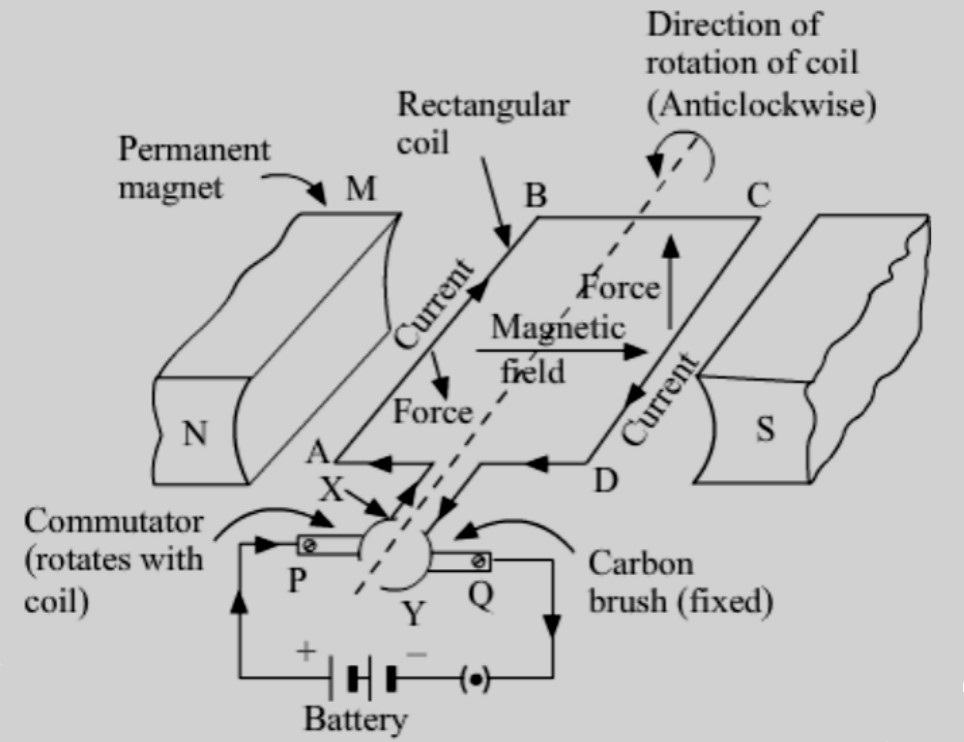
Electric Motor is a device which converts electrical energy into mechanical energy.
Principle of Electric Motor
The principle of the electric motor is based on the fact that a current carrying conductor produces a magnetic field around it. A current carrying conductor placed perpendicular to magnetic field experiences a force.
Construction of Electric Motor
(1) Armature coil
It consist of a single loop of an insulated copper wire in the form of a rectangle.
(2) Strong field magnet
Armature coil is placed between 2 pole pieces of a strong magnet which provide strong magnetic field.
(3) Split ring type commutator
It consist of 2 halves of a metallic ring.The two ends of armature coil are connected to these 2 halves of ring.Commutators reverses the direction of current in armature coil.
(4) Brushes
Two carbon brushes press against the commutator.These brushes act as contact between commutator and terminal battery.
(5) Battery
It is connected across the carbon brushes.It supplies current to the armature coil.
Working of Electric Motor
1)In the side AB of the rectangular cil ABCD, the direction of current is from A to B and in the side CD of the coil, the direction of current is from C to D.The direction of magnetic field is from N pole of the magnet to its S pole.
2) Applying Fleming’s Left hand rule to sides AB and CD of the coil, the force on side AB of the coil is in downward direction whereas the force on side CD of the coil is in upward direction. Due to this the side AB of the coil is pushed down and side CD is pushed up.This makes the coil ABCD rotate in the anticlockwise direction.
3) While rotating, when the coil reached vertical position, then the brushes will touch the gap between the two commutator rings and current of the coil is cut off. Though the current to the coil is cut off when it is in the exact vertical position, the coil does not stop rotating because it has already gained momentum due to which it goes beyond the vertical position.
4) After half rotation, when the coil goes beyond vertical position, the side CD of the coil comes on the left side whereas side AB of the coil comes to the right side, and the two commutator half rings automatically change contact from one brush to the other.
5) After half rotation of the coil , the commutator half ring R2 makes contact with brush B1 whereas the commutator half ring R1 makes contact with brush B2.This reverse the direction of current in the coil.
6) The reversal of direction of current reverses the direction of force acting on the sides AB and CD of the coil.The side CD of the coil is now on the left side with a downward force on it whereas the side AB is now on the right side with an upward force on it.Due to this the side CD of the coil is pushed down and the side AB of coil is pushed up.This makes the coil rotate anticlockwise by another half rotation.
7) The reversing of current in the coil is repeated after every half rotation due to which the coil continue to rotate as long as current from the battery is passed through it.
Posted by Saloni Priya 5 years, 4 months ago
- 2 answers
Yogita Ingle 5 years, 4 months ago
The chemical properties of metals.
- The density of metals is usually high.
- Metals are malleable and ductile.
- Metals form an alloy with other metals or non – metals.
- Some metals react with air and corrode. For e.g. Iron.
- Metals are good conductors of heat and electricity. Lead is an exception.
- Generally, metals are in a solid state at room temperature. Except for Mercury. Mercury is in a liquid state.
The chemical properties of nonmetals
- Nonmetals are poor conductors of heat and electricity. Graphite and Gas carbon are exceptions.
- Unlike metals, nonmetals aren’t malleable and ductile.
- Nonmetals react more with metals than with nonmetals.
- Usually, nonmetals react with other nonmetals in high temperature.
- Most nonmetals do not react with air in room temperature.
- White phosphorus is the only nonmetal that reacts with air to form its oxide by burning.
Karan Dhiman 5 years, 4 months ago
Posted by Kk Ks 5 years, 4 months ago
- 5 answers
Posted by Athul Raj M.S 5 years, 4 months ago
- 3 answers
Diksha Patel 5 years, 4 months ago
Yogita Ingle 5 years, 4 months ago
Limitations of Dobereiner’s classification of elements was that it failed to arrange all the then known elements in the form of triads of elements having similar chemical properties. His classification was not applicable to all known elements but was limited only to a few elements. For example: nitrogen, Phosphorus and arsenic have similar chemical properties but they do not constituent a Dobereiner’s triad. Dobereiner’s could identify only three triads from the elements known at that time. So his classification of elements was not much successful. Dobereiner also failed to explain the relation between atomic masses of elements and their chemical properties.
Som Patel 5 years, 4 months ago
Posted by Ganesh Sharma 5 years, 4 months ago
- 2 answers
Yogita Ingle 5 years, 4 months ago
Mercury is obtained from its sulphide ore called cinnabar, HgS which is actually mercury(ii) sulphide.
The following steps are involved in its extraction:
1. mercury ore is roasted
2HgS(s) + 3 O2 (g) -----> 2HgO (s ) + 2 SO2 (g)
2. when this mercury oxide is heated at about 300 degrees Celsius , it decomposes to form mercury metal.
2HgO (s) ------> 2Hg (l) + O2(g)
Posted by M K 5 years, 4 months ago
- 3 answers
Som Patel 5 years, 4 months ago
Tejasvini S 5 years, 4 months ago
Posted by Sneha Kumari 5 years, 4 months ago
- 3 answers
Ganesh Sharma 5 years, 4 months ago
Yogita Ingle 5 years, 4 months ago
| Saturated hydrocarbons | Unsaturated hydrocarbons |
| Saturated hydrocarbons are the compounds containing only single covalent bonds. These are also known as alkanes. | Unsaturated hydrocarbons are the straight chain compounds containing double or triple covalent bonds. Hydrocarbons with a double bond between carbon atoms are known as alkenes. Hydrocarbons with triple bonds between carbon atoms are known as alkynes. |
| These compounds have more number of hydrogen atoms when compared to its corresponding unsaturated hydrocarbons. | These compounds have less number of hydrogen atoms when compared to its corresponding unsaturated hydrocarbons. |
| These compounds are less reactive. | These compounds are more reactive. |
| These compounds under go substitution reactions. CH4 + Cl2 → CH3Cl + HCl |
These compounds under go addition reactions. Ex: CH2=CH2 + H2 → CH3 - CH3 |
| Saturated hydrocarbons burns with blue flame | Unsaturated hydrocarbons burns with sooty flame |
Vaishu ? 5 years, 4 months ago
Posted by Treesa Joseph 5 years, 4 months ago
- 1 answers
Yogita Ingle 5 years, 4 months ago
(a) Aqueous solution is indicated by the symbol ‘aq’.
An exothermic reaction is indicated by writing “+Heat” or “+Heat energy” or “+Energy” on the products side of an equation.
An endothermic reaction is indicated by writing “+Heat” or “+Heat energy” or “+Energy” on the reactants side of an equation.
Posted by Ñèpàĺ Ssùßmiþà 5 years, 4 months ago
- 1 answers
Gaurav Seth 5 years, 4 months ago
i) Temperature - The dark reactions of photosynthesis are enzymatic and hence temperature controlled. Though the light reactions are also temperature sensitive, they are affected to a much lesser extent. The C4 plants respond to higher temperatures and show higher rate of photosynthesis while C3 plants have a much lower temperature optimum.
The temperature optimum for photosynthesis of different plants also depends on the habitat that they are adapted to. Tropical plants have a higher temperature optimum than the plants adapted to temperate climates.
ii) Water - The effect of water as a factor is more through its effect on the plant, rather than directly on photosynthesis. Water stress causes stomata to close hence reducing CO2 availability. Besides, water stress also makes leaves wilt, thus reducing the surface area of the leaves and their metabolic activity as well.
iii) CO2 - CO2 is a vital raw material needed for photosynthesis.Increased amount of CO2 will increase the rate of photosynthesis to a certain limit, after which a further increase in its amount will no longer increase the rate any further. This is when the other factors necessary for photosynthesis, such as light, become "limiting reactants"; that is, those other factors also need to increase to bring about a further increase in the rate.
Posted by Bhumi Patel 5 years, 4 months ago
- 4 answers
Yangzee Sherpa 5 years, 4 months ago
Gaurav Seth 5 years, 4 months ago
A compact fluorescent lamp (CFL), also called compact fluorescent light, energy-saving light and compact fluorescent tube, is a fluorescent lamp designed to replace an incandescent light bulb; some types fit into light fixtures designed for incandescent bulbs.
Posted by Sapna Bhutani 5 years, 4 months ago
- 5 answers
Manthan Singhal 5 years, 4 months ago
Arunpratap Singhbhadoriya 5 years, 4 months ago
Swayong Prakash Sahoo 5 years, 4 months ago
Varun Kumar Barnwal 5 years, 4 months ago
Posted by Ganesh Sharma 5 years, 4 months ago
- 5 answers
Yogita Ingle 5 years, 4 months ago
Phenolphthalein is often used as an indicator in acid-base titrations. It is slightly soluble soluble in water. It turns acidic in acidic solution and turns pink in basic solution. Since soap solution is basic, so phenophthalein turns pink in pink solution.
Shivam Verma 5 years, 4 months ago
Posted by Ganesh Sharma 5 years, 4 months ago
- 1 answers
Posted by Rishikesh Kumar 5 years, 4 months ago
- 0 answers
Posted by Sonal Singh 5 years, 4 months ago
- 0 answers
Posted by _Sakshi Raj_ 5 years, 4 months ago
- 5 answers
Ranbeer Boparai 5 years, 4 months ago
P B Student 5 years, 4 months ago
Yogita Ingle 5 years, 4 months ago
Brine is a solution of sodium chloride (NaCl) and water (H2O). The electrolysis of brine is a large-scale process used to manufacture chlorine from salt. Two other useful chemicals are obtained during the process, sodium hydroxide (NaOH) and hydrogen (H2).
Posted by Priya ✧*。٩(๑˙╰╯˙๑)و✧*。 5 years, 4 months ago
- 2 answers
Yogita Ingle 5 years, 4 months ago
Fossils are the remains or impression preserved of prehistoric plant or animal embedded in rock. Fossils provide us with the knowledge of animals and plants that lived hundreds of years ago which are now extinct. It helps us to compare the animals that lived during prehistoric times with its present descendants. They provide the missing link in the study of evolution. They are helpful in providing information while forming a sequence of the organisms in the pathway of evolution.
Posted by Sumit Chand 5 years, 4 months ago
- 4 answers
P B Student 5 years, 4 months ago
Yogita Ingle 5 years, 4 months ago
The blood of earthworm is red due to thepresence of dissolved haemoglobin in plasma. Earthworm's blood does not have RBC.
Posted by Prabhjot Kaur 5 years, 4 months ago
- 1 answers
Vaishu ? 5 years, 4 months ago
Posted by Rohit Yadav 5 years, 4 months ago
- 1 answers
Meghna Thapar 5 years, 4 months ago
The reason a carbon atom cannot bond with four electrons with another carbon is due to the carbon electron orbitals. Since it has a s and 3 p orbitals, it must create one sigma and at most 2 pi bonds with another carbon. Hence, you'll have to bond them with another atom. Carbon can not form 4 bonds with another carbon because of its orbitals which are some time hybridized. ... In case of ethyne it shows sp hybirdization and two p unhybird orbitals forms two pi bonds with other atom and two hybrid orbitals forms sigma bonds one with carbon and other with hydrogen.

myCBSEguide
Trusted by 1 Crore+ Students

Test Generator
Create papers online. It's FREE.

CUET Mock Tests
75,000+ questions to practice only on myCBSEguide app

Swarnima Verma 5 years, 4 months ago
0Thank You