
Ask questions which are clear, concise and easy to understand.
Ask QuestionPosted by Misthi Upadhyay 5 years, 2 months ago
- 2 answers
Gaurav Seth 5 years, 2 months ago
Fleming's right hand rule states to hold the forefinger, middle finger and thumb of right hand mutually perpendicular to each other so that the forefinger points in the direction of external magnetic field and thumb points in the direction of motion of conductor. Now the direction in which the middle finger is pointed gives the direction of induced current in the conductor. Fleming's right hand rule is used to determined the direction of induced current in the conductor when a conductor moves in a region of magnetic field.
Posted by Unbelieve Able 5 years, 2 months ago
- 1 answers
Gaurav Seth 5 years, 2 months ago
Valency is the combining power or the combining capacity of an atom. The number of electrons gained, lost or shared by an atom so as to achieve the nearest noble gas configuration gives us valency.
Posted by Shanthi.K Shanthi.K 5 years, 2 months ago
- 2 answers
Yogita Ingle 5 years, 2 months ago
As we move above the Earth’s surface, the density of air goes on decreasing. There is a gradual increase in the refractive index from the atmosphere to the Earth’s surface. Thus, the refractive index of the atmosphere is different at different altitudes.
Anshika Pandey 5 years, 2 months ago
Posted by Raj Sandeep 5 years, 2 months ago
- 1 answers
Gaurav Seth 5 years, 2 months ago
There is no electric field near a long, straight-thin uniform current-carrying conductor. Therefore, a charged particle moving parallel to the conductor experiences a magnetic force, as per the electrodynamics. The left hand Fleming rule came into existence through John Ambrose Fleming in the 19th Century. It was the simplest approach to understand the direction of the motion or the direction of the electric current. The left-hand rule of Fleming states that when we stretch the forefinger and middle finger of the left hand in a manner that they are mutually perpendicular to each other.
Now, if the forefinger is taken as the direction of the current and the middle finger towards the magnetic field then the thumb points towards the motion of the conductor or the force. It is one of the rules of electricity. The reason being when a current-carrying the conductor comes under the magnetic field there is likely to be a force acting on the conductor. With the help of Fleming's left-hand rule, the director of the force can be determined.
Usage of The Rule
Generally, Fleming's left-hand rule is used for electric motors. On the other hand, for electric generator the right-hand rule is applicable. The reason why the left-hand rule of Fleming is used in the electric motor because in the electric motor there is the presence of magnetic field and electric current which leads to the force that enables creating the motion. This can be referred to as the effect. Hence, the left-hand rule is used. It thus gives us the direction of the force that works on the current if well aware of the magnetic field.
There is a need for different hands for motors and generators because there is a certain amount of difference between the effect and the cause. To elaborate that, the magnetic field and the electric current creates the force which results in motion and that is why the left hand is used. While the motion and the magnetic field exist in the electric generator and they create the current which is why the right hand is used. The physical basis for the rules that are to be remembered is that the electrons flow in the same direction from where they generate a cylindrical magnetic field that encircles around the conductor.
Posted by Nikhil Agrahari 5 years, 2 months ago
- 1 answers
Gaurav Seth 5 years, 2 months ago
| CHORDATES | NON-CHORDATES |
| 1) Animal having a notocord or backbone in their body structure are called chordates. | 1) Animals without a notochord are called non-chordates. |
| 2) Central nervous system is hollow and dorsal. | 2) It is solid and ventral. |
| 3) Heart is ventrally placed. | 3) If present, it is on the dorsal side. |
| 4) Haemoglobin is present in the RBCs. | 4) If present, it is dissolved in the plasma. |
| 5) Post **** tail is present. | 5) It is absent in them. |
| 6) Pharyngeal gill slits is present at some stage of life. | 6) It is absent in them. |
Posted by P B Pujari 5 years, 2 months ago
- 1 answers
Tanu Man 5 years, 2 months ago
Posted by P B Pujari 5 years, 2 months ago
- 1 answers
Gaurav Seth 5 years, 2 months ago
Sexually transmitted diseases by virus:
Genital Herpes is caused by herpes simplex virus and AIDS is caused by HIV.
Sexually transmitted diseases by bacteria:
Gonorrhoea is caused by Nisseria gonorrhoeae and Syphilis is caused by Trepanoma pallidum
Prevention of transmission of STD's:
i. Having *** with infected or any unknown person should be avoided.
ii. Sharing of needles, syringes etc. must be prohibited.
iii. The surgical and dental instruments should be sterilized properly before use.
iv. Avoid blood transfusion from infected person. Blood should be tested before transfusion.
v. Adequate medical treatment should be provided to the pregnant woman to protect the child from getting infected.
Posted by P B Pujari 5 years, 2 months ago
- 2 answers
Gaurav Seth 5 years, 2 months ago
1)’ Placenta is a tissue formed by the cells from the embryo and the mother.
2) It is formed at around 12 weeks of pregnancy and becomes an important structure
for nourishment of the embryo. ’
3) Placenta is a disc which is embedded in the uterine wall. It contains villi on the embryo’s side of the tissue.
4) On the mother’s side are blood spaces, '
5) This provides a large surface area for diffusion of glucose, oxygen and other nutrients from the mother of the embryo.
Anshika Pandey 5 years, 2 months ago
Posted by P B Pujari 5 years, 2 months ago
- 1 answers
Gaurav Seth 5 years, 2 months ago
Draw a ray diagram to show the path of light when it travels through glass slab.
Answer
Incident ray I enters the glass slab forms an angle of incidence ‘i’. Its bends towards the normal and forms an angle of refraction ‘r’.
The emergent ray is parallel to the incident ray.
Posted by P B Pujari 5 years, 2 months ago
- 1 answers
Manav Kumar 5 years, 2 months ago
Posted by P B Pujari 5 years, 2 months ago
- 1 answers
Manav Kumar 5 years, 2 months ago
Posted by P B Pujari 5 years, 2 months ago
- 1 answers
Gaurav Seth 5 years, 2 months ago
Double fertilization : It occurs when one male nucleus fertilizes (fuses) with egg cell to form zygote cell and other male nucleus fuses (fertilizes) with two polar nuclei to cause triple fusion. As these two types of fertilizations take place at the same time in the ovule of the plant, it is known as double fertilization.
After fertilization:
(i) Ovary develops into fruit.
(ii) Ovules develop into seeds.
Posted by P B Pujari 5 years, 2 months ago
- 1 answers
Gaurav Seth 5 years, 2 months ago
Double fertilization : It occurs when one male nucleus fertilizes (fuses) with egg cell to form zygote cell and other male nucleus fuses (fertilizes) with two polar nuclei to cause triple fusion. As these two types of fertilizations take place at the same time in the ovule of the plant, it is known as double fertilization.
After fertilization:
(i) Ovary develops into fruit.
(ii) Ovules develop into seeds.
Posted by P B Pujari 5 years, 2 months ago
- 1 answers
Gaurav Seth 5 years, 2 months ago
(i) Change in colour: Reaction between lead nitrate solution and potassium iodide solution.
Pb(NO3)2(aq)+2KI → PbI2(s)+2KNO3(aq)
In this reaction, colour changes from colourless to yellow.
(ii)Change in temperature: Action of dilute sulphuric acid on zinc.
Zn(s) + H2SO4(aq) → ZnSO4(aq) + H2
In this reaction, heat is evolved
(iii) Formation of precipitate: Action of barium chloride on sodium sulphate.
BaCl2(aq) +Na2SO4(aq) → BaSO4(s) +2NaCl(aq)
BaSO4(s) - ppt
Posted by P B Pujari 5 years, 2 months ago
- 1 answers
Gaurav Seth 5 years, 2 months ago
A n s w e r :
Bleaching powder is formed.
(i) It is used as bleaching agent in paper and textile industries.
(ii)It is used as disinfectant in purification of drinking water.
Posted by P B Pujari 5 years, 2 months ago
- 4 answers
Tanu Man 5 years, 2 months ago
Gaurav Seth 5 years, 2 months ago
1. Length of conductor: The resistance (R) of a conductor is directly proportional to its length (l).
R∝l
If we increase the length of a conductor, its resistance increases since only less amount of current can pass through it. If we reduce the length of a conductor, the resistance decreases since more current can pass through it.
2. Area of cross-section: Area of the cross-section is inversely proportional to the resistance.
R∝1 / A
If we double the area of cross-section, the resistance will be half. So, electricity can. That's why we are using thick wires for the heavy electrical loads.
3. Nature of material: Conductors offer less resistance compared to insulators. That’s why we are using plastic materials for electrical insulation purposes like switches, coatings etc.
Effect of temperature: Resistance of pure metals are showing a direct relationship with temperature. But generally, alloys like nichrome won’t show that much change in resistance with respect to the temperature. The resistance of semiconductors decreases with increasing temperature.
From these conclusions, we can conclude that,
R∝l / A
The proportionality constant is known as resistivity (ρ).
R=ρ l / A
Resistivity is a measurable property that quantifies how strongly a given material opposes the electric current flow. It depends upon the dimension of the material. It is also known as specific electrical resistance. It is inverse to conductivity. Its unit is Ω
If we are considering unit measurements, we can say that; the electrical resistivity of a material is the resistance of the material per unit length and per unit cross-sectional area at a specified temperature.
Gaurav Seth 5 years, 2 months ago
A n s w e r:
The resistance of the conductor depends on the following factors:
- The temperature of the conductor
- The cross-sectional area of the conductor
- Length of the conductor
- Nature of the material of the conductor
Posted by Mungi Rajesh 5 years, 2 months ago
- 4 answers
Gaurav Seth 5 years, 2 months ago
Kepler First law – The Law of Orbits
According to Kepler’s first law,” All the planets revolve around the sun in elliptical orbits having the sun at one of the foci”. The point at which the planet is close to the sun is known as perihelion and the point at which the planet is farther from the sun is known as aphelion.
It is the characteristics of an ellipse that the sum of the distances of any planet from two foci is constant. The elliptical orbit of a planet is responsible for the occurrence of seasons.
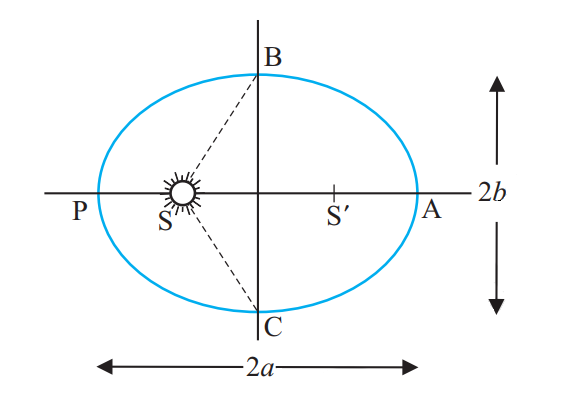
Kepler First Law – The Law of Orbits
<a id="Kepler’s Second Law - The law of Equal Areas" name="Kepler’s Second Law - The law of Equal Areas"></a>
Kepler’s Second Law – The Law of Equal Areas
Kepler’s second law states ” The radius vector drawn from the sun to the planet sweeps out equal areas in equal intervals of time”
As the orbit is not circular, the planet’s kinetic energy is not constant in its path. It has more <a href="https://byjus.com/physics/kinetic-energy/">kinetic energy</a> near perihelion and less kinetic energy near aphelion implies more speed at perihelion and less speed (vmin) at aphelion. If r is the distance of planet from sun, at perihelion (rmin) and at aphelion (rmax), then,
rmin + rmax = 2a × (length of major axis of an ellipse) . . . . . . . (1)
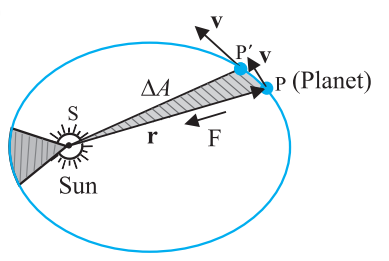
Kepler’s Second Law – The law of Equal Areas
For an infinitesimal movement of the planet in a time interval in an elliptical orbit, the area swept by the planet in time is given by;
dA/dt = d/dt [ 1/2 × r × (v dt)]= 1/2 × rv . . . . . (2)
At perihelion r = rmin, v = vmax then from Equation 2;
dA/dt = 1/2 × rmin × vmax) = [m × vmax × rmin]/2m = L/2m;
At aphelion r = rmax, v = vmin then from Equation 2;
dA/dt = 1/2 × vmin × rmax = [m × vmin × rmax]/2m = L/2m
Kepler’s second law can also be stated as “The areal velocity of a planet revolving around the sun in elliptical orbit remains constant which implies the angular momentum of a planet remains constant”. As the angular momentum is constant all planetary motions are planar motions, which is a direct consequence of central force.
Kepler’s Third Law – The Law of Periods
According to Kepler’s law of periods,” The square of the time period of revolution of a planet around the sun in an elliptical orbit is directly proportional to the cube of its semi-major axis”.
T2 ∝ a3
Shorter the orbit of the planet around the sun, shorter the time taken to complete one revolution. Using the equations of Newton’s law of gravitation and laws of motion, Kepler’s third law takes a more general form:
P2 = 4π2 /[G(M1+ M2)] × a3
where M1 and M2 are the masses of the two orbiting objects in solar masses.
Posted by Swayam Gupta 5 years, 2 months ago
- 2 answers
Tanu Man 5 years, 2 months ago
Posted by Lavi Awasthi 5 years, 2 months ago
- 1 answers
Yogita Ingle 5 years, 2 months ago
As it contains three carbon atoms, so the word root will be "prop". Because of the presence of functional group aldehyde, we will use "al" as a secondary suffix. As the "al" begins with the vowel "a", we will drop down the "e" from "Propane" and replace with "al". Therefore, the naming for CH3−CH2−CHO is "Propanal".
Posted by Lavi Awasthi 5 years, 2 months ago
- 2 answers
Himani Yadav 5 years, 2 months ago
Posted by Shravan Patil 5 years, 2 months ago
- 1 answers
Posted by Lipi Nag 5 years, 2 months ago
- 3 answers
Malaika Sharma 5 years, 2 months ago
Lipi Nag 5 years, 2 months ago
Posted by Lipi Nag 5 years, 2 months ago
- 3 answers
Posted by Priya Choudhary 5 years, 2 months ago
- 3 answers
Gopika Satheesh 5 years, 2 months ago
Gaurav Seth 5 years, 2 months ago
The availability of ions is very important to conduct electricity. Distilled water is a pure type of water which does not contain any ions in it. Whereas rainwater contains dissolved gasses such as SO2, CO2.
These gases dissolve in water to form some kind of acids like carbonic acids which dissociates to give ions. Thus rainwater is conducting electricity while distilled water is not conducting electricity.
</article>Posted by Renu Bala 5 years, 2 months ago
- 4 answers
Gaurav Seth 5 years, 2 months ago
One such compound is benzene. In benzene, six carbon atoms form a ring structure and there are three single and three double bonds between the carbon atoms. We can draw the structure of benzene as: Hence, benzene can be taken as an example of a cyclic unsaturated carbon compound.
Posted by Riya 10Th Green 5 years, 2 months ago
- 2 answers
Shravan Patil 5 years, 2 months ago
Gaurav Seth 5 years, 2 months ago
Circulatory System: The circulatory system is responsible for transport of various substances in human beings. It is composed of the heart, arteries, veins and blood capillaries. Blood plays the role of the carrier of substances.
Posted by Aaku Rustogi 5 years, 2 months ago
- 0 answers
Posted by Bhumika - 5 years, 2 months ago
- 1 answers
Suman Kumar 5 years, 2 months ago
Posted by Aditya Jha 5 years, 2 months ago
- 1 answers
Yogita Ingle 5 years, 2 months ago
Materials which allow light to pass through them completely are called Transparent objects. Objects on the other side of Transparent objects can be seen clearly. Eg: Glass, water and air.
Posted by Bivab Mishra 5 years, 2 months ago
- 2 answers
Harsh Dev Jha 5 years, 2 months ago
When Quick lime (CaO) is added to water (H2O) an exothermic reaction takes place. In which slaked lime [Ca(OH)2] is formed as a product with the evolution of a large amount of heat.
CaO + H2O -> Ca(OH)2 + Heat
Yogita Ingle 5 years, 2 months ago
When quick lime also known as (CaO) is added to water(H2O)it reacts vigorously to form slaked lime(CaOH2). A large amount of heat is produced during the chemical reaction. It can also be termed exothermic due to the evolution of heat.
Chemical formula: CaO + H20 -> CaOH2

myCBSEguide
Trusted by 1 Crore+ Students

Test Generator
Create papers online. It's FREE.

CUET Mock Tests
75,000+ questions to practice only on myCBSEguide app

Ridhima Dang 5 years, 2 months ago
1Thank You