
Ask questions which are clear, concise and easy to understand.
Ask QuestionPosted by Kashish Marwa 5 years, 2 months ago
- 0 answers
Posted by Aanya Jain 5 years, 2 months ago
- 1 answers
Yogita Ingle 5 years, 2 months ago
The following methods we can use to avoid env pollution are :
1st; we shouldn't use plastic disposals
2nd; to prepare a perfect sewage system at our homes
3rd; RRR Principle we should need
4th; planting atleast 4 trees or eco plants at our homes
5th; avoid wasting unwanted water cuz I think the next world war will hold the great issue of water
Posted by Lisa Anto 5 years, 2 months ago
- 1 answers
Shrinidhi R Shetty 5 years, 2 months ago
Posted by Mayank Rauthan 5 years, 2 months ago
- 2 answers
Aanya Jain 5 years, 2 months ago
Gaurav Seth 5 years, 2 months ago
F1 (also called first filial generation) are offspring produced by crossing traits of parents and F2 (also called second filial generation) are offspring produced by crossing of traits of offspring produced in F1 generation.
Dominant trait: The trait which can express its effect over contrasting trait is called a dominant trait. It is expressed even in the presence of one copy of an allele for a particular character in the gene, i.e., it is expressed in the heterozygous condition.
Example: Yy represents dominant trait for yellow seed colour. Seed is yellow even when single copy is dominant allele Y is present.
Recessive trait: The trait which cannot express its effect over contrasting trait or which gets suppressed by the contrasting trait is called a recessive trait. It is expressed only when two copies of an allele for a particular character in the gene are present, i.e., it is expressed in the homozygous condition and in the absence of corresponding dominant trait.
Example: yy shows recessive trait for green seed colour. It is expressed only when two copies of recessive allele yy is present.
Posted by Mahak Sadhya 5 years, 2 months ago
- 3 answers
Aanya Jain 5 years, 2 months ago
Account Deleted 5 years, 2 months ago
Posted by Dimple Sahu 5 years, 2 months ago
- 1 answers
Gaurav Seth 5 years, 2 months ago
The process of photosynthesis occurs when green plants use the energy of light to convert carbon dioxide (CO2) and water (H2O) into carbohydrates. Light energy is absorbed by chlorophyll, a photosynthetic pigment of the plant, while air containing carbon dioxide and oxygen enters the plant through the leaf stomata.
Posted by Mahak Aggarwal 5 years, 2 months ago
- 5 answers
Maxtern .Op 5 years, 2 months ago
Mayank Rauthan 5 years, 2 months ago
Posted by Geetha Bhat Geetha 5 years, 2 months ago
- 3 answers
Maxtern .Op 5 years, 2 months ago
Mayank Rauthan 5 years, 2 months ago
Gaurav Seth 5 years, 2 months ago
(a) Joule's law of heating states that heat produced in joules when a current of I amperes flows in a wire of resistance R ohms for time t seconds is given by H = I2Rt.
Thus the heat produced in a wire is directly proportional to:
(i) Square of current
(ii) Resistance of wire
(iii) Time for which current is passed
(b) Given: R1=40ohms, R2=60ohms (in series), V=220V, t=30sec
We know that
Total resistance, R=40+60=100ohms
By Ohm's law,
V = IR
I = V/R
I = 220/100 = 2.2amp
Putting the values of I, R and t in eq. H = I2RT
H = 2.22 X 100 X 30
H = 14520 J
Posted by Geetha Bhat Geetha 5 years, 2 months ago
- 2 answers
Vijay Anand V 5 years, 2 months ago
Gaurav Seth 5 years, 2 months ago
(a) Magnetic field:
The magnetic field is the area around a magnet in which there is magnetic force. Moving electric charges can make magnetic fields. In physics, the magnetic field is a field that passes through space and which makes a magnetic force move electric charges and magnetic dipoles.
(b) Magnetic lines around bar magnet:
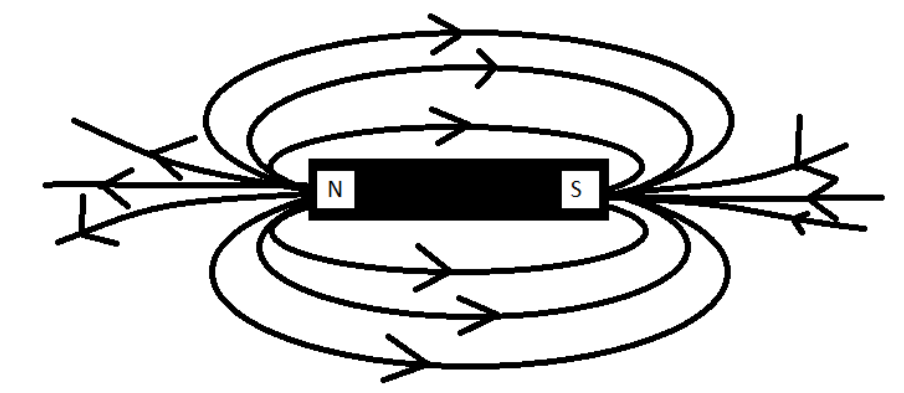
This is the respective diagram of a bar magnet with magnetic field lines.
The lines originate from the north pole and terminate on the south pole of the bar magnet.
The magnetic field lines make closed loops.
(c) Characteristics of magnetic field lines:
- The lines originate from the north pole and terminate on the south pole of the bar magnet.
- The strength of the magnetic field is proportional to the density of lines.
- Magnetic field lines cannot cross each other.
- Magnetic field lines are continuous loops.
Posted by Geetha Bhat Geetha 5 years, 2 months ago
- 1 answers
Mayank Rauthan 5 years, 2 months ago
Posted by Geetha Bhat Geetha 5 years, 2 months ago
- 1 answers
Gaurav Seth 5 years, 2 months ago
Properties of Ionic compound:
- Ionic compounds are solid. Ionic bond has greater force of attraction because of which ions attract each other strongly. This makes ionic compounds solid.
- Ionic compounds are brittle.
- Ionic compounds have high melting and boiling points because force of attraction between ions of ionic compounds is very strong.
- Ionic compounds generally dissolve in water.
- Ionic compounds are generally insoluble in organic solvents; like kerosene, petrol, etc.
- Ionic compounds do not conduct electricity in solid state.
- Solution of ionic compounds in water conduct electricity. This happens because ions present in the solution of ionic compound facilitate the passage of electricity by moving towards opposite electrodes.
- Ionic compounds conduct electricity in molten state.
Posted by Jhon Rathi 5 years, 2 months ago
- 4 answers
ऋShav राJ 5 years, 2 months ago
Mayank Rauthan 5 years, 2 months ago
Shoaib Ansari 5 years, 2 months ago
Gaurav Seth 5 years, 2 months ago
Volt: Volt is the unit of potential difference between two points. If 1 joule work is done to move 1 coulomb positive charge from one point to another, then the potential difference between the points is 1 volt.
IV = 1JC-1
One volt is also defined as the potential difference across a resistance of 1 Ohm when 1 ampere of current flows through it.
Posted by Md Asim 5 years, 2 months ago
- 2 answers
Shoaib Ansari 5 years, 2 months ago
Gaurav Seth 5 years, 2 months ago
Groups 13–16 of the periodic table of p block are the only groups that contain elements classified as metalloids. Unlike other groups of the periodic table, which contain elements in just one class, groups 13–16 contain elements in at least two different classes.
Boron (B), Silicon (Si), Germanium (Ge), Arsenic (As), Antimony (Sb), Tellurium (Te), Polonium (Po). Here we can see that these seven elements were classified as metalloids in the periodic table from the 13th to the 16th group of p-block.
Posted by Md Asim 5 years, 2 months ago
- 2 answers
Gaurav Seth 5 years, 2 months ago
Right
Explanation:
The metals are to the left of the line (except for hydrogen, which is a nonmetal), the nonmetals are to the right of the line, and the elements immediately adjacent to the line are the metalloids.
Posted by Vishal Gupta 5 years, 2 months ago
- 1 answers
Arjun Deshmukh 5 years, 2 months ago
Posted by Aakriti Rustagi 5 years, 2 months ago
- 2 answers
Posted by Sandeep Kumar 5 years, 2 months ago
- 2 answers
Adhi Pragathees 5 years, 2 months ago
Trineshwar H 5 years, 2 months ago
Posted by Shweta Singh 5 years, 2 months ago
- 4 answers
Posted by Saurabh Kumar 5 years, 2 months ago
- 1 answers
Posted by Prachi Tiwari 5 years, 2 months ago
- 3 answers
Mohammad Junaid Khan 5 years, 2 months ago
Posted by Maxtern .Op 5 years, 2 months ago
- 4 answers
Mahak Sadhya 5 years, 2 months ago
Posted by Satyam Kr 5 years, 2 months ago
- 1 answers
Manav Kumar 5 years, 2 months ago
Posted by Tejomurthula Sai Sathvika 5 years, 2 months ago
- 1 answers
Yogita Ingle 5 years, 2 months ago
Genes are the basic unit of heredity. They hold the genetic information in the form of DNA which can be translated into useful proteins to carry out life processes. These genes undergo a mutation sometimes, which changes the instructions to formulate the protein, due to which the protein does not work properly. Such disorders are known as genetic disorders.
Some disorders are innate, i.e., present by birth, while others are acquired due to mutations in a particular gene.
Posted by Gupta Binita 5 years, 2 months ago
- 1 answers
Yogita Ingle 5 years, 2 months ago
The element K is in I group of Mendeleev's periodic table in which general formula is R2O. So formula of oxide of K is K2O
2.element C is in group IV of Mendeleev's periodic table .General formula of oxide is R2O so formula of oxide is CO2
3. Similarly oxide of Al is Al2O3.
4. Formula of Si oxide is SiO2.
5. oxide of Ba is BaO
Posted by Shweta Rani 5 years, 2 months ago
- 2 answers
Yogita Ingle 5 years, 2 months ago
Environment is the surrounding of a person or an object. Every thing including living and non living which is around you is a part of your environment.
Anshika Sheoran Sheoran 5 years, 2 months ago
Posted by Aziz Fatima 5 years, 2 months ago
- 2 answers
Yogita Ingle 5 years, 2 months ago
The upward movement of water and minerals from roots to different plant parts is called ascent of sap.
Anshika Sheoran Sheoran 5 years, 2 months ago

myCBSEguide
Trusted by 1 Crore+ Students

Test Generator
Create papers online. It's FREE.

CUET Mock Tests
75,000+ questions to practice only on myCBSEguide app
