
Ask questions which are clear, concise and easy to understand.
Ask QuestionPosted by Amal Fathima 5 years, 1 month ago
- 3 answers
Purodha Praslay 5 years, 1 month ago
Yogita Ingle 5 years, 1 month ago
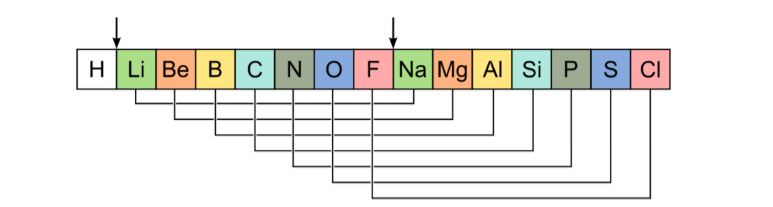
- In 1864, Newlands arranged the known 56 elements in the order of increasing atomic masses.
- He observed that the properties of every eighth element are similar to the properties of the first element.
- Based on this observation, he proposed the Law of Octaves for the classification of elements.
- Law of Octaves: When the elements are arranged in the increasing order of their atomic masses, the properties of every eighth element are similar to the first.
Posted by Airan Mishra 5 years, 1 month ago
- 5 answers
Reema Janu 5 years, 1 month ago
Aashutosh Kumar 5 years, 1 month ago
Purodha Praslay 5 years, 1 month ago
Yogita Ingle 5 years, 1 month ago
Double Displacement Reaction:Reactions in which ions are exchanged between two reactants forming new compounds are called double displacement reactions.
<i>AB + CD → AC + BD</i>
Example: When solution of barium chloride reacts with the solution of sodium sulphate, white precipitate of barium sulphate is formed along with sodium chloride.
<i>BaCl2 + Na2SO4 → BaSO4 + 2NaCl</i>
Posted by Pihu ✨ 5 years, 1 month ago
- 1 answers
Yogita Ingle 5 years, 1 month ago
Let us have a detailed look at the different parts of the respiratory system and their functions.
Nose
The nose possesses a couple of exterior nostrils, which are divided by a framework of cartilaginous structure termed as the septum. This is the structure that evenly separates the right nostril from the left nostril. Tiny hair follicles that cover the interior lining of nostrils acts as the body’s first line of defence against foreign <a href="https://byjus.com/biology/pathogen/">pathogens</a>. Furthermore, they provide additional humidity for inhaled air.
Larynx
Two cartilaginous chords lay the framework for the larynx. They are situated at the point of joining the pharynx and trachea. It is also termed as Adam’s apple or the voice box. It is the portion which rises and falls during swallowing of food particles. It generates sound as air passes through the hollow in the middle.
Pharynx
The nasal chambers open up into a wide hollow space termed as the pharynx. It is a common path for both air and food. It functions by preventing the entry of food particles into the windpipe. The epiglottis is an elastic cartilage, which serves as a switch between the larynx and the oesophagus by allowing the passage of air into the airway to the lungs, and food in the <a href="https://byjus.com/biology/gastrointestinal-tract/">gastrointestinal tract</a>.
Have you ever wondered why we cough when we eat or swallow?
Talking while we eat or swallow results in incessant coughing. The reason behind this reaction is the epiglottis. It is forced to open for the air to exit outwards and the food to enter into the windpipe, triggering a cough.
Trachea
The trachea or the windpipe rises below the larynx and moves down to the neck. The walls of trachea comprise C-shaped cartilaginous rings which give hardness to the trachea and maintain it by completely expanding. The trachea extends further down into the breastbone and splits into two bronchi, one for each lung.
Bronchi
The trachea splits into two tubes termed as bronchi, which enter each lung individually. The bronchi divide into secondary, tertiary, and to bronchioles, which is again further divided into small air-sacs called the alveoli. The alveoli are minute sacs of air with thin walls and single-celled manner. It enables the exchange of oxygen and carbon dioxide molecules into or away from the bloodstream.
Lungs
Lungs are the chief centres of the respiration in humans and other vertebrates. They are located in the thoracic cavity of the chest near the backbone and on either side of the heart. They are the pair of large, spongy organs, mainly involved in the exchange of gases between the blood and the air. Compared to the left lung, the right lung is quite bigger and heavier.
Posted by Aayush Sharma 5 years, 1 month ago
- 2 answers
Reema Janu 5 years, 1 month ago
Srikar B 5 years, 1 month ago
Posted by Aman Meena 5 years, 1 month ago
- 3 answers
Purodha Praslay 5 years, 1 month ago
Shiwani Kumari 5 years, 1 month ago
Himanshu Yadav 5 years, 1 month ago
Posted by # Anushka Negi 5 years, 1 month ago
- 3 answers
Abhimanyu Singh 5 years, 1 month ago
Posted by Prawash Priyam 5 years, 1 month ago
- 4 answers
Malaika Sharma 5 years, 1 month ago
Posted by Ranvijay Kumar 5 years, 1 month ago
- 3 answers
Posted by Aziz Fatima 5 years, 1 month ago
- 3 answers
Tanu Choudhary # 5 years, 1 month ago
Tanu Choudhary # 5 years, 1 month ago
Yogita Ingle 5 years, 1 month ago
If excessive nitrogenous compounds reach the pond,the pond water and its soil will become nutrient rich. The nitrogenous compounds absorbed by plants get converted into amino acids, nucleotides and protein, which help in plant growth and development. The higher the amount of nitrogenous compounds, the greater will be the growth of plant life. Nitrogenous compound enriched pond environment leads to rapid growth of algae and phytoplanktons, followed by more organic matter accumulation. This process is called eutrophication.
Posted by Aziz Fatima 5 years, 1 month ago
- 1 answers
Yogita Ingle 5 years, 1 month ago
1. We can avoid toxic chemical pesticides
2. We can eat organic foods when possible . we should always wash fruits and vegetable before eating
3. We should choose fish wisely , as many contain unsafe levels of toxins
Posted by Pihu ✨ 5 years, 1 month ago
- 3 answers
Pankaj Verma 5 years, 1 month ago
Posted by Swarnima Chauhan 5 years, 1 month ago
- 1 answers
Yogita Ingle 5 years, 1 month ago
An aquarium is an artificial ecosystem and the organisms present in it are selective and maintained in a restricted environment. In the Aquarium the uneaten food as well as the waste generated by the fishes mixes with the water and is left untreated due to the lack of decomposers. The waste materials thus accumulate in the water making it toxic. Hence an aquarium has to be cleaned after regular intervals.
On the other hand, a pond or a lake ecosystem is a natural ecosystem and the types of organism present in it is balanced. The waste produced in this ecosystem serves as the food material for the decomposers and is thus eliminated by them from the water. This ensures a balance in the water body and keeps the water clean and thus does not require physical cleaning.
Posted by ಹರ್ಷನಂದ ಹರ್ಷನಂದ 5 years, 1 month ago
- 2 answers
Kiran Kumari 5 years, 1 month ago
Yogita Ingle 5 years, 1 month ago
The red colour deviates the least.
Violet colour deviates the most.
This is because red has largest wavelength while violet has the shortest wavelength
Posted by Anirudh Singh 5 years, 1 month ago
- 3 answers
Posted by Baisa Hkm ?? 5 years, 1 month ago
- 3 answers
Nayan Pawar 5 years, 1 month ago
Yogyta Sharma 5 years, 1 month ago
Yogita Ingle 5 years, 1 month ago
Through the placenta.
Placenta is a disc-shaped tissue embedded in the uterine wall. Embryo derives its nourishment from the mother’s blood through the placenta. Placenta contains villi on the side of the embryo and blood vessels surrounding villi on the side of the mother. Oxygen and glucose pass from the mother to the embryo through the placenta. In addition, the wastes are also removed into the mother’s blood through the placenta.
Posted by Nikhil Kumar Singh 5 years, 1 month ago
- 1 answers
Yogita Ingle 5 years, 1 month ago
Reproduction through spores gives several advantages to an organism. Some of them are as follows:
- Spores can remain dormant till favourable conditions become available.
- Spores help an organism to tide over the bad phase.
- Spores can be spread through water, air or animals and thus is good for the spread of an organism to more places.
Posted by Md Faiyaz 5 years, 1 month ago
- 2 answers
Srikar B 5 years, 1 month ago
Yogita Ingle 5 years, 1 month ago
|
Arteries |
Veins |
|
|
|
|
|
|
|
|
Posted by Md Faiyaz 5 years, 1 month ago
- 1 answers
Yogita Ingle 5 years, 1 month ago
- Food web is a network of food chains where all the chains are naturally interconnected.
- Each organism is generally eaten by two or more kinds or organisms which are again eaten by several other organisms and so instead of straight line food chain, the series of organisms dependent on one another food can be shown by branched lines which is called as a food web.
- Flow of energy in a food chain is unidirectional, once it reaches the next tropic level it does not come back again.
- For example- energy which passes to the herbivores does not come back again to autotrophs.
Posted by Md Faiyaz 5 years, 1 month ago
- 2 answers
Swarnima Chauhan 5 years, 1 month ago
Yogita Ingle 5 years, 1 month ago
Various roles played by decomposers in the ecosystem are:
- They decompose biodegradable substances into useful substances.
- They release nutrients into soil by decomposing dead and decaying matter, thus making the soil fertile.
- They maintain the nutrient pool by returning back the nutrients in the pool.
Posted by Prawash Priyam 5 years, 1 month ago
- 4 answers
Posted by Anjali Yadav 5 years, 1 month ago
- 2 answers
Kiran Kumari 5 years, 1 month ago
Yogita Ingle 5 years, 1 month ago
The modern periodic table has seven periods.
On moving from left to right in the periodic table, the metallic character of elements decreases, while the valency first increases from 1 to 4 and then decreases to 0 (zero). On moving down the group, the atomic size of the elements increases, but the valency remains the same.
Posted by Ojal Gupta 5 years, 1 month ago
- 2 answers
Srikar B 5 years, 1 month ago
Yogita Ingle 5 years, 1 month ago
| Sl. No. | Differentiating Property | Resistance | Resistivity |
| 1 | Definition | Resistance is the physical property of a substance because of which it opposes the flow of current i.e. electrons. | Resistivity is the physical property of a particular substance which is having particular dimensions. |
| 2 | Proportionality | Resistance is directly proportional to the length and temperature while it is inversely proportional to the cross-sectional area of the material. | Resistivity is only proportional to the nature and temperature of the particular material. |
| 3 | Symbol | R | ρ |
| 4 | Formula | R = V/I or, R = ρ(L/A)V = Voltage, I = Current, ρ = Resistivity |
ρ = (R×A)/L
R = Resistance, L= Length, A = Cross-sectional area |
| 5 | SI Units | The SI unit of resistance is Ohms | The SI unit of resistivity is Ohms-meter. |
| 6 | Applications | The property of resistance is used in several places like heaters, fuses, sensors, etc. | Electrical resistivity measurement is used as a quality control test for calcareous soil. |
Posted by Chakshu Ranka 5 years, 1 month ago
- 2 answers
King?Adithya H. M.. 5 years, 1 month ago
Yogita Ingle 5 years, 1 month ago
Photosynthate moves in the phloem in the form of sucrose.
The final product of photosynthesis is glucose. These sugars are essential for the plant growth and need to be transported to the lower parts of the plants through the phloem.
These sugar are transported through phloem in the form of dissolved sucrose rather than glucose because sucrose is less reactive than glucose.
Posted by Himanshu Kumar 5 years, 1 month ago
- 4 answers
King?Adithya H. M.. 5 years, 1 month ago
Yogita Ingle 5 years, 1 month ago
For Ammeter, We see that 10 Divisions is equal to 0.2 Amperes So, Least Count = 0.2/10 = 0.02 A
Posted by Shiva Raju 5 years, 1 month ago
- 3 answers
King?Adithya H. M.. 5 years, 1 month ago
Yogita Ingle 5 years, 1 month ago
The basis of classification of Dobereiner 's traids is atomic mass.
Dobereiner arranged elements in the form of triads. In each triad the elements are arranged in increasing order of their atomic mass. The atomic mass of the middle element is equal to the average atomic mass of both the terminal elements.
Posted by Shiva Raju 5 years, 1 month ago
- 3 answers
King?Adithya H. M.. 5 years, 1 month ago
Yogita Ingle 5 years, 1 month ago
a) X belongs to Group 17 and 3rd period
Y belongs to Group 2 and 4th period
b) X-Non-metal and Y metal
c) Basic oxide; Ionic bonding

Himanshu Kumar 5 years, 1 month ago
Posted by Shiwani Kumari 5 years, 1 month ago
- 2 answers
Yogita Ingle 5 years, 1 month ago
1 dioptre of power of a lens is described as the unit of measurement of the optical power of a lens or curved mirror equivalent to the reciprocal of focal length (f). Measurement of the focal length in a meter.
The SI unit of power of lens is dioptre whose focal length is one meter, which is denoted by the letter D.
1 dioptre (D) = P = 1/f
Where f = focal length
Shtri Sakti 5 years, 1 month ago
Posted by Shiwani Kumari 5 years, 1 month ago
- 4 answers
King?Adithya H. M.. 5 years, 1 month ago
Gaurav Seth 5 years, 1 month ago
Both the surfaces of sun glasses are curved
R1 = R2
Therefore,
Power, P,

Yogita Ingle 5 years, 1 month ago
Sunglasses do not have any power because both the surfaces of the glasses are equally curved.
Sumit Rathi 5 years, 1 month ago
Posted by Shiwani Kumari 5 years, 1 month ago
- 4 answers
Kiran Kumari 5 years, 1 month ago
Srikar B 5 years, 1 month ago
Yogita Ingle 5 years, 1 month ago
Metals which lie above Hydrogen in the activity series ie. Zn, Al, Mg can displace hydrogen from dilute acids, because they are more reactive than H2. Metals which lie below hydrogen in the activity series i.e. Cu, Ag, Au cannot displace hydrogen from dilute acids, because they are less reactive than hydrogen.
Shtri Sakti 5 years, 1 month ago

myCBSEguide
Trusted by 1 Crore+ Students

Test Generator
Create papers online. It's FREE.

CUET Mock Tests
75,000+ questions to practice only on myCBSEguide app

Raj Kote 5 years, 1 month ago
0Thank You