
Ask questions which are clear, concise and easy to understand.
Ask QuestionPosted by Avinash Kumar 7 years, 2 months ago
- 5 answers
Anchal Kashyap 7 years, 2 months ago
Posted by Somil Gupta 7 years, 2 months ago
- 0 answers
Posted by Nishant Singhal 6 years, 4 months ago
- 1 answers
Sia ? 6 years, 4 months ago
{tex}{S_1} = \frac{n}{2}\left[ {2a + (n - 1)d} \right]{/tex}
{tex}{S_2} = \frac{{2n}}{2}\left[ {2a + (2n - 1)d} \right]{/tex}
{tex}{S_3} = \frac{{3n}}{2}\left[ {2a + (3n - 1)d} \right]{/tex}
R.H.S = 3(S2 - S1)
{tex} = 3\left[ {\frac{{2n}}{2}(2a + (2n - 1)d - \frac{n}{2}(2a + (n - 1)d)} \right]{/tex}
{tex} = 3\left[ {\frac{n}{2}\left[ {4a + 4nd - 2d - 2a - nd + d} \right]} \right]{/tex}
{tex} = 3\left[ {\frac{n}{2}(2a + 3nd - d)} \right]{/tex}
{tex} = \frac{{3n}}{2}\left[ {2a + (3n - 1)d} \right] = {S_3}{/tex}
Posted by Sahil Singh 7 years, 2 months ago
- 0 answers
Posted by Harsh Agarwal 7 years, 2 months ago
- 0 answers
Posted by Sarvesh Saraf 7 years, 2 months ago
- 1 answers
Posted by Nandini Mandloi 6 years, 6 months ago
- 1 answers
Sia ? 6 years, 6 months ago
Let the first term be a and the common difference be d.
{tex}a = a' + (p - 1)d, b = a' + (q - 1)d, c = a' + (r - 1)d{/tex}
{tex}a(q-r) = [a' + (p - 1)d] [(q - r)]{/tex}
{tex}b(r - p) = [a' + (q - 1)d][r - p]{/tex}
and {tex}c[p - q ] = [a' + (r - 1)d][p - q]{/tex}
{tex}\therefore{/tex} {tex}a(q - r) + b(r - p) + c(p - q) = [a' + (p - 1)d] [(q - r)] + [a' + (q - 1)d][r - p] + [a' + (r - 1)d][p - q]{/tex}
{tex}= a' [q - r + r - p + p - q] + d [p (q - r)-q + r + (q - 1) (r - p) + (r -1) (p - q)]{/tex}
{tex}= a'\times0 + d[ pq - pr + qr - pq + pr - qr + (-q + r - r + p - p + q)]{/tex}
= 0
Posted by Palak Devpura 7 years, 2 months ago
- 3 answers
Posted by Anurag Singh 6 years, 6 months ago
- 1 answers
Sia ? 6 years, 6 months ago
We have to prove that {tex} \frac { 1 + \sec \theta - \tan \theta } { 1 + \sec \theta + \tan \theta } = \frac { 1 - \sin \theta } { \cos \theta }{/tex}
Recall identity sec2 θ – tan2θ = 1
Here, LHS {tex}= \frac { 1 + \sec \theta - \tan \theta } { 1 + \sec \theta + \tan \theta }{/tex}
{tex}= \frac { \sec ^ { 2 } \theta - \tan ^ { 2 } \theta + \sec \theta - \tan \theta } { 1 + \sec \theta + \tan \theta }{/tex}
{tex}= \frac { ( \sec \theta - \tan \theta ) ( \sec \theta + \tan \theta ) + ( \sec \theta - \tan \theta ) } { 1 + \sec \theta + \tan \theta }{/tex} [ because, a2 – b2 = (a – b)(a + b)]
{tex}= \frac { ( \sec \theta - \tan \theta ) [ \sec \theta + \tan \theta + 1 ] } { ( \sec \theta + \tan \theta + 1 ) }{/tex}
= sec θ – tan θ
{tex}= \frac { 1 } { \cos \theta } - \frac { \sin \theta } { \cos \theta }{/tex}
{tex}= \frac { 1 - \sin \theta } { \cos \theta }{/tex} = RHS
Hence, proved.
Posted by Tanmay Bareja 7 years, 2 months ago
- 2 answers
Suraj Gupta 7 years, 2 months ago
Posted by Deepak Jaiswal 7 years, 2 months ago
- 0 answers
Posted by Manish Kumar 7 years, 2 months ago
- 0 answers
Posted by Ajay Singj 6 years, 6 months ago
- 1 answers
Sia ? 6 years, 6 months ago
{tex}x^2 + 6x - 16 = 0{/tex}
{tex}\Rightarrow{/tex} {tex}x^2 + 6x = 16{/tex}
{tex}\Rightarrow{/tex} {tex}x^2 + 6x + 9 = 16 + 9{/tex} [Adding on both sides square of coefficient of x, i.e. ({tex}\frac{6}{2}{/tex})2]
{tex}\Rightarrow{/tex} {tex}(x + 3)^2 = 25{/tex}
{tex}\Rightarrow{/tex} x + 3 = {tex}\pm{/tex}{tex}\sqrt{25}{/tex}
{tex}\Rightarrow{/tex} x + 3 =5 or x + 3 = -5
{tex}\Rightarrow{/tex} x = 2 or x = -8
Posted by Ramkrishna Tiwari 7 years, 2 months ago
- 1 answers
Posted by Modassir Alam 7 years, 2 months ago
- 1 answers
Gaurav Kumar 7 years, 2 months ago
Posted by Soham Kumar Gupta 7 years, 2 months ago
- 0 answers
Posted by Soham Kumar Gupta 7 years, 2 months ago
- 1 answers
Posted by Kokila Vani 6 years, 6 months ago
- 1 answers
Sia ? 6 years, 6 months ago
The given pair of linear equations
8x + 5y = 9 ...(1) ...(1)
3x + 2y = 4 ...(2) ...(2)
- by substituting method
From equation (2), 2y = 4 - 3x
{tex}\Rightarrow \;y = \frac{{4 - 3x}}{2}{/tex} ...(3)
Substitute this value of y in equation (1), we get
{tex}8x + 5\left( {\frac{{4 - 3x}}{2}} \right) = 9{/tex}
{tex}\Rightarrow{/tex} 16x + 20 - 15x = 18
{tex}\Rightarrow{/tex} x + 20 = 18
{tex}\Rightarrow{/tex} x = 18 - 20
{tex}\Rightarrow{/tex} x = -2
substituting this value of x in equation (3), we get
{tex}y = \frac{{4 - 3( - 2)}}{2} = \frac{{4 + 6}}{2} = \frac{{10}}{2} = 5{/tex}
So the solution of the given pair of linear equations is x = -2, y = 5. - by cross-multiplication method
Let us write the given pair of linear equation is
8x + 5y - 9 = 0 ...(1)
3x + 2y - 4 = 0 ...(2)
To solve the equation (1) and (2) by cross multiplication method,
we draw the diagram below:
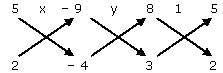
Then,
{tex}\frac{x}{{(5)( - 4) - (2)( - 9)}} = \frac{y}{{( - 9)(3) - ( - 4)(8)}}{/tex}{tex} = \frac{1}{{(8)(2) - (3)(5)}}{/tex}
{tex}= \frac{x}{{ - 20 + 18}} = \frac{y}{{ - 27 + 32}} = \frac{1}{{16 - 15}}{/tex}
{tex}\Rightarrow \frac{x}{{ - 2}} = \frac{y}{5} = \frac{1}{1}{/tex}
{tex}\Rightarrow{/tex} x = -2 and y = 5
Hence, the required solution of the given pair of linear equations is x = -2, y = 5.
Verification : substituting x = -2, y = 5, we find that both the equation (1) and (2) are satisfied as shown below:
8x + 5y = 8(-2) + 5(5) = -16 + 25 = 9
3x + 2y = 3(-2) + 2(5) =- 6 + 10 = 4
Hence, the solution is correct.
Posted by Vishal Nautiyal 7 years, 2 months ago
- 3 answers
Afia Chauhan 7 years, 2 months ago
Posted by Niteesh Kumar 7 years, 2 months ago
- 1 answers
Rakesh Kumar Tiwari 7 years, 2 months ago
Posted by Pooja Kumari 7 years, 3 months ago
- 1 answers
Posted by Venkat Reddy 7 years, 3 months ago
- 1 answers
Posted by Saurav Kumar 7 years, 3 months ago
- 2 answers
Taiyab Hussain. 7 years, 3 months ago
Posted by Dhruv Pawar 7 years, 3 months ago
- 2 answers
Posted by Dhruv Pawar 7 years, 3 months ago
- 0 answers
Posted by Rushvi Parikh 6 years, 6 months ago
- 1 answers
Sia ? 6 years, 6 months ago
According to the question,A car covers a distance of 2592 km with a uniform speed. The number of hours taken for the journey is one half the number representing the speed in km/ hour.
Let the speed of the car be x km/hr.
There fore time taken = {tex}\frac { x } { 2 }{/tex} hour
{tex}\therefore {/tex} {tex}speed= \frac { \text { Distance } } { \text { Time } }{/tex}
{tex}x = \frac { 2592 } { \frac { x } { 2 } }{/tex}
{tex}\Rightarrow \quad x ^ { 2 } = 2592 \times 2{/tex}
{tex}x ^ { 2 } = 5184{/tex}
{tex}x ^ { 2 } = \sqrt { 5184 }{/tex}
x = 72
Hence the time taken will be {tex}\frac { 72 } { 2 } = 36{/tex} hours.
Posted by Thakur Pavanendra 7 years, 3 months ago
- 0 answers
Posted by Manisha Gidi 7 years, 3 months ago
- 0 answers
Posted by Himanshu Singh 7 years, 3 months ago
- 3 answers

myCBSEguide
Trusted by 1 Crore+ Students

Test Generator
Create papers online. It's FREE.

CUET Mock Tests
75,000+ questions to practice only on myCBSEguide app

Santosh Seth 7 years, 2 months ago
0Thank You