
Ask questions which are clear, concise and easy to understand.
Ask QuestionPosted by Devisha Gondaliya 7 years ago
- 1 answers
Posted by Puja Sahoo 7 years ago
- 3 answers
Posted by Nabeel Misbah 7 years ago
- 1 answers
Ram Kushwah 7 years ago
{tex}\begin{array}{l}Area\;=\frac{3\sqrt3}2\;r^2\\r\;is\;radius\;of\;circle\end{array}{/tex}
Posted by Siddesh Jain 7 years ago
- 2 answers
Posted by Muskan Chhilar 7 years ago
- 1 answers
Chētnà Pandey✌️ 7 years ago
Posted by Kavish Gupta 7 years ago
- 0 answers
Posted by Uzzwal Upadhyay 7 years ago
- 2 answers
Gaurav Seth 7 years ago
Given that, mth term=1/n and nth term=1/m.
then ,let a and d be the first term and the common difference of the A.P.
so a+(m-1)d=1/n...........(1) and a+(n-1)d=1/m...........(2).
subtracting equation (1) by (2) we get,
md-d-nd+d=1/n-1/m
=>d(m-n)=m-n/mn
=>d=1/mn.
again if we put this value in equation (1) or (2) we get, a=1/mn.
then, let A be the mnth term of the AP
a+(mn-1)d=1/mn+1+(-1/mn)=1
hence proved.
Posted by Lekhaansh Sagar 7 years ago
- 2 answers
Gaurav Seth 7 years ago
In a right triangle, the square of the hypotenuse is equal to the sum of the squares of the other two sides.
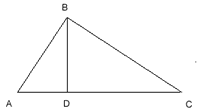
Given: -  is a right angle of
To Prove:-
Construction:-
is drawn
Proof:- In
Or, AB2 = AC X AD ---------------------(i)
Similarly
Or, BC2 = AC X CD ---------------------(ii)
Adding (i) and (ii) we get
AB2 + BC2 = AC X AD + AC X CD
= AC X (AD + CD)
= AC X AC
= AC2
Or, AC2 = AB2 + BC2








Posted by Ujjwal Banna 7 years ago
- 4 answers
Saniya Sarfaraz 7 years ago
Chētnà Pandey✌️ 7 years ago
Posted by Hari Haran 7 years ago
- 3 answers
Chētnà Pandey✌️ 7 years ago
Posted by Hansa Solanki 7 years ago
- 1 answers
Posted by Mangesh Satav 7 years ago
- 1 answers
Shubhendra Singh ? 5 years, 8 months ago
Posted by Tripti Sahu 6 years, 6 months ago
- 1 answers
Sia ? 6 years, 6 months ago
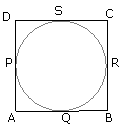
Given ABCD is a parallelogram in which all the sides touch a given circle
To prove:- ABCD is a rhombus
Proof:-
{tex}\because{/tex} ABCD is a parallelogram
{tex}\therefore{/tex} AB = DC and AD = BC
Again AP, AQ are tangents to the circle from the point A
{tex}\therefore{/tex} AP = AQ
Similarly, BR = BQ
CR = CS
DP = DS
{tex}\therefore{/tex}(AP + DP) + (BR + CR) = AQ + DS + BQ + CS = (AQ + BQ) + (CS + DS)
{tex}\Rightarrow{/tex} AD + BC = AB + DC
{tex}\Rightarrow{/tex} BC + BC = AB + AB [{tex}\because{/tex} AB = DC, AD = BC]
{tex}\Rightarrow{/tex} 2BC = 2AB
{tex}\Rightarrow{/tex} BC = AB
Hence, parallelogram ABCD is a rhombus
Posted by Sachin Sheoran 7 years ago
- 2 answers
Saniya Sarfaraz 7 years ago
Posted by Santosh Suresh 7 years ago
- 3 answers
Posted by Pummy Kumari 7 years ago
- 2 answers
Gurjar Naam ही भत्हैरा ??? 7 years ago
Posted by Vanshika Singh 7 years ago
- 2 answers
Gurjar Naam ही भत्हैरा ??? 7 years ago
Posted by Sonu 7 years ago
- 3 answers
Sonu 7 years ago
Posted by Sonu 7 years ago
- 2 answers
Posted by Mifta Mifta 7 years ago
- 7 answers
Gaurav Seth 7 years ago
A.P. 7 , 13 , 19 , ...... , 205
a = 7
d = 13 – 7 = 6
An = 205
As we know,
An = a + (n–1) d
205 = 7 + (n–1) 6
=> 205 – 7 = (n–1) 6
=> 198 = (n–1) 6
=> n–1 = 198 / 6
=> n–1 = 33
=> n = 33 + 1
=> n = 34
Thus, total no. of terms is 34.
Puja Sahoo 7 years ago
Posted by Manoj Sharma 6 years, 4 months ago
- 1 answers
Sia ? 6 years, 4 months ago
Let the usual speed of the plane b x km/hr.
Distance to the destination = 1500 km
Case (i):
{tex}\text{we know that,} \ Speed = {Distance\over Time} \\ \Rightarrow Time = {Distance\over speed}{/tex}
So, in case(i) Time = {tex}1500 \over x{/tex}Hrs
Case (iI)
Distance to the destination = 1500 km
Increased speed = 100 km/hr
So, speed = x+100
So, in case(ii) Time = {tex}1500 \over {x+100}{/tex}Hrs
So, according to the question
{tex}\therefore{/tex} {tex}\frac{1500}{x}{/tex} - {tex}\frac{1500}{x + 100}{/tex} = {tex}\frac{30}{60}{/tex}
{tex}\Rightarrow{/tex} x2 + 100x - 300000 = 0
{tex}\Rightarrow{/tex} x2 + 600x - 500x - 300000 = 0
{tex}\Rightarrow{/tex} (x + 600)(x - 500) = 0
{tex}\Rightarrow{/tex}x = 500 or x = -600
Since, speed can not be negative, x = 500
Therefore, Speed of plane = 500 km/hr.
Posted by Shubham Painuly 7 years ago
- 6 answers
V.Uthaya Kumar 7 years ago
Posted by Prachi Singh 7 years ago
- 5 answers
Kddpe Nnsve S 7 years ago
Posted by Akshat Sharma 7 years ago
- 1 answers
Posted by Avaneesh Sharma Mdjssv 7 years ago
- 1 answers
Gaurav Seth 7 years ago
1. he was was an Italian revolutionary born in Genoa, 1807 who became a member of the secret society of the Carbonari
2. he was sent to prison for revolting against the monarchs at the age of 24
3. he then formed secret society i. e. young Italy and young Europe in Marseilles and Berne respectively
4. He also helped Bismarck during the war for unification of Italy ( he had sought to put together coherent programme for a unitary Italian Republic )
5. He believed that good had intended nations to be the natural units of mankind. So Italy couldn't continue to be the patchwork of small states and kingdoms.
6. even Duke Metternich of Austria even stated that he was the most dangerous enemy of their social order i. e. monarchical rule
Posted by Akshita Rastogi 7 years ago
- 1 answers
Feba ????? 7 years ago
Posted by Nakul Sharma 7 years ago
- 0 answers

myCBSEguide
Trusted by 1 Crore+ Students

Test Generator
Create papers online. It's FREE.

CUET Mock Tests
75,000+ questions to practice only on myCBSEguide app

Ram Kushwah 7 years ago
sinA=cosA
sinA/cosA=1
tanA=1
and cosA=1/(1+tan2A)1/2
=1/{tex}\sqrt2{/tex}
so 2tanA+ Cos2A=2*1 +1/2
=5/2
3Thank You