
Ask questions which are clear, concise and easy to understand.
Ask QuestionPosted by Gaurav Chilkoti 6 years, 11 months ago
- 2 answers
Mansi ??⚘?? 6 years, 11 months ago
Posted by Ketan Surde 6 years, 11 months ago
- 4 answers
Posted by Pratibha Sahu 6 years, 6 months ago
- 1 answers
Sia ? 6 years, 6 months ago
Since, α and β are the zeroes of the quadratic polynomial
f(x) = x2 - p (x+1) - c=x2-px-(p+c)
So A=1 B=-p,C=-(p+c)
Sum of the zeroes α + β = {tex}-\frac BA{/tex}=P
Product of the zeroes αβ ={tex}\frac CA{/tex}=- (p + c)
(α + 1)(β + 1)
= αβ + α + β + 1
= αβ + (α + β) + 1
=-(p+c)+p+1
=-p-c-p+1
=1-c
Hence proved
Posted by Soham Deshpande 6 years, 11 months ago
- 0 answers
Posted by Puja Sahoo 6 years, 11 months ago
- 3 answers
Santosh Parida 6 years, 11 months ago
Posted by Tabrez Shaiwale 6 years, 11 months ago
- 2 answers
Posted by Sakshi Kurchaniya 6 years, 11 months ago
- 1 answers
Posted by Sumant Adky 6 years, 11 months ago
- 3 answers
Posted by Nitesh Patel 6 years, 11 months ago
- 0 answers
Posted by Aditya Gupta 5 years, 8 months ago
- 2 answers
Aditya Gupta 6 years, 11 months ago
Posted by Aditya Gupta 6 years, 11 months ago
- 2 answers
Jatin Gera 6 years, 11 months ago
Posted by Kalash Maan 6 years, 11 months ago
- 2 answers
Posted by Karamveer Singh 6 years, 11 months ago
- 3 answers
Posted by Ankit Bisht 6 years, 11 months ago
- 4 answers
Posted by Abhishek Kandari 6 years, 11 months ago
- 2 answers
Posted by Karamveer Singh 6 years, 11 months ago
- 3 answers
Posted by Ashwani Kumar 6 years, 11 months ago
- 0 answers
Posted by Pulkit Singh 6 years, 11 months ago
- 1 answers
Riya Tulsani 6 years, 11 months ago
Posted by Sanjana Shashi 6 years, 11 months ago
- 1 answers
Jatin Gera 6 years, 11 months ago
Posted by Puja Sahoo 6 years, 11 months ago
- 5 answers
Puja Sahoo 6 years, 11 months ago
Posted by Yush Gupta 6 years, 11 months ago
- 1 answers
Posted by Pratibha Sahu 6 years, 11 months ago
- 1 answers
Posted by Neha Jangir 6 years, 11 months ago
- 7 answers
Jatin Gera 6 years, 11 months ago
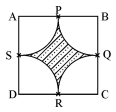
Posted by Divy Panchal 6 years, 11 months ago
- 0 answers
Posted by Priyanshu Digari 6 years, 11 months ago
- 1 answers
Abhinav Yadav 6 years, 11 months ago
Posted by Arsh Dhillon 6 years, 11 months ago
- 0 answers
Posted by Ritik Badge 6 years, 11 months ago
- 0 answers

myCBSEguide
Trusted by 1 Crore+ Students

Test Generator
Create papers online. It's FREE.

CUET Mock Tests
75,000+ questions to practice only on myCBSEguide app

Sia ? 6 years, 6 months ago
Let PM be the light house of height 200 m and let A and B be two ships on the either sides of lighthouse such that the angles of depression of A and B are {tex}60^o{/tex} and {tex}45^o{/tex} respectively.
Let, AM = x m and BM=y m
Then, {tex}\angle XPB=\angle MBP=45^o{/tex} [alternate angle]
and {tex}\angle YPA=\angle MAP=60^o{/tex} [alternate angles]
In right-angled {tex}\triangle AMP,{/tex} {tex}\tan{60^o}=\frac{P}{B}=\frac{PM}{AM}{/tex}
{tex}\Rightarrow \sqrt3=\frac{200}{x}{/tex}
{tex}\Rightarrow x=\frac{200}{\sqrt3}\;m{/tex}
In right-angled {tex}\triangle BMP, {/tex} {tex}\tan{45^o}=\frac{PM}{BM}{/tex}
{tex}\Rightarrow 1=\frac{200}{y}{/tex}
{tex}\Rightarrow y=200 \;m{/tex}
Now, distance between the two ships = AB = {tex}x+y=200+\frac{200}{\sqrt3}=315.48\;m{/tex}
0Thank You