
Ask questions which are clear, concise and easy to understand.
Ask QuestionPosted by Harsh Singh Oberoi 7 years, 3 months ago
- 1 answers
Posted by Aman Kaushik 7 years, 3 months ago
- 0 answers
Posted by Sagar Sagar 7 years, 3 months ago
- 1 answers
Posted by Sushant Thareja 7 years, 3 months ago
- 5 answers
Puja Sahoo 7 years, 3 months ago
Posted by Yashasvi Yadav 7 years, 3 months ago
- 6 answers
Shruti Singh 7 years, 3 months ago
S Sihag Ji 7 years, 3 months ago
Prashant Chaudhary 7 years, 3 months ago
Raunak _ Pandey ?? 7 years, 3 months ago
Posted by Yashasvi Yadav 7 years, 3 months ago
- 3 answers
Puja Sahoo 7 years, 3 months ago
Raunak _ Pandey ?? 7 years, 3 months ago
Posted by Vishal Singh 7 years, 3 months ago
- 3 answers
Posted by Shaurya Mishra 7 years, 3 months ago
- 2 answers
Posted by Ayush Jaiswal 7 years, 3 months ago
- 2 answers
Gaurav Seth 7 years, 3 months ago
There is a mistake in a question.
I think question is like this
Question:
The sum of first n terms of an AP is given by Sn = 2n² + 3n . Find the sixteenth term of
the AP.
Solution:
Let an be the nth term & Sn be the sum of first n terms.
Given:
Sn = 2n²+3n
an = S(n) - S(n-1)
=2n²+3n -[ 2(n-1)²+3(n-1)]
= 2n²+3n -[2(n²+1-2n)+3n -3]
= 2n²+3n -[2n²+2-4n + 3n -3]
= 2n²+3n -2n²+4n-3n -2+3
= 2n²+2n²+3n -3n +4n -2+3
= 4n +1
an = 4n+1
a16= 4×16 +1= 64+1= 65
Hence, the 16th term of an AP is 65
Posted by Akansha Sundriyal 6 years, 9 months ago
- 1 answers
Posted by Sachin Rao 7 years, 3 months ago
- 0 answers
Posted by Prashant Mitraov 7 years, 3 months ago
- 6 answers
Posted by Vivek Chaurasiya 7 years, 3 months ago
- 5 answers
Neha Narula 7 years, 3 months ago
Puja Sahoo 7 years, 3 months ago
Posted by Mahtab Alam 7 years, 3 months ago
- 3 answers
Posted by Prashant Mitraov 6 years, 9 months ago
- 1 answers
Sia ? 6 years, 9 months ago
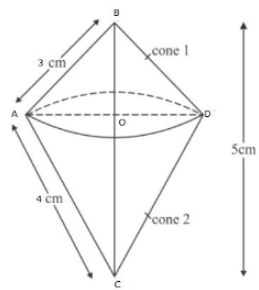
AB = 3 m, AC = 4 m
In {tex}\triangle{/tex}BAC, by pythagoras theorem
BC2 = AB2 + AC2
{tex}\Rightarrow{/tex}BC2 = 32 + 42
{tex}\Rightarrow{/tex}BC2 = 25
{tex}\Rightarrow{/tex}BC = {tex}\sqrt {25} {/tex} = 5 m
In {tex}\triangle{/tex}AOB and {tex}\triangle{/tex}CAB
{tex}\angle{/tex}ABO = {tex}\angle{/tex}ABC [common]
{tex}\angle{/tex}AOB = {tex}\angle{/tex}BAC [each 90o]
Then, {tex}\triangle{/tex}AOB - {tex}\triangle{/tex}CAB [by AA similarity]
{tex}\therefore{/tex} {tex}\frac { A O } { C A } = \frac { O B } { A B } = \frac { A B } { C B }{/tex} [c.p.s.t]
{tex}\Rightarrow{/tex} {tex}\frac { A O } { 4 } = \frac { O B } { 3 } = \frac { 3 } { 5 }{/tex}
Then, AO = {tex}\frac{{4 \times 3}}{5}{/tex} and OB = {tex}\frac{{3 \times 3}}{5}{/tex}
{tex}\Rightarrow{/tex} AO = {tex}\frac{12}{5}{/tex} m and OB = {tex}\frac{9}{5}{/tex} m
{tex}\therefore{/tex}OC = 5 - {tex}\frac{9}{5}{/tex} = {tex}\frac{16}{5}{/tex}m
{tex}\therefore{/tex} Volume of double cone thus generated = volume of first cone + volume of second cone
{tex}= \frac { 1 } { 3 } \pi ( A O ) ^ { 2 } \times B O + \frac { 1 } { 3 } \pi ( A O ) ^ { 2 } \times O C{/tex}
{tex}= \frac { 1 } { 3 } \times \frac { 22 } { 7 } \times \left( \frac { 12 } { 5 } \right) ^ { 2 } \times \frac { 9 } { 5 } + \frac { 1 } { 3 } \times \frac { 22 } { 7 } \times \left( \frac { 12 } { 5 } \right) ^ { 2 } \times \frac { 16 } { 5 }{/tex}
{tex}= \frac { 1 } { 3 } \times \frac { 22 } { 7 } \times \frac { 12 } { 5 } \times \frac { 12 } { 5 } \left[ \frac { 9 } { 5 } + \frac { 16 } { 5 } \right]{/tex}
{tex}= \frac { 1 } { 3 } \times \frac { 22 } { 7 } \times \frac { 12 } { 5 } \times \frac { 12 } { 5 } \times 5{/tex}
={tex}\frac{1056}{35}{/tex} = {tex}30 \frac { 6 } { 35 } \mathrm { m } ^ { 3 }{/tex}.
Posted by Gaurav Bisht 7 years, 3 months ago
- 0 answers
Posted by Kunal Choudhary 7 years, 3 months ago
- 0 answers
Posted by Renuka Mali 7 years, 3 months ago
- 0 answers
Posted by Abhi Mahato 6 years, 9 months ago
- 1 answers
Sia ? 6 years, 9 months ago

We know that the two tangents drawn to a circle from an external point are equal.
{tex}\therefore{/tex} AQ = AR, BP = BQ, CP = CR
{tex}\therefore{/tex} Perimeter of {tex}\triangle{/tex}ABC = AB + BC + AC
= AB + BP + PC + AC
= AB + BQ + CR + AC [{tex}\because{/tex} BP = BQ, PC = CQ]
= AQ + AR = 2AQ = 2AR = [{tex}\because{/tex} AQ = AR]
= AQ = AR = {tex}\frac 12{/tex}[Perimeter of {tex}\triangle{/tex}ABC]
Posted by Divyansh Dhadwal 7 years, 3 months ago
- 1 answers
Posted by Mr. Sehrawat 7 years, 3 months ago
- 2 answers
Neha Narula 7 years, 3 months ago
Posted by Renuka Mali 7 years, 3 months ago
- 1 answers
Posted by Magesh Bhupathy 7 years, 3 months ago
- 3 answers
Gaurav Seth 7 years, 3 months ago
n =4
Therefore,
3(4) + 2 = 14
Hence the 4th term of an A.P. is 14
Posted by Amandeep Pingua 7 years, 3 months ago
- 1 answers
Posted by Wãsïm Såhil 7 years, 3 months ago
- 1 answers
Posted by Harsh Kumar 7 years, 3 months ago
- 0 answers

myCBSEguide
Trusted by 1 Crore+ Students

Test Generator
Create papers online. It's FREE.

CUET Mock Tests
75,000+ questions to practice only on myCBSEguide app

Prashant Mitraov 7 years, 3 months ago
0Thank You