
Ask questions which are clear, concise and easy to understand.
Ask QuestionPosted by Richa Yadav 7 years, 3 months ago
- 1 answers
Posted by Richa Yadav 7 years, 3 months ago
- 1 answers
Posted by Richa Yadav 7 years, 3 months ago
- 0 answers
Posted by Yash Rana 6 years, 9 months ago
- 1 answers
Sia ? 6 years, 9 months ago
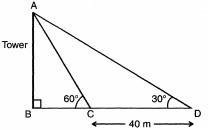
In {tex}\triangle A B C,{/tex} {tex}\tan 60 ^ { \circ } = \frac { A B } { B C }{/tex}
{tex}\Rightarrow \quad A B = \sqrt { 3 } B C{/tex} .....(i)
In {tex}\triangle A B D,{/tex}
{tex}\tan 30 ^ { \circ } = \frac { A B } { B C + 40 }{/tex}
{tex}\frac{ 1}{√3}=\frac{AB}{BC+40}=\frac{√3BC}{BC+40}{/tex}
3BC = BC + 40
BC = 20, Hence from (i) we get
AB = 20√3 = 20 {tex}\times{/tex} 1.73 = 34.6 meter
Posted by Richa Yadav 6 years, 10 months ago
- 1 answers
Sia ? 6 years, 10 months ago
A graph of p(x) cut y-axis
∴ At y-axis x = 0
∴ p(0) = a(0)2 + b(0) + c
= 0 + 0 + c
= c
{tex}\Rightarrow\ p(0)=c{/tex}
Now
If p(x) cut y-axis in positive direction
∴ p(0) > 0 so that c>0.
Therefore, c is positive
Posted by Diya Tripathi 7 years, 3 months ago
- 1 answers
Richa Yadav 7 years, 3 months ago
Posted by Eshwar Mohan 7 years, 3 months ago
- 2 answers
Aradhana Singh 7 years, 3 months ago
Posted by Arjun Singh 6 years, 10 months ago
- 1 answers
Sia ? 6 years, 10 months ago
Suppose x and y be two cars starting from points A and B respectively.
Let the speed of the car X be x km/hr and that of the car Y be y km/hr.
Case I: When two cars move in the same directions:
Suppose two cars meet at point Q, then,
Distance travelled by car X = {tex}AQ{/tex}
Distance travelled by car Y = {tex}BQ{/tex}
Distance travelled by car X in 8 hours = 8x km.
{tex}AQ = 8x{/tex}
Distance travelled by car Yin 8 hours = 8y km.
{tex}BQ = 8y{/tex}
Clearly {tex}AQ - BQ = AB{/tex}
{tex}8x - 8y = 80{/tex}
{tex}\Rightarrow {/tex} {tex}x - y = 10{/tex} ...(i)
Case II: When two cars move in opposite direction
Suppose two cars meet at point P, then,
Distance travelled by X car X = AP
Distance travelled by Y car Y = BP
we can write it as 1 hour = {tex}\frac{{20}}{{60}}{/tex}hours.
Therefore, Distance travelled by a car Y in {tex}\frac{4}{3}{/tex}hrs = {tex}\frac{4}{3}{/tex}x km.
AP + BP = AB
{tex}\frac{4}{3}x{/tex} km + {tex}\frac{4}{3} y{/tex} km = 80
{tex}\frac{4}{3}{/tex}{tex}(x + y) = 80{/tex}
{tex}( x + y ) = 80{/tex} × {tex}\frac{3}{4}{/tex}
{tex}x + y = 60{/tex} ...(ii)
By solving equations (i) and (ii), we get, {tex}x = 35.{/tex}
By substituting x = 35 in equation (ii), we get
{tex}x + y = 60{/tex}
{tex}35 + y = 60{/tex}
{tex}y = 60 - 35{/tex}
{tex}y = 25.{/tex}
Hence, speed of car X {tex}= 35\ km/hr.{/tex}
Speed of car Y ={tex} 25\ km/hr.{/tex}
Posted by Uttam Khora 7 years, 3 months ago
- 2 answers
Chētnà Pandey✌️ 7 years, 3 months ago
Posted by Shreya Sharma 7 years, 3 months ago
- 2 answers
Chirag Saini 7 years, 3 months ago
Yogita Ingle 7 years, 3 months ago
Perimeter means distance around a figure or curve. We can only measure perimeter of a closed figure/2 dimensional shape or curve as movement around a closed figure or curve is possible.
Perimeter of a square = sum of all sides = 4 x side
Perimeter of Rectangle = L + L + B + B
Posted by Akash Yadav 7 years, 3 months ago
- 1 answers
Puja Sahoo 7 years, 3 months ago
Posted by Rasmiti Pandey 7 years, 3 months ago
- 0 answers
Posted by Shiv Communication 7 years, 3 months ago
- 0 answers
Posted by Rahul Rathore 7 years, 3 months ago
- 0 answers
Posted by Nithish .P 7 years, 3 months ago
- 1 answers
Posted by Abhinav Yadav 7 years, 3 months ago
- 0 answers
Posted by Navneeth Naidu 7 years, 3 months ago
- 2 answers
Puja Sahoo 7 years, 3 months ago
Yogita Ingle 7 years, 3 months ago
Smallest angle = 120degree
Common difference = 5
A P is 120, 125, 130,……..
The sum of interior angles of a polygon = (n - 2)180
Hence Sum of n terms of an A P = (n - 2)180
n/2 {2.120+(n-1)5} = 180(n-2)
5n 2 - 125n + 720 = 0
n2 -25n + 144 = 0
n = 9 or 16
Hence number of sides can be 9 or 16.
Posted by Padmanabhan Raghavendran 7 years, 3 months ago
- 0 answers
Posted by Maneet Singh 7 years, 3 months ago
- 3 answers
Maneet Singh 7 years, 3 months ago
Posted by Kavya Yadav 7 years, 3 months ago
- 2 answers
Ram Kushwah 7 years, 3 months ago
Let son age =x
So father age=x2
Before one year
x2-1=8*(x-1)
x2-8x+7=0
(x-7)(x-1)=0 , X=7 or 1
son 7 yr father 49 yr
Maneet Singh 7 years, 3 months ago
Posted by Sudhanshu Singh 7 years, 3 months ago
- 1 answers
Yogita Ingle 7 years, 3 months ago
{tex}\;\frac\theta{360\;}\times{/tex}2 πr = 44
Putting r = 42cm, we get= 60°
Now, Area of minor segmen t= Area of minor sector-Area of ∆
Since = 60°, so the triangle formed will be an equilateral ∆
Area of minor segment = Area of minor sector-Area of equilateral ∆
i.e. Area of minor segment = {tex}\;\frac\theta{360\;}\times\mathrm{πr}^2\;-\;\frac{\sqrt3}4\mathrm a^{{}^2}{/tex}
Posted by Rajat Kalyan 7 years, 3 months ago
- 1 answers
Sudhanshu Singh 7 years, 3 months ago
Posted by Ebi Boaz 7 years, 3 months ago
- 1 answers
Chētnà Pandey✌️ 7 years, 3 months ago
Posted by Rajat Kalyan 6 years, 9 months ago
- 1 answers
Sia ? 6 years, 9 months ago
(-4) + (-1) + 2 + 5 + ---- + x = 437.
Now,
-1 - (-4) = -1 + 4 = 3
2 - (-1) = 2 + 1 = 3
5 - 2 = 3
Thus, this forms an A.P. with a = -4, d = 3,l = x
Let their be n terms in this A.P.
Then,
Sn = {tex}\frac { n } { 2 } [ 2 a + ( n - 1 ) d ] {/tex}
{tex}\Rightarrow 437 = \frac { n } { 2 } [ 2 \times ( - 4 ) + ( n - 1 ) \times 3 ]{/tex}
{tex}\Rightarrow{/tex} 874 = n[-8 + 3n - 3]
{tex}\Rightarrow{/tex}874 = n[3n - 11]
{tex}\Rightarrow{/tex}874 = 3n2 - 11n
{tex}\Rightarrow{/tex}3n2 - 11n - 874 = 0
{tex}\Rightarrow{/tex}3n2 - 57n + 46n - 874 = 0
{tex}\Rightarrow{/tex}3n(n - 19) + 46(n - 19) = 0
{tex}\Rightarrow{/tex}3n + 46 = 0 or n = 19
{tex}\Rightarrow n = - \frac { 46 } { 3 }{/tex} or n = 19
Numbers of terms cannot be negative or fraction.
{tex}\Rightarrow{/tex} n = 19
Now, Sn = {tex}\frac { n } { 2 } [ a + l ]{/tex}
{tex}\Rightarrow 437 = \frac { 19 } { 2 } [ - 4 + x ]{/tex}
{tex}\Rightarrow - 4 + x = \frac { 437 \times 2 } { 19 }{/tex}
{tex}\Rightarrow - 4 + x = 46{/tex}
{tex}\Rightarrow x = 50{/tex}
Posted by Vijay Singh 7 years, 3 months ago
- 1 answers
Gaurav Seth 7 years, 3 months ago
Secants And Tangents
A secant is a line that intersects the circle in two different points and a tangent is a line that intersects the circle in exactly one point, called the point of tangency. Secant and tangent theorems can be used to find congruency, similarity, and special length relationships between the two. One important theorem about secants and tangents states that the measure of an angle formed by two secants, a secant and a tangent, or two tangents intersecting in the interior of a circle is equal to one-half the difference of the measures of the intercepted arcs; that is,  .
.

Posted by Manoj Kumar 7 years, 3 months ago
- 0 answers
Posted by Prashant Mitraov 6 years, 9 months ago
- 1 answers
Sia ? 6 years, 9 months ago
Let ABC be the right triangle right angled at A
whose sides AB and AC measure 3 cm
and 4 cm respectively,
{tex}\therefore \text { hypotenuse } \mathrm { BC } = \sqrt { 3 ^ { 2 } + 4 ^ { 2 } } = 5 \mathrm { cm }{/tex}
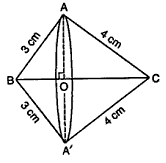
Let AO (A'O) is the radius of the common base of the double cone formed by revolving the triangle around BC.
Now, the area of {tex}\triangle A B C = \frac { 1 } { 2 } \times 4 \times 3 = \frac { 1 } { 2 } \times B C \times A O{/tex}
{tex}\Rightarrow 6 = A 0 \times \frac { 5 } { 2 } \Rightarrow A O = \frac { 12 } { 5 } = 2.4 \mathrm { cm }{/tex}
Now, the volume of the double cone
{tex}= \frac { 1 } { 3 } \times \pi \times \mathrm { AO } ^ { 2 } \times \mathrm { BO } + \frac { 1 } { 3 } \times \pi \times \mathrm { A } \mathrm { O } ^ { 2 } \times \mathrm { CO }{/tex}
{tex}= \frac { 1 } { 3 } \pi \times A O ^ { 2 } \times ( B O + C O ){/tex}
{tex}= \frac { 1 } { 3 } \times \pi \times \mathrm { AO } ^ { 2 } \times \mathrm { BC } [ \because \mathrm { BO } + \mathrm { CO } = \mathrm { BC } ]{/tex}
{tex}= \frac { 1 } { 3 } \times \frac { 22 } { 7 } \times 2.4 \times 2.4 \times 5 = 30.17 \mathrm { cm } ^ { 3 }{/tex}
The surface area of the double cone = {tex}\pi \times A O \times A B + \pi \times A O \times A C{/tex}
{tex}= \pi \times A O [ A B + A C ]{/tex}
{tex}= \frac { 22 } { 7 } \times 2.4 \times ( 3 + 4 ) = 22 \times 2.4 = 52.8 \mathrm { cm } ^ { 2 }{/tex}

myCBSEguide
Trusted by 1 Crore+ Students

Test Generator
Create papers online. It's FREE.

CUET Mock Tests
75,000+ questions to practice only on myCBSEguide app

Aradhana Singh 7 years, 3 months ago
0Thank You