
Ask questions which are clear, concise and easy to understand.
Ask QuestionPosted by The One 7 years, 2 months ago
- 1 answers
Posted by Riya ? 7 years, 2 months ago
- 7 answers
Akarsh Singh 7 years, 2 months ago
Riya ? 7 years, 2 months ago
Posted by Md Sarfaraz 6 years, 9 months ago
- 1 answers
Sia ? 6 years, 9 months ago
Let a be the first term and d be the common difference
pth term = a +(p - 1)d = q(given)-----(1)
qth term = a +(q - 1) d = p(given)-----(2)
subtracting (2) from (1)
(p-q)d=q-p
(p-q)d=-(p-q)
{tex}\therefore{/tex} d = -1
putting d=-1 in (i)
a - (p - 1) = q
{tex}\therefore{/tex} a=p+q-1
{tex}\therefore{/tex} (p + q)th term = a + (p + q - 1)d
= (p + q - 1) - (p + q - 1) = 0
Posted by Jasline S.? 7 years, 2 months ago
- 1 answers
Posted by Satyanand Kumar 7 years, 2 months ago
- 2 answers
Akarsh Singh 7 years, 2 months ago
. . 7 years, 2 months ago
Posted by Abhishek Pathak 7 years, 2 months ago
- 3 answers
. . 7 years, 2 months ago
Posted by Livank Sharma 6 years, 7 months ago
- 1 answers
Posted by @Jay Bunkar 7 years, 2 months ago
- 0 answers
Posted by Abhishek Kumar Singh 7 years, 2 months ago
- 2 answers
Posted by Rdx Trox 7 years, 2 months ago
- 5 answers
Posted by Sheikh Yasar 7 years, 2 months ago
- 0 answers
Posted by Tryambak Mishra Tryambak 7 years, 2 months ago
- 2 answers
Posted by Ashish Pandey 7 years, 2 months ago
- 5 answers
Posted by Gudia Kumari 7 years, 2 months ago
- 3 answers
Gaurav Seth 7 years, 2 months ago
nth term of an A.P whose starting term is "a" and common difference is "d"
is an = a+(n-1)d
1st term = a 3rd term =a+2d 17th term = a+16d
According to question
a+a+2d+a+16d=216
3a+18d=216
3(a+6d) = 216
a+6d= 216/3
a+6d= 72
Sum of "n" terms in an AP = n(2a+(n-1)d)/2
Sum of thirteen terms = 13(2a+12d)/2
=13(a+6d) = 13*72 = 936
Posted by Kuldeep Malik 7 years, 2 months ago
- 2 answers
Posted by Kuldeep Malik 7 years, 2 months ago
- 0 answers
Posted by ?Apna Time ???? Zala 6 years, 9 months ago
- 1 answers
Sia ? 6 years, 9 months ago
The given system of equations may be written as
{tex}9x -10y + 12 = 0{/tex} ...(i)
{tex}2x + 3y - 13 = 0{/tex}.... (ii)
From (ii), we get {tex} y = \frac { 13 - 2 x } { 3 }{/tex}
Substituting {tex} y = \frac { 13 - 2 x } { 3 }{/tex} in (i), we get
{tex} 9 x - \frac { 10 ( 13 - 2 x ) } { 3 } + 12 = 0{/tex}
{tex} \Rightarrow{/tex} {tex}27x - 10(13 - 2x) + 36 = 0{/tex}
{tex} \Rightarrow{/tex} {tex}27x -130 + 20x + 36 = 0{/tex}
{tex} \Rightarrow{/tex} {tex}47x - 94 = 0{/tex}
{tex} \Rightarrow{/tex} {tex}47x = 94{/tex}
{tex} \Rightarrow x = \frac { 94 } { 47 } = 2{/tex}
Substituting {tex}x = 2{/tex} in (i), we get
9 {tex} \times{/tex} 2 - 10y + 12 = 0
{tex} \Rightarrow 10 y = 30 {/tex}
{tex}\Rightarrow y = \frac { 30 } { 10 } = 3{/tex}
Hence, x = 2 and y = 3 is the required solution.
Posted by Aditi Phadke 7 years, 2 months ago
- 2 answers
Posted by Akshat Agarwal 6 years, 9 months ago
- 1 answers
Sia ? 6 years, 9 months ago
Given,
AB is the diameter of the circle
{tex}\angle C O B = \theta{/tex}
According to question
Area of minor segment cut off by AC = 2 {tex}\times{/tex} Area of sector BOC
{tex}\Rightarrow \quad \frac { \angle A O C } { 360 ^ { \circ } } \times \pi r ^ { 2 } - \frac { 1 } { 2 } r ^ { 2 } \sin \angle A O C = 2 \times \frac { \theta } { 360 ^ { \circ } } \times \pi r ^ { 2 }{/tex}
{tex}\Rightarrow \quad \frac { 180 - \theta } { 360 ^ { \circ } } \times \pi r ^ { 2 } - \frac { 1 } { 2 } r ^ { 2 } \sin ( 180 - \theta ) = 2 \times \frac { \theta } { 360 ^ { \circ } } \pi r ^ { 2 }{/tex}
{tex}\Rightarrow \quad \frac { 180 - \theta } { 360 ^ { \circ } } \times \pi r ^ { 2 } - 2 \times \frac { \theta } { 360 ^ { \circ } } \pi r ^ { 2 } = \frac { 1 } { 2 } r ^ { 2 } \sin \theta{/tex}
{tex}\Rightarrow \quad \pi r ^ { 2 } \left[ \frac { 180 - \theta } { 360 ^ { \circ } } - \frac { 2 \theta } { 360 ^ { \circ } } \right] = \frac { 1 } { 2 } r ^ { 2 } \sin \theta{/tex}
{tex}\Rightarrow \quad \pi r ^ { 2 } \left[ \frac { 180 - \theta - 2 \theta } { 360 ^ { \circ } } \right] = \frac { 1 } { 2 } r ^ { 2 } \sin \theta{/tex}
{tex}\Rightarrow \quad \pi \left[ \frac { 180 - 3 \theta } { 360 ^ { \circ } } \right] = \frac { 1 } { 2 } \sin \theta{/tex} [Cancel r2 from both side]
{tex}\Rightarrow \quad \pi \left[ \frac { 180 } { 360 ^ { \circ } } - \frac { 3 \theta } { 360 ^ { \circ } } \right] = \frac { 1 } { 2 } \times 2 \sin \frac { \theta } { 2 } \cdot \cos \frac { \theta } { 2 }{/tex} [We know that {tex}\sin 2 \theta = 2 \sin \theta \cos \theta{/tex}]
{tex}\Rightarrow \quad \pi \left[ \frac { 1 } { 2 } - \frac { \theta } { 120 ^ { \circ } } \right] = \sin \frac { \theta } { 2 } \cdot \cos \frac { \theta } { 2 }{/tex} Hence Proved
Posted by Simran Raj 7 years, 2 months ago
- 5 answers
Vidhi Lalwani? 7 years, 2 months ago
Simran Raj 7 years, 2 months ago
Posted by Gurjot Kaur 7 years, 2 months ago
- 0 answers
Posted by Jogendra Jogendra Pochanpuriya 7 years, 2 months ago
- 1 answers
Posted by Ragini Jha? 7 years, 2 months ago
- 1 answers
Posted by Tushar Aggarwal 6 years, 8 months ago
- 1 answers
Sia ? 6 years, 8 months ago
According to the question,
L.H.S. = {tex}\frac { \sec \theta + \tan \theta - 1 } { \tan \theta - \sec \theta + 1 }{/tex}
{tex}= \frac { ( \sec \theta + \tan \theta ) - \left( \sec ^ { 2 } \theta - \tan ^ { 2 } \theta \right) } { ( \tan \theta - \sec \theta + 1 ) }{/tex} [{tex}\because{/tex} sec2{tex}\theta{/tex} - tan2{tex}\theta{/tex} = 1]
{tex}= \frac { ( \sec \theta + \tan \theta ) [ 1 - ( \sec \theta - \tan \theta ) ] } { ( \tan \theta - \sec \theta + 1 ) }{/tex}
{tex}= \frac { ( \sec \theta + \tan \theta ) ( \tan \theta - \sec \theta + 1 ) } { ( \tan \theta - \sec \theta + 1 ) } = ( \sec \theta + \tan \theta ){/tex}
{tex}= \left( \frac { 1 } { \cos \theta } + \frac { \sin \theta } { \cos \theta } \right) = \frac { ( 1 + \sin \theta ) } { \cos \theta } = \frac { ( 1 + \sin \theta ) } { \cos \theta } \times \frac { ( 1 - \sin \theta ) } { ( 1 - \sin \theta ) }{/tex}
{tex}= \frac { \left( 1 - \sin ^ { 2 } \theta \right) } { \cos \theta ( 1 - \sin \theta ) } = \frac { \cos ^ { 2 } \theta } { \cos \theta ( 1 - \sin \theta ) } = \frac { \cos \theta } { ( 1 - \sin \theta ) }{/tex} = R.H.S.
{tex}\therefore{/tex} {tex}\frac { \sec \theta + \tan \theta - 1 } { \tan \theta - \sec \theta + 1 } = \frac { \cos \theta } { ( 1 - \sin \theta ) }{/tex}
Posted by Saurabh Kumar 5 years, 11 months ago
- 1 answers
Sia ? 6 years, 9 months ago
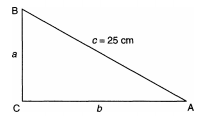
Here, a + b + c = 60, c = 25
a + b = 6 0 - c
a + b = 6 0 - 2 5 = 35
Using Pythagoras theorem|
{tex}a ^ { 2 } + b ^ { 2 } = 625{/tex}
Using identity {tex}( a + b ) ^ { 2 } = a ^ { 2 } + b ^ { 2 } + 2 a b{/tex}
{tex}35 ^ { 2 } = 625 + 2 a b{/tex}
1225 - 625 = 2ab
or, ab = 300
Hence, Area of {tex}\triangle A B C = \frac { 1 } { 2 } a b = 150 \mathrm { cm } ^ { 2 }{/tex}
Posted by Veena Katti 6 years, 9 months ago
- 1 answers
Sia ? 6 years, 9 months ago
By the question,Water is flowing at the rate of 15 km/hr through a cylindrical pipe of diameter 14 cm into a cuboidal pond which is 50 m long and 44 m wide
Speed of water flowing through the pipe
{tex}= 15 \mathrm { km } / \mathrm { hr } = 15000 \mathrm { m } / \mathrm { hr }{/tex}
Volume of water flowing in 1 hr
{tex}= \pi R ^ { 2 } H{/tex}
{tex}= \frac { 22 } { 7 } \times \frac { 7 } { 100 } \times \frac { 7 } { 100 } \times 15000 \mathrm { m } ^ { 3 }{/tex}
{tex}= 231 \mathrm { m } ^ { 3 }{/tex}
Volume of water in the tank when the depth is 21 cm
{tex}= l b h = 50 \times 44 \times \frac { 21 } { 100 } \mathrm { m } ^ { 3 }{/tex}
{tex}= 462 \mathrm { m } ^ { 3 }{/tex}
{tex}\therefore{/tex} Time taken to fill {tex}462 \mathrm { m } ^ { 3 }{/tex}
{tex}= \frac { 462 } { 231 } = 2 \mathrm { hrs }{/tex}

myCBSEguide
Trusted by 1 Crore+ Students

Test Generator
Create papers online. It's FREE.

CUET Mock Tests
75,000+ questions to practice only on myCBSEguide app

Gaurav Seth 7 years, 2 months ago
Given ,
{tex}{\frac{2\sqrt{45}+3\sqrt{20}}{2\sqrt{5}}} \\\\={\frac{2\sqrt{3\times3\times5}+3\sqrt{2\times2\times5}}{2\sqrt{5}}}\\\\={\frac{2.3\sqrt{5}+3.2\sqrt{5}}{2\sqrt{5}}}\\\\={\frac{12\sqrt{5}}{2\sqrt{5}}}=6{/tex}
Here you can see after simplifying we get 6 , according to definition of rational number [ a number , is in the form of P/Q, Q≠ 0 and P , Q ∈ I ] given number is rational number .
0Thank You