
Ask questions which are clear, concise and easy to understand.
Ask QuestionPosted by Alok Kumar 7 years, 2 months ago
- 3 answers
Posted by Shreshtha Tyagi 6 years, 9 months ago
- 1 answers
Sia ? 6 years, 9 months ago
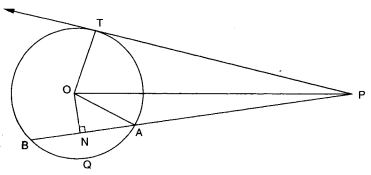
- PA .PB = (PN - AN)(PN + BN)
= (PN - AN) (PN + AN) {tex}\left[ \begin{array} { c } { \because O N \perp A B } \\ { \therefore N \text { is the mid-point of } A B } \\ { \Rightarrow A N = B N } \end{array} \right]{/tex}
= PN2 - AN2 - Applying Pythagoras theorem in right triangle PNO, we obtain
OP2 = ON2 + PN2
{tex}\Rightarrow{/tex}PN2 = OP2 - ON2
{tex}\therefore{/tex} PN2 - AN2 = (OP2 - ON2) - AN2
= OP2 - (ON2 + AN2)
= Op2 _ OA 2 [Using Pythagoras theorem in {tex}\Delta O N A{/tex}]
= OP2 - OT2 {tex}[ \because O A = O T = \text { radius } ]{/tex} - From (i) and (ii), we obtain
PA.PB = PN2 - AN2 and PN2 - AN2 = OP2 - OT2
{tex}\Rightarrow{/tex} PA .PB = OP2 - OT2
Applying Pythagoras theorem in {tex}\triangle O T P{/tex}, we obtain
OP2 = OT2 + PT2
{tex}\Rightarrow{/tex} OP2 - OT2 = PT2
Thus, we obtain
PA.PB = OP2 - OT2
and OP2 - OT2 = PT2
Hence, PA.PB = PT2.
Posted by Mirjan Mandal 7 years, 2 months ago
- 0 answers
Posted by Vineet Rathore 7 years, 2 months ago
- 1 answers
Posted by Mohit Kumar 7 years, 2 months ago
- 1 answers
Sujatha Sujatha 7 years, 2 months ago
Posted by Anirudh Karanth 7 years, 2 months ago
- 4 answers
Posted by Aditi Sagar 6 years, 9 months ago
- 1 answers
Sia ? 6 years, 9 months ago
- PA .PB = (PN - AN)(PN + BN)
= (PN - AN) (PN + AN) {tex}\left[ \begin{array} { c } { \because O N \perp A B } \\ { \therefore N \text { is the mid-point of } A B } \\ { \Rightarrow A N = B N } \end{array} \right]{/tex}
= PN2 - AN2 - Applying Pythagoras theorem in right triangle PNO, we obtain
OP2 = ON2 + PN2
{tex}\Rightarrow{/tex}PN2 = OP2 - ON2
{tex}\therefore{/tex} PN2 - AN2 = (OP2 - ON2) - AN2
= OP2 - (ON2 + AN2)
= Op2 _ OA 2 [Using Pythagoras theorem in {tex}\Delta O N A{/tex}]
= OP2 - OT2 {tex}[ \because O A = O T = \text { radius } ]{/tex} - From (i) and (ii), we obtain
PA.PB = PN2 - AN2 and PN2 - AN2 = OP2 - OT2
{tex}\Rightarrow{/tex} PA .PB = OP2 - OT2
Applying Pythagoras theorem in {tex}\triangle O T P{/tex}, we obtain
OP2 = OT2 + PT2
{tex}\Rightarrow{/tex} OP2 - OT2 = PT2
Thus, we obtain
PA.PB = OP2 - OT2
and OP2 - OT2 = PT2
Hence, PA.PB = PT2.
Posted by Ramakant??? 8306360538 7 years, 2 months ago
- 0 answers
Posted by Akash Kumar 7 years, 2 months ago
- 2 answers
Posted by Labib Ansari 7 years, 2 months ago
- 1 answers
Posted by Aditi Sagar 6 years, 9 months ago
- 1 answers
Sia ? 6 years, 9 months ago
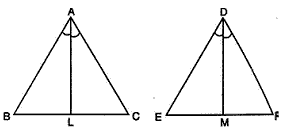
Given: Two triangles ABC and DEF in which {tex}\angle{/tex} A = {tex}\angle{/tex}D, {tex}\angle{/tex}B = {tex}\angle{/tex}E and {tex}\angle{/tex}C = {tex}\angle{/tex}F, AL and DM are angle bisectors of {tex}\angle{/tex}A
and {tex}\angle{/tex}D respectively
To prove: {tex}\frac{{BC}}{{EF}} = \frac{{AL}}{{DM}}{/tex}
Proof: Triangle ABC and DEF are Similar.
{tex}\Rightarrow {/tex} {tex}\frac{{AB}}{{DE}} = \frac{{BC}}{{EF}}{/tex} ......(i)
In {tex}\triangle {/tex} ABL and {tex}\triangle {/tex} DEM, we have
{tex}\angle{/tex}B= {tex}\angle{/tex}E [Given]
{tex}\angle{/tex} BAL= {tex}\angle{/tex} EDM [ {tex}\because {/tex} {tex}\angle{/tex} A= {tex}\angle{/tex} D {tex}\Rightarrow {/tex} {tex}\frac{1}{2}\angle A = \frac{1}{2}\angle D{/tex}]
{tex}\Rightarrow {/tex} {tex}\triangle {/tex} ABL {tex} \sim {/tex} {tex}\triangle {/tex} DEM [AA similarity]
{tex}\Rightarrow {/tex} {tex}\frac{{AB}}{{DE}} = \frac{{AL}}{{DM}}{/tex} .......(ii)
From (i) and (ii) we have
{tex}\frac{{BC}}{{EF}} = \frac{{AL}}{{DM}}{/tex}
Posted by Aditi Sagar 7 years, 2 months ago
- 1 answers
Raj Dhali 7 years, 2 months ago
Posted by Pawan Khatana 7 years, 2 months ago
- 2 answers
ẞì D Hàrth 7 years, 2 months ago
Posted by Mayank Rajput 7 years, 2 months ago
- 0 answers
Posted by ?Garima Sharma? 7 years, 2 months ago
- 1 answers
Posted by Gauri ❤ 7 years, 2 months ago
- 0 answers
Posted by Aman Chamoli 7 years, 2 months ago
- 1 answers
Yogita Ingle 7 years, 2 months ago
According to condition
The perpendicular point on y axis will be (0,2)
Distance between (4,2) and (0,2) = √ (x2 - x1)2 + (y2 - y1)2
= √ (4 -0)2 + (2 - 2)2
= √ 42 + 0
= 4 units
Posted by Chetan Rastogi 7 years, 2 months ago
- 2 answers
Posted by Ninad Joshi 7 years, 2 months ago
- 2 answers
Anushka ??? 7 years, 2 months ago
Ram Kushwah 7 years, 2 months ago
If O(,0,0) is origin A(3,4) is a pint on circumference then
r=OB{ (3-0)2 +(4-0)2 }1/2
r=5
{tex}\begin{array}{l}Area=\mathrm{πr}^2=3.14\times5\times5=78.5\;\mathrm{sq}\;\mathrm{unit}\\\mathrm{circumference}=2\mathrm{πr}=2\times3.14\times5=31.4\\\end{array}{/tex}
Posted by Supriya Sahoo 7 years, 2 months ago
- 1 answers
Ram Kushwah 7 years, 2 months ago
{tex}\begin{array}{l}\frac{(1-\mathrm{tanA})^2}{(1-\mathrm{cotA})^2}=\frac{(1-{\displaystyle\frac{\mathrm{sinA}}{\mathrm{cosA}}})^2}{(1-\frac{\mathrm{cosA}}{\mathrm{sinA}})^2}\\=\frac{{\displaystyle(}\cos{\displaystyle\mathrm A}{\displaystyle-}{\displaystyle\mathrm{sinA}}{\displaystyle{\displaystyle)}^2}}{{\displaystyle\cos^2}{\displaystyle\mathrm A}}\times\frac{{\displaystyle\sin^2}{\displaystyle\mathrm A}}{(\mathrm{sinA}-\mathrm{cosA})^2}=\frac{\sin^2\mathrm A}{{\displaystyle\cos}^2\mathrm A}=\tan^2\mathrm A\\\end{array}{/tex}
Posted by Priya Sharma 7 years, 2 months ago
- 1 answers
Posted by Suman Y 7 years, 2 months ago
- 2 answers
Neha Sirur 7 years, 2 months ago
Posted by Rajesh Chauhan 7 years, 2 months ago
- 2 answers
Neha Sirur 7 years, 2 months ago
Posted by Vikas Yadav 7 years, 2 months ago
- 1 answers
Neha Sirur 7 years, 2 months ago

myCBSEguide
Trusted by 1 Crore+ Students

Test Generator
Create papers online. It's FREE.

CUET Mock Tests
75,000+ questions to practice only on myCBSEguide app

Riya Pal 7 years, 2 months ago
0Thank You