
Ask questions which are clear, concise and easy to understand.
Ask QuestionPosted by Anshika & Aliens???? 7 years, 2 months ago
- 5 answers
Ram Kushwah 7 years, 2 months ago
sec a=5/3
a+b =90 so b=90-a
cosec b =cosec(90-a)=sec a=5/3
Aryan Khare 7 years, 2 months ago
Posted by Anshika & Aliens???? 7 years, 2 months ago
- 5 answers
Anshika & Aliens???? 7 years, 2 months ago
Puja Sahoo? 7 years, 2 months ago
Posted by Puja Sahoo? 6 years, 9 months ago
- 1 answers
Sia ? 6 years, 9 months ago
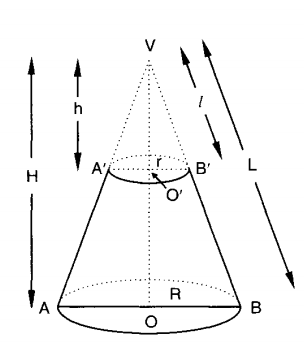
Assume that the ratio of the altitude of the bigger and smaller cone be l : L
Let R and r be the radii of the bigger and smaller cone respectively.
Let H and h be the height of the bigger and smaller cone respectively.
Clearly, {tex}\Delta V O ^ { \prime } A ^ { \prime } \sim \Delta V O A{/tex}
{tex}\therefore \quad \frac { V O ^ { \prime } } { V O } = \frac { O ^ { \prime } A ^ { \prime } } { O A } = \frac { V A ^ { \prime } } { V A } \Rightarrow \frac { h } { H } = \frac { r } { R } = \frac { l } { L }{/tex}
It is given that
Curved surface area of the frustum ABB'A = {tex}\frac { 8 } { 9 } \times{/tex}Curved surface area of the cone
{tex}\Rightarrow \quad \pi ( R + r ) ( L - l ) = \frac { 8 } { 9 } \pi R L{/tex}
{tex}\Rightarrow \quad ( R + r ) ( L - l ) = \frac { 8 } { 9 } R L{/tex}
{tex}\Rightarrow \quad \left( \frac { R + r } { R } \right) \left( \frac { L - l } { L } \right) = \frac { 8 } { 9 }{/tex}
{tex}\Rightarrow \quad \left( 1 + \frac { r } { R } \right) \left( 1 - \frac { l } { L } \right) = \frac { 8 } { 9 }{/tex}
{tex}\Rightarrow \quad \left( 1 + \frac { h } { H } \right) \left( 1 - \frac { h } { H } \right) = \frac { 8 } { 9 }{/tex} [Using (i)]
{tex}\Rightarrow \quad 1 - \frac { h ^ { 2 } } { H ^ { 2 } } = \frac { 8 } { 9 }{/tex}
{tex}\Rightarrow \quad \frac { h ^ { 2 } } { H ^ { 2 } } = 1 - \frac { 8 } { 9 }{/tex}
{tex}\Rightarrow \quad \frac { h ^ { 2 } } { H ^ { 2 } } = \frac { 1 } { 9 } \Rightarrow \frac { h } { H } = \frac { 1 } { 3 } \Rightarrow h = \frac { H } { 3 }{/tex}
Hence, required ratio = {tex}\frac { h } { H - h } = \frac { \frac { H } { 3 } } { H - \frac { H } { 3 } } = \frac { 1 } { 2 }{/tex}
Posted by Sahil Patel 7 years, 2 months ago
- 1 answers
Naitik Tayal 7 years, 2 months ago
Posted by Golu Yadav 7 years, 2 months ago
- 1 answers
Shivam Tripathi 7 years, 2 months ago
Posted by Banu M 7 years, 2 months ago
- 4 answers
Posted by Aditya Agrawal 7 years, 2 months ago
- 3 answers
Yogita Ingle 7 years, 2 months ago
2x2 + 4x + 2 = 0
2x2 + 2x + 2x + 2 = 0
2x(x + 1) + 2 (x + 1) = 0
(2x + 2 )(x + 1)= 0
2x + 2 = 0 or x + 1 = 0
2x = - 2 or x = -1
x = -1
Posted by Pushpender Yadav 7 years, 2 months ago
- 0 answers
Posted by Mohd Azhar 7 years, 2 months ago
- 1 answers
Posted by Upendra Kumar 7 years, 2 months ago
- 1 answers
Gaurav Seth 7 years, 2 months ago
Sol: The circle touches the sides BC, CA, AB of the right triangle ABC at D, E and F respectively.
Assume BC = a, CA = b and AB = c
Then AE = AF and BD = BF, CE = CD .
OE = OD = OF = r.
Here OEDC is a square then CE = CD = r.i.e., b – r = AF, a – r = BF or AB = c = AF + BF = b – r + a – r
∴ r = (a + b - c )/2
Posted by Nirmal Mishra 7 years, 2 months ago
- 2 answers
Posted by Mariya Robin 7 years, 2 months ago
- 0 answers
Posted by V Alagesan 7 years, 2 months ago
- 1 answers
Prince Kumar Gupta 7 years, 2 months ago
Posted by Gurman Singh Khanuja 7 years, 2 months ago
- 0 answers
Posted by Avi Pathak 6 years, 9 months ago
- 1 answers
Sia ? 6 years, 9 months ago
Given,
{tex}sec\ \theta+ tan\ \theta = p{/tex} ...(i)
Also, we know that,
{tex}sec^2 \theta - tan^2 \theta = 1{/tex}
{tex}\Rightarrow{/tex} (sec {tex}\theta{/tex} - tan {tex}\theta{/tex}) (sec {tex}\theta{/tex} + tan {tex}\theta{/tex}) = 1 [{tex}\because a^2-b^2=(a+b)(a-b){/tex}]
{tex}\Rightarrow{/tex} (sec {tex}\theta{/tex} - tan {tex}\theta{/tex})p = 1 [using equation (i)]
{tex}\Rightarrow{/tex} sec {tex}\theta{/tex} - tan {tex}\theta{/tex} {tex}=\frac{1}{p}{/tex} ...(ii)
(i)+(ii), we get,
{tex}sec\theta + tan\theta+ sec\theta - tan\theta = p+ \frac{1}{p}{/tex}
{tex}\Rightarrow 2sec\theta = \frac{p^2+1}{p}{/tex}
{tex}\Rightarrow sec\theta = \frac{p^2+1}{2p}{/tex}
{tex}\Rightarrow \frac{1}{cos\theta} =\frac{p^2+1}{2p}{/tex}
{tex}\Rightarrow cos\theta =\frac{2p}{p^2+1}{/tex}------(iii)
Now, we know that,
{tex}sin\theta = \sqrt( 1- cos^2\theta) {/tex}
put the value of {tex}cos\theta{/tex} from eq. (iii), we get,
{tex}sin\theta = \sqrt(1-(\frac{2p}{p^2+1})^2){/tex}
{tex}\Rightarrow sin\theta = \sqrt(1-\frac{4p^2}{(p^2+1)^2}){/tex}
{tex}\Rightarrow sin\theta = \sqrt(\frac{(p^2+1)^2-4p^2}{(p^2+1)^2}){/tex}
{tex}\Rightarrow sin\theta = \sqrt(\frac{p^4+1+2p^2-4p^2}{(p^2+1)^2}){/tex}
{tex}\Rightarrow sin\theta = \sqrt(\frac{p^4+1-2p^2}{(p^2+1)^2}){/tex}
{tex}\Rightarrow sin\theta = \sqrt(\frac{(p^2-1)^2}{(p^2+1)^2}){/tex}
{tex}\Rightarrow sin\theta = \frac{p^2-1}{p^2+1}{/tex}
{tex}cosec\theta = \frac{p^2+1}{p^2-1} [\because cosec\theta =\frac{1}{sin\theta}]{/tex}
hence, {tex}cosec\ \theta{/tex} {tex}=\frac{1+p^{2}}{1-p^{2}}{/tex}
Posted by Sushmita Kaushik 7 years, 2 months ago
- 4 answers
Puja Sahoo? 7 years, 2 months ago
Sushmita Kaushik 7 years, 2 months ago
Posted by Sant Kumar 7 years, 2 months ago
- 4 answers
Posted by Kamal Gupta 7 years, 2 months ago
- 1 answers
Abhik Kumar 7 years, 2 months ago
Posted by Sushmita Kaushik 7 years, 2 months ago
- 4 answers
Neha Sirur 7 years, 2 months ago
Posted by Shobhit Samadhiya 7 years, 2 months ago
- 1 answers
Posted by Lucky Bisht 7 years, 2 months ago
- 1 answers
Abhik Kumar 7 years, 2 months ago
Posted by Jai Singh 7 years, 2 months ago
- 0 answers
Posted by Chirag Khandelwal 7 years, 2 months ago
- 1 answers
Abhik Kumar 7 years, 2 months ago
Posted by Riya Thapa 7 years, 2 months ago
- 4 answers
Rashina Asharaf 7 years, 2 months ago
Poonam Bais 7 years, 2 months ago
Aryan Khare 7 years, 2 months ago

myCBSEguide
Trusted by 1 Crore+ Students

Test Generator
Create papers online. It's FREE.

CUET Mock Tests
75,000+ questions to practice only on myCBSEguide app

Rohit Sahani?? 7 years, 2 months ago
2Thank You