
Ask questions which are clear, concise and easy to understand.
Ask QuestionPosted by Jagjit Grewal 7 years, 2 months ago
- 1 answers
Posted by Spplg Yadav 7 years, 2 months ago
- 1 answers
Bakul Gupta 7 years, 2 months ago
Posted by Utkarsh Singh 7 years, 2 months ago
- 1 answers
Posted by Bhavishya Kumar 7 years, 2 months ago
- 1 answers
Shivam Tripathi 7 years, 2 months ago
Posted by Keerthi Manjunath 6 years, 7 months ago
- 1 answers
Sia ? 6 years, 7 months ago
For the first AP,
Let first term=a1
common difference=d1
using formula:
{tex}\Longrightarrow \mathrm { S } _ { \mathrm { n } } = \frac { \mathrm { n } } { 2 } [ 2 \mathrm { a } + ( \mathrm { n } - 1 ) \mathrm { d } ]{/tex}
{tex}\Longrightarrow \left( \mathrm { S } _ { \mathrm { n } } \right) _ { 1 } = \frac { \mathrm { n } } { 2 } \left[ 2 \mathrm { a } _ { 1 } + ( \mathrm { n } - 1 ) \mathrm { d } _ { 1 } \right]{/tex}
For 2nd AP.
Given,
{tex}\Rightarrow{/tex}No. of terms=n
Let,
{tex}\Rightarrow{/tex}first term=a2
{tex}\Rightarrow{/tex}common difference=d2
Using formula:
{tex}\Longrightarrow \mathrm { S } _ { \mathrm { n } } = \frac { \mathrm { n } } { 2 } [ 2 \mathrm { a } + ( \mathrm { n } - 1 ) \mathrm { d } ]{/tex}
{tex}\Longrightarrow \left( \mathrm { S } _ { \mathrm { n } } \right) _ { 2 } = \frac { \mathrm { n } } { 2 } \left[ 2 \mathrm { a } _ { 2 } + ( \mathrm { n } - 1 ) \mathrm { d } _ { 2 } \right]{/tex}
According to question :
{tex}\Longrightarrow \frac { \left( \mathrm { S } _ { \mathrm { n } } \right) _ { 1 } } { \left( \mathrm { S } _ { \mathrm { n } } \right) _ { 2 } } = \frac { 3 \mathrm { n } + 8 } { 7 \mathrm { n } + 15 }{/tex}
{tex}\Rightarrow{/tex}{tex}\frac { \frac { n } { 2 } \left[ 2 a _ { 1 } + ( n - 1 ) d _ { 1 } \right] } { \frac { n } { 2 } \left[ 2 a _ { 2 } + ( n - 1 ) d _ { 2 } \right] } = \frac { 3 n + 8 } { 7 n + 15 }{/tex}
Substitute n=23:
{tex}\Longrightarrow \frac { 2 a _ { 1 } + ( 23 - 1 ) d _ { 1 } } { 2 a _ { 2 } + ( 23 - 1 ) d _ { 2 } } = \frac { 3 \times 23 + 8 } { 7 \times 23 + 15 }{/tex}
{tex}\Longrightarrow \frac { 2 \mathrm { a } _ { 1 } + 22 \mathrm { d } _ { 1 } } { 2 \mathrm { a } _ { 2 } + 22 \mathrm { d } _ { 2 } } = \frac { 69 + 8 } { 161 + 15 }{/tex}
{tex}\Longrightarrow \frac { 2 \left( a _ { 1 } + 11 d _ { 1 } \right) } { 2 \left( a _ { 2 } + 11 d _ { 2 } \right) } = \frac { 77 } { 176 }{/tex}
{tex}\Longrightarrow \frac { a _ { 1 } + ( 12 - 1 ) d _ { 1 } } { a _ { 2 } + ( 12 - 1 ) d _ { 2 } } = \frac { 7 } { 16 }{/tex}
{tex}\Longrightarrow \frac { \left( T _ { 12 } \right) _ { 1 } } { \left( T _ { 12 } \right) _ { 2 } } = \frac { 7 } { 16 }{/tex}
{tex}\therefore{/tex} (T12)1 : (T12)2=7: 16.
Posted by Sourabh Kumar Kumar 7 years, 2 months ago
- 2 answers
Harshita Thakur 7 years, 2 months ago
Posted by Vivek Joshi 7 years, 2 months ago
- 2 answers
Riya ? 7 years, 2 months ago
Posted by Mansi ??⚘?? 7 years, 2 months ago
- 3 answers
Posted by Saima Yasrib 7 years, 2 months ago
- 3 answers
Posted by Lucifer ? Morningstar? 7 years, 2 months ago
- 3 answers
Lucifer ? Morningstar? 6 years, 3 months ago
Lucifer ? Morningstar? 6 years, 3 months ago
Posted by Sant Vijay 7 years, 2 months ago
- 3 answers
Posted by Spplg Yadav 7 years, 2 months ago
- 4 answers
Neha Sirur 7 years, 2 months ago
Posted by Spplg Yadav 6 years, 7 months ago
- 1 answers
Sia ? 6 years, 7 months ago
Given: Radius of base (r) and height (h) of the conical tank are 7 m and 24 m
⇒ Slant height (l) = r2 + h2
{tex}= \sqrt { r ^ { 2 } + h ^ { 2 } } = \sqrt { 7 ^ { 2 } + 24 ^ { 2 } }{/tex}
{tex}= \sqrt { 625 } = 25 \mathrm { m }{/tex}
C.S.A. {tex}= \pi r l{/tex}
{tex}= \frac { 22 } { 7 } \times 7 \times 25 = 550 \mathrm { m } ^ { 2 }{/tex}
Let x m of cloth is required
CSA of tent = area of cloth.
or, {tex}5 x = 550 \text { or, } x = \frac { 550 } { 5 } = 110 \mathrm { m }{/tex}
{tex}\therefore{/tex} 110 m of cloth is required.
Cost of cloth {tex}= 25 \times 110 = Rs. 2750{/tex}
Posted by Sushant Yadav 7 years, 2 months ago
- 4 answers
Posted by Apurva Shreshth 7 years, 2 months ago
- 3 answers
Posted by Apurva Shreshth 7 years, 2 months ago
- 5 answers
Apurva Shreshth 7 years, 2 months ago
Honey ??? 7 years, 2 months ago
Posted by Apurva Shreshth 7 years, 2 months ago
- 4 answers
Honey ??? 7 years, 2 months ago
Posted by Preet Kotiya 7 years, 2 months ago
- 2 answers
Posted by Shantanu Bhardwaj 7 years, 2 months ago
- 2 answers
Honey ??? 7 years, 2 months ago
Honey ??? 7 years, 2 months ago
Posted by Akashdeep Kaur 6 years, 7 months ago
- 1 answers
Sia ? 6 years, 7 months ago
Given points will be collinear, if area of the triangle formed by them is zero.
Area = {tex}\frac { 1 } { 2 } \left[ x _ { 1 } \left( y _ { 2 } - y _ { 3 } \right) + x _ { 2 } \left( y _ { 3 } - y _ { 1 } \right) + x _ { 3 } \left( y _ { 1 } - y _ { 2 } \right) \right]{/tex}
{tex}\Rightarrow 0 = \frac { 1 } { 2 } {/tex}[(k + 1)(2k + 3 - 5k) + 3k(5k - 2k) + (5k - 1) (2k - 2k - 3)]
{tex}\Rightarrow {/tex} 0 = (k + 1)(3 - 3k) + 3k(3k) +(5k - 1)(-3)
{tex}\Rightarrow {/tex} 0 = 3k - 3k2 + 3 - 3k + 9k2 - 15k + 3
{tex}\Rightarrow {/tex}0 = 6k2 - 15k + 6
{tex}\Rightarrow {/tex}0 = 2k2 - 5k + 2
{tex}\Rightarrow {/tex}0 = 2k2 - 4k - k + 2
{tex}\Rightarrow {/tex}0 = 2k(k - 2) - 1(k - 2)
{tex}\Rightarrow {/tex}0 = (2k - 1)(k - 2)
{tex}\Rightarrow {/tex}2k - 1 = 0 or k - 2 = 0
{tex}\Rightarrow k = \frac { 1 } { 2 }{/tex} Or k = 2
Posted by Dhruv Baswal 7 years, 2 months ago
- 1 answers
Bhumika Budhia 7 years, 2 months ago
Posted by Vishal Kumar 7 years, 2 months ago
- 2 answers
Anushka Jugran❣️ 7 years, 2 months ago
Posted by Shivani Yadav 7 years, 2 months ago
- 1 answers
Shashikant ? 7 years, 2 months ago
Posted by Vivek Singh 7 years, 2 months ago
- 2 answers
Shubham Daule 7 years, 2 months ago
Posted by Suraj Kumar 6 years, 7 months ago
- 1 answers
Sia ? 6 years, 7 months ago
Let l1 and l2 be two intersecting lines.
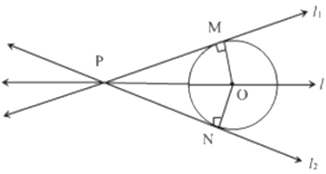
Suppose a circle with centre O touches the lines
l1 and l2 at M and N respectively.
{tex}{/tex} Therefore,OM = ON
{tex}{/tex}Therefore, O is equidistant from l1 and l2.
Consider {tex}\Delta{/tex}OPM and {tex}\Delta{/tex}OPN,
{tex}\angle OMP = \angle ONP{/tex} ....(radius is perpendicular to the tangent)
OP = OP ...(Common side)
OM = ON ...(radii of the same circle)
{tex}\Rightarrow \Delta OPM \cong \Delta OPN{/tex} ...(RHS congruence criterion)
{tex}\Rightarrow \angle MPO = \angle NPO{/tex} ...(CPCT)
{tex}\Rightarrow{/tex} l bisects {tex}\angle MPN{/tex}.
{tex}\Rightarrow{/tex} O lies on the bisector of the angles between
l1 and l2, that is, O lies on l.
Therefore, the centre of the circle touching two intersecting lines lies on the angles bisector of the two lines.
Posted by Suraj Kumar 7 years, 2 months ago
- 1 answers
Posted by Lucifer ? Morningstar? 7 years, 2 months ago
- 1 answers
Ayush Bandhu 7 years, 2 months ago
Posted by Aman Sarve 6 years, 7 months ago
- 1 answers
Sia ? 6 years, 7 months ago
Let the usual speed of the plane b x km/hr.
Distance to the destination = 1500 km
Case (i):
{tex}\text{we know that,} \ Speed = {Distance\over Time} \\ \Rightarrow Time = {Distance\over speed}{/tex}
So, in case(i) Time = {tex}1500 \over x{/tex}Hrs
Case (iI)
Distance to the destination = 1500 km
Increased speed = 100 km/hr
So, speed = x+100
So, in case(ii) Time = {tex}1500 \over {x+100}{/tex}Hrs
So, according to the question
{tex}\therefore{/tex} {tex}\frac{1500}{x}{/tex} - {tex}\frac{1500}{x + 100}{/tex} = {tex}\frac{30}{60}{/tex}
{tex}\Rightarrow{/tex} x2 + 100x - 300000 = 0
{tex}\Rightarrow{/tex} x2 + 600x - 500x - 300000 = 0
{tex}\Rightarrow{/tex} (x + 600)(x - 500) = 0
{tex}\Rightarrow{/tex}x = 500 or x = -600
Since, speed can not be negative, x = 500
Therefore, Speed of plane = 500 km/hr.

myCBSEguide
Trusted by 1 Crore+ Students

Test Generator
Create papers online. It's FREE.

CUET Mock Tests
75,000+ questions to practice only on myCBSEguide app

Jatt Putt Aryan???? 7 years, 2 months ago
1Thank You