
Ask questions which are clear, concise and easy to understand.
Ask QuestionPosted by ????? ❤️ 7 years, 2 months ago
- 3 answers
Zeeshan Younis 7 years, 2 months ago
????? ❤️ 7 years, 2 months ago
Posted by Akash Kumar 6 years, 7 months ago
- 1 answers
Sia ? 6 years, 7 months ago
Let the three numbers in A.P. be {tex}a - d, a, a + d{/tex}.
{tex}3a = 12 {/tex}or, {tex}a = 4{/tex}.
Also, (4 - d)3 + 43 + (4 + d)3 = 288
or, 64 - 48d + 12d2- d3 + 64 + 64 + 48d + 12d2 + d3 = 288
or, 24d2 + 192 = 288
or, 24d2 = 288 - 192
or, 24d2 = 96
or, d2 = 96/24
or, d2 = 4
d ={tex}\pm{/tex}2
The numbers are 2,4, 6, or 6,4,2.
Posted by Sarvendu Singh 7 years, 2 months ago
- 0 answers
Posted by Diksha Aishna 7 years, 2 months ago
- 2 answers
Posted by Mohammed Bilal 7 years, 2 months ago
- 1 answers
Posted by Richa Rana 7 years, 2 months ago
- 1 answers
Posted by Sunny Yadav 5 years, 11 months ago
- 0 answers
Posted by Sarah Wilson 7 years, 2 months ago
- 4 answers
Posted by Apurva Sharma 7 years, 2 months ago
- 3 answers
Jatt Putt Aryan???? 7 years, 2 months ago
Posted by Zeeshan Younis 5 years, 11 months ago
- 1 answers
Posted by Vikash Gujjar 7 years, 2 months ago
- 1 answers
Posted by Chanchal Chauhan 7 years, 2 months ago
- 1 answers
Posted by Aakash Kumar 7 years, 2 months ago
- 0 answers
Posted by Mohd Farhan 6 years, 7 months ago
- 1 answers
Sia ? 6 years, 7 months ago
Let the first term and the common difference of the AP be a and d respectively.
According to the question,
Third term + seventh term = 6
{tex} \Rightarrow {/tex} [a + (3 - 1)d] + [a + (7 - 1)d] = 6 = a + (n - 1)d
{tex} \Rightarrow {/tex} (a + 2d) + (a + 6d) = 6 {tex} \Rightarrow {/tex} 2a + 8d = 6
{tex} \Rightarrow {/tex} a + 4d = 3 ..... (1)
Dividing throughout by 2 &
(third term) (seventh term) = 8
{tex} \Rightarrow {/tex} (a + 2d) (a + 6d) = 8
{tex} \Rightarrow {/tex} (a + 4d - 2d) (a + 4d + 2d) = 8
{tex} \Rightarrow {/tex} (3 - 2d) (3 + 2d) = 8
{tex} \Rightarrow {/tex} 9 - 4d2 = 8
{tex} \Rightarrow 4{d^2} = 1 \Rightarrow {d^2} = \frac{1}{4} \Rightarrow d + \pm \frac{1}{2}{/tex}
Case I, when {tex}d = \frac{1}{2}{/tex}
Then from (1), {tex}a + 4\left( {\frac{1}{2}} \right) = 3{/tex}
{tex} \Rightarrow {/tex} a + 2 = 3 {tex} \Rightarrow {/tex} a = 3 - 2 {tex} \Rightarrow {/tex} a = 1
{tex}\therefore {/tex} Sum of first sixteen terms of the AP = S16
{tex} = \frac{{16}}{2}[2a + (16 - 1)d]{/tex} {tex}\because {S_n} = \frac{n}{2}[2a + (n - 1)d]{/tex}
= 8[2a + 15d]
{tex} = 8[2(1) + 15(\frac{1}{2})]{/tex}
{tex} = 8[12 + \frac{{15}}{2}]{/tex}
{tex} = 8[\frac{{19}}{2}]{/tex}
{tex} = 4 \times 19 = 76{/tex}
Case II. When {tex}d = - \frac{1}{2}{/tex}
Then from (1),
{tex}a + 4\left( { - \frac{1}{2}} \right) = 3{/tex}
{tex} \Rightarrow {/tex} a - 2 = 3 {tex} \Rightarrow {/tex} a = 3 + 2 {tex} \Rightarrow {/tex} a = 5
{tex}\therefore {/tex} Sum of first sixteen terms of the AP = S16
{tex} = \frac{{16}}{2}[2a + (16 - 1)d]{/tex} {tex}\because {S_n} = \frac{n}{2}[2a + (n - 1)d]{/tex}
{tex} = 8[2a + 15d] = 8\left[ {2(5) + 15\left( { - \frac{1}{2}} \right)} \right] = 8\left[ {10 - \frac{{15}}{2}} \right] = 8\left[ {\frac{5}{2}} \right] = 20{/tex}
Posted by Ayushi Singh 7 years, 2 months ago
- 4 answers
Jatin Jaju 7 years, 2 months ago
Abi Shinchan 7 years, 2 months ago
Posted by Deepak Thakur 7 years, 2 months ago
- 1 answers
Posted by Tohid Raza 6 years, 7 months ago
- 1 answers
Sia ? 6 years, 7 months ago
From point O angle of elevation is {tex}\theta{/tex} and from point P it is {tex}\phi{/tex}, OP =240 m.
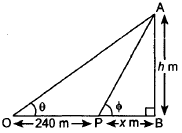
Let PB = x m.
{tex}\tan \theta = \frac { 5 } { 12 } ; \tan \phi = \frac { 3 } { 4 }{/tex}
In right angled {tex}\triangle{/tex}OBA,
{tex}\frac { \mathrm { AB } } { \mathrm { OB } } = \tan \theta{/tex}
{tex}\Rightarrow \frac { h } { 240 + x } = \frac { 5 } { 12 }{/tex} .....(i)
In right-angled {tex}\triangle{/tex}PBA,
{tex}\frac { A B } { P B } = \tan \phi{/tex}
{tex}\Rightarrow \quad \frac { h } { x } = \frac { 3 } { 4 }{/tex} .......(ii)
Dividing (i) by (ii), we get
{tex}\frac { h } { 240 + x } \times \frac { x } { h } = \frac { 5 } { 12 } \times \frac { 4 } { 3 }{/tex}
{tex}\Rightarrow \frac { x } { 240 + x } = \frac { 5 } { 9 } \Rightarrow 9 x = 1200 + 5 x{/tex}
{tex}\Rightarrow \quad 4 x = 1200 \Rightarrow x = 300{/tex}
Putting x= 300 in (ii) we get, {tex}h = \frac { 3 } { 4 } \times 300 = 225 \mathrm { m }{/tex}
Hence, height of lighthouse is 225 metres.
Posted by Ashmit Chauhan 7 years, 2 months ago
- 4 answers
Divya Garg 7 years, 2 months ago
Vansh Sehgal 7 years, 2 months ago
Zeeshan Younis 7 years, 2 months ago
Posted by Tohid Raza 7 years, 2 months ago
- 2 answers
Avinash Saigal 7 years, 2 months ago
Posted by Bhavya Tandon 7 years, 2 months ago
- 1 answers
Vansh Sehgal 7 years, 2 months ago

myCBSEguide
Trusted by 1 Crore+ Students

Test Generator
Create papers online. It's FREE.

CUET Mock Tests
75,000+ questions to practice only on myCBSEguide app

Ashish Roy 7 years, 2 months ago
0Thank You