
Ask questions which are clear, concise and easy to understand.
Ask QuestionPosted by Parneet Mangat 7 years, 2 months ago
- 3 answers
Khushnuda?Khushi ??? 7 years, 2 months ago
Posted by Paulo Dybala 6 years, 7 months ago
- 1 answers
Sia ? 6 years, 7 months ago
Let the middle most terms of the A.P. be {tex}(a - d), a, (a + d){/tex}
Given {tex}a -d + a + a + d = 225{/tex}
{tex}3a = 225{/tex}
or, {tex}a = 75{/tex}
and the middle term = {tex}\frac { 37 + 1 } { 2 }{/tex}= 19th term
{tex}\therefore{/tex} A.P. is
(a - 18d ),....(a - 2d), {a - d), a, (a + d), (a + 2d),..........{tex}(a + 18d){/tex}
Sum of last three terms
{tex}(a + 18d) + (a + 17d) + (a + 16d) = 429{/tex}
or,{tex} 3a +51d = 429{/tex}
or, {tex}225 + 51d = 429 {/tex}
or, d = 4
First term a1 = a - 18d = 75 - 18{tex}\times{/tex}4 = 3
a2 = 3 + 4 = 7
Hence, A.P. = 3, 7, 11 ,.........., 147
Posted by Neha Khan?? 5 years, 11 months ago
- 1 answers
Lakshita Saini 7 years, 2 months ago
Posted by Jaswant Singh Mehmi 7 years, 2 months ago
- 1 answers
Mehakdeep Kaur 7 years, 2 months ago
Posted by Md Suleman Siddiqu 7 years, 2 months ago
- 1 answers
Sunny Chandrawat 7 years, 2 months ago
Posted by Jagjit Grewal 7 years, 2 months ago
- 0 answers
Posted by Indu Bala 7 years, 2 months ago
- 1 answers
Posted by Rohini Sv0 7 years, 2 months ago
- 1 answers
Posted by Rohini Sv0 7 years, 2 months ago
- 4 answers
Posted by Manasvi Jaju 7 years, 2 months ago
- 1 answers
Akhilesh Vardikar 7 years, 2 months ago
Posted by Maisha Singh 7 years, 2 months ago
- 1 answers
Yogita Ingle 7 years, 2 months ago
3x - y = 3........ (i)
9x - 3y = 9
3x - y = 3 .......... (ii)
(i) and (ii) are equal Hence, the given pair of equations has infinite possible solutions and the relation between these variables can be given by y = 3x - 3
Posted by Samarth Jain 6 years, 7 months ago
- 1 answers
Sia ? 6 years, 7 months ago
Given points are A(3k -1, k - 2), B(k, k - 7) and C(k-1, -k - 2)
We know that points A, B, C will be collinear, if the area of the ΔABC =0
Area of ΔABC={tex}\frac{1}{2}{/tex}|x1(y2 - y3)+x2(y3 - y1)+x3(y1 - y2)|
here, x1 =3k-1, x2 = k, x3= k-1, y1= k-2, y2= k-7, y3= -k-2
Area of ΔABC = 0
{tex}\Rightarrow{/tex} {tex}\frac{1}{2}{/tex}|(3k−1)[(k−7)−(−k−2)]+k[(−k−2)−(k−2)]+(k−1)[(k−2)−(k−7)]|=0
{tex}\Rightarrow{/tex} {tex}\frac{1}{2}{/tex}|(3k−1)(k−7+k+2)+k(−k−2−k+2)+(k−1)(k−2−k+7)|=0
{tex}\Rightarrow{/tex} |(3k−1)(2k−5)+k(−2k)+(k−1)(5)|=0
{tex}\Rightarrow{/tex} |3k(2k−5)−1(2k−5)−2k2+5k−5|=0
{tex}\Rightarrow{/tex} |6k2−15 k−2k+5−2k2+5k−5|=0
{tex}\Rightarrow{/tex} |4k2 - 10k - 2k|=0
{tex}\Rightarrow{/tex} 4k2 - 12k = 0
{tex}\Rightarrow{/tex} 4k(k-3) = 0
{tex}\Rightarrow{/tex} k = 0 or k - 3 =0
{tex}\Rightarrow{/tex} k = 0 or k = 3
Posted by Balwinder Grewal 7 years, 2 months ago
- 1 answers
Yogita Ingle 7 years, 2 months ago
If nth term of an A.P = 2n+1
then, first term of A.P = 2(1)+1
= 2+1
= 3
then, second term = 2 (2) + 1 = 4 +1 = 5
third term = 2 (3) +1 = 6+1 = 7
sum of terms = 3+5+7
sum of terms = 15
Posted by Rina Sharma 5 years, 11 months ago
- 1 answers
Posted by Bhavishya Kumar 7 years, 2 months ago
- 2 answers
Yogita Ingle 7 years, 2 months ago
Since, 3 is the least prime factor of 'p' therefore the number 'q' must be odd (because if the number would have been even, then the least prime factor will definitely be '2')
So, p is odd. Similarly , q is also odd.
Hence p + q is even (that is, a multiple of 2)
Thus the least prime factor of 'p + q' is 2.
Posted by Maisha Singh 7 years, 2 months ago
- 2 answers
Yogita Ingle 7 years, 2 months ago
2x + 3y = 9......... (i)
4x + 6y = 18 .... (ii)
On multiplying equation (1) with 2, we get
2(2x + 3y) = 2(9)
⇒ 4x + 6y = 18 .... (iii)
Here, both the equation (ii) and (iii) are same and we know that when both equations are exactly same there are infinitely many solutions and the value of x and y can't be predicted.
Posted by Maisha Singh 7 years, 2 months ago
- 2 answers
Yogita Ingle 7 years, 2 months ago
x + 2y - 4 = 0
x + 2y = 4.......... (i)
2x + 4y - 12 = 0
2x + 4y = 12
x + 2y = 4 ......... (ii)
Here, both the equation (i) and (ii) are same and we know that when both equations are exactly same there are infinitely many solutions and the value of x and y can't be predicted.
Posted by ????? ❤️ 7 years, 2 months ago
- 1 answers
Yogita Ingle 7 years, 2 months ago
Let the 4 numbers are a , a + d , a + 2d , a + 3d.
Sum of 4 numbers AP = 50
a + a + d + a + 2d + a + 3d = 50
⇒ 4a + 6d = 50
⇒ 2a + 3d = 25 --------------(1)
Also given the forth term is four times the first
4(a) = a + 3d
4a - a = 3d
a = d
putting a = d in (1) , we obtain
5d = 25
d = 5
a = 5 but d = a.
∴ First four terms are 5 , 10 ,15 , 20.
Posted by Hema Pandey 7 years, 2 months ago
- 1 answers
Posted by Shivam Gupta 6 years, 7 months ago
- 1 answers
Sia ? 6 years, 7 months ago
Given:
f(x) = (2x4 – 9x3 + 5x2 + 3x – 1)
Zeroes = (2 + √3) and (2 – √3)
Given the zeroes, we can write the factors = (x – 2 + √3) and (x – 2 – √3)
{Since, If x = a is zero of a polynomial f(x), we can say that x - a is a factor of f(x)}
Multiplying these two factors, we can get another factor which is:
((x – 2) + √3)((x – 2) – √3) = (x – 2)2 – (√3)2
⇒x2 + 4 – 4x – 3 = x2 – 4x + 1
So, dividing f(x) with (x2 – 4x + 1)
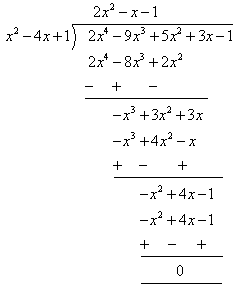
f(x) = (x2 – 4x + 1) (2x2 – x – 1)
Solving (2x2 – x – 1), we get the two remaining roots as
{tex}x = {-b \pm \sqrt{b^2-4ac} \over 2a}{/tex}
where f(x) = ax2 + bx + c = 0(using Quadratic Formula)
{tex}\mathrm{x}=\frac{-(-1) \pm \sqrt{(-1)^{2}-4(2)(-1)}}{2(2)}{/tex}
{tex}\mathrm{x}=\frac{-1 \pm 3}{4}{/tex}
{tex}\Rightarrow \mathrm{x}=1,-\frac{1}{2}{/tex}
Zeros of the polynomial = {tex}1,-\frac{1}{2}, 2+\sqrt{3}, 2-\sqrt{3}{/tex}
Posted by Raushan Verma 7 years, 2 months ago
- 1 answers
Posted by Gajendra Verma 7 years, 2 months ago
- 2 answers
Kuldeep Redhu 7 years, 2 months ago
Posted by Dev Goswami 7 years, 2 months ago
- 0 answers
Posted by Nidhi Sukhija 7 years, 2 months ago
- 1 answers

myCBSEguide
Trusted by 1 Crore+ Students

Test Generator
Create papers online. It's FREE.

CUET Mock Tests
75,000+ questions to practice only on myCBSEguide app

Nimish Jain 7 years, 2 months ago
1Thank You