
Ask questions which are clear, concise and easy to understand.
Ask QuestionPosted by Prabhu Naregal 7 years, 2 months ago
- 0 answers
Posted by Pratima Nath 7 years, 2 months ago
- 4 answers
Somil Modi 7 years, 2 months ago
Yogita Ingle 7 years, 2 months ago
a + 6 (–4) = 4
⇒ a = 28
Detailed Answer :
Given d = – 4 and a7 = 4
We know that nth term of A.P. is
an = a + (n – 1)d
a7 = a + (7 – 1)d [n = 7]
4 = a + 6(– 4)
∴ a = 4 + 24 = 28
∴ First term of an A.P. = 28.
Posted by Arun Patel 7 years, 2 months ago
- 2 answers
Rohit Keshri 7 years, 2 months ago
Posted by Vaitheeswari Eesu 7 years, 2 months ago
- 3 answers
Puja Sahoo? 7 years, 2 months ago
Satendra Singh 7 years, 2 months ago
Posted by Shalu Singh 6 years, 7 months ago
- 1 answers
Sia ? 6 years, 7 months ago
Factors of x2 + 7x + 12 :
x2 + 7x + 12 = 0
{tex}\Rightarrow{/tex} x2 + 4x + 3x + 12 = 0
{tex}\Rightarrow{/tex} x(x + 4) + 3(x + 4) = 0
{tex}\Rightarrow{/tex}(x + 4) (x + 3) = 0
{tex}\Rightarrow{/tex} x = - 4, -3 ...(i)
Since p(x) = x4 + 7x3 + 7x2 + px + q
If p(x) is exactly divisible by x2+ 7x + 12, then x = - 4 and x = - 3 are its zeroes. So putting x = - 4 and x = - 3.
p(- 4) = (- 4)4 + 7(- 4)3 + 7(- 4)2 + p(- 4) + q
but p(- 4) = 0
{tex}\therefore{/tex} 0 = 256 - 448 + 112 - 4p + q
0 = - 4p + q - 80
{tex}\Rightarrow{/tex}4p - q = - 80 ...(i)
and p(-3) = (-3)4 + 7(-3)3 + 7(-3)2 + p(-3) + q
but p(-3) = 0
{tex}\Rightarrow{/tex}0 = 81-189 + 63 - 3p + q
{tex}\Rightarrow{/tex}0 = -3p + q -45
{tex}\Rightarrow{/tex}3p -q = -45 ..........(ii)
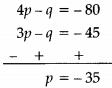
On putting the value of p in eq. (i),we get,
{tex}4(-35) - q = - 80{/tex}
{tex}\Rightarrow{/tex}{tex}-140 - q = - 80{/tex}
{tex}\Rightarrow\ {/tex}{tex}-q = 140 - 80{/tex}
{tex}\Rightarrow\ {/tex} {tex}-q = 60{/tex}
{tex}\therefore{/tex} {tex}q = -60{/tex}
Hence, p = -35, q = -60
Posted by Khushpreet Singh 7 years, 2 months ago
- 1 answers
Posted by Jay Kumar 6 years, 7 months ago
- 1 answers
Sia ? 6 years, 7 months ago
Given: PQR is a triangle right angled at P and M is a point on QR such that PM {tex} \bot {/tex} QR

To prove PM2 = QM.MR
Proof: In right triangle PQR,
QR2 = PQ2 + PR2 (1).............[By Pythagoras theorem]
In right triangle PMQ,
PQ2 = PM2 + MQ2 (2)...........[By Pythagoras theorem]
In right triangle PMR,
PR2 = PM2 + MR2 (3) ............[By Pythagoras theorem]
Using (2) and (3), (1) gives
QR2 = (PM2 + MQ2) + (PM2 + MR2)
{tex}\Rightarrow {/tex} QR2 = 2PM2 + MQ2 + MR2
=(MQ + MR)2 = 2PM2 + MQ2 + MR2
{tex}\Rightarrow {/tex} MQ2 + MR2 + 2MQ.MR
= 2PM2 + MQ2 + MR2
{tex}\Rightarrow {/tex} PM2 = QM.MR
A litre.
In {tex}\triangle {/tex}QMP and {tex}\triangle {/tex}PMR,
{tex}\angle{/tex} QMP= {tex}\angle{/tex} PMR......[Each equal to 90o]
{tex}\angle{/tex}MQP {tex} \sim {/tex} {tex}\angle{/tex}PMR.......AA similarity criterion
{tex}\therefore \frac{{QM}}{{PM}} = \frac{{PM}}{{RM}}{/tex} {tex}\therefore {/tex} corresponding sides of two similar triangles
{tex}\Rightarrow {/tex} PM2 = QM.RM
{tex}\Rightarrow {/tex} QM.MR
Posted by Saloni Gupta 7 years, 2 months ago
- 3 answers
Kajal Singh 7 years, 2 months ago
Posted by Sanjana ? 7 years, 2 months ago
- 1 answers
Anshika / U Can Call Me Alien ???? 7 years, 2 months ago
Posted by ☺️ ? 7 years, 2 months ago
- 1 answers
Posted by Karan Yadav 7 years, 2 months ago
- 1 answers
Yash Kanchan 7 years, 2 months ago
Posted by Bhabani Parida 7 years, 2 months ago
- 2 answers
Shivam Tripathi 7 years, 2 months ago
Posted by Rohan Patel 7 years, 2 months ago
- 3 answers
Madhur Dubey ??? 7 years, 1 month ago
Posted by Nakul Verma 7 years, 2 months ago
- 2 answers
Yogita Ingle 7 years, 2 months ago
sin θ = 3/5
tanθ = 3/4
cosec θ = 1/sinθ = 5/3
Sec θ = 1/cos = 5/4
Cot θ = 1/tan = 4/3
Honey ??? 7 years, 2 months ago
Posted by Md Arbaaz Ansari 7 years, 2 months ago
- 2 answers
Posted by Raja Bhaiya 7 years, 2 months ago
- 2 answers
Anshika / U Can Call Me Alien ???? 7 years, 2 months ago
Posted by Raghav Garg 7 years, 2 months ago
- 2 answers
Anshika / U Can Call Me Alien ???? 7 years, 2 months ago
Posted by Chetna Saini 7 years, 2 months ago
- 3 answers
Diksha Chawla 7 years, 2 months ago
As sin 45 degree is 1/√2 so sin square 45degree is (1/√2)^2= 1/2 and its 4times become 2.......... Eq(1)
Similarly tan sqare 60 become 3 ..... Eq(2)
And cosec square 30 become 2.... Eq (3)
On adding all these equations as required in question
We get
2+3+2 = 7
Posted by Divya Garg 7 years, 2 months ago
- 2 answers
Yogita Ingle 7 years, 2 months ago
The main diagonal of any cube can be found my multiplying the length of one side by the square root of 3.
Diagonal of cube = √ 3 × side
Posted by Sheila Sharma 7 years, 2 months ago
- 1 answers
Gaurav Seth 7 years, 2 months ago
 Given ABC and ADE are equilateral triangles. Let AB=BC=CA = a Recall that the altitude of an equilateral triangle is √3/2 times its side Hence AD = √3a/2ΔABC ~ ΔADE [By AAA similarity criterion]
  [Since ratio of areas of two similar triangles is equal to the ratio of their corresponding sides]
Hence area(ADE):area(ABC)=3:4.
Posted by Shriyanshi Gupta 7 years, 2 months ago
- 1 answers
Abhinav Dutta 7 years, 2 months ago
Posted by Manya Singh 7 years, 2 months ago
- 1 answers
Posted by Yash Deo 7 years, 2 months ago
- 1 answers
Asmita Joshi 7 years, 2 months ago
Posted by Soumya Tiwari 7 years, 2 months ago
- 1 answers
. . 7 years, 2 months ago
Posted by Abhishek Kumar 7 years, 2 months ago
- 1 answers
Asmita Joshi 7 years, 2 months ago

myCBSEguide
Trusted by 1 Crore+ Students

Test Generator
Create papers online. It's FREE.

CUET Mock Tests
75,000+ questions to practice only on myCBSEguide app
