
Ask questions which are clear, concise and easy to understand.
Ask QuestionPosted by Sahil Yadav 7 years, 1 month ago
- 1 answers
Posted by Nita Kafle 7 years, 1 month ago
- 1 answers
Posted by Guriya Kumari 6 years, 7 months ago
- 1 answers
Sia ? 6 years, 7 months ago
Factorization of 250 =2×5×5×5 ={tex} 2 \times 5 ^ { 3 }{/tex}
Therefore, sum of exponents = 1 + 3 = 4
Posted by Priyanka Kumari 7 years, 1 month ago
- 1 answers
Chirayu . 7 years, 1 month ago
Posted by Navya Chauhan 7 years, 1 month ago
- 3 answers
Madhav Maheshwari 7 years, 1 month ago
Posted by Harshit Tamrakar 7 years, 1 month ago
- 2 answers
Puja Sahoo? 7 years, 1 month ago
Posted by Gurudhan Sathish 7 years, 1 month ago
- 2 answers
Gurudhan Sathish 7 years, 1 month ago
Puja Sahoo? 7 years, 1 month ago
Posted by Gurudhan Sathish 7 years, 1 month ago
- 1 answers
Posted by Gurudhan Sathish 7 years, 1 month ago
- 1 answers
Gurudhan Sathish 7 years, 1 month ago
Posted by Gurudhan Sathish 7 years, 1 month ago
- 1 answers
Gurudhan Sathish 7 years, 1 month ago
Posted by Gurudhan Sathish 7 years, 1 month ago
- 2 answers
Gurudhan Sathish 7 years, 1 month ago
Posted by Ispita Biswal 5 years, 11 months ago
- 1 answers
Posted by Vashvi Kashyap 5 years, 11 months ago
- 0 answers
Posted by Krishna Bansal 7 years, 1 month ago
- 0 answers
Posted by Kapil Phalswal 7 years, 1 month ago
- 1 answers
Chirayu . 7 years, 1 month ago
Posted by Krishna Bansal 7 years, 1 month ago
- 1 answers
Paulo Dybala 7 years, 1 month ago
Posted by Krishna Bansal 7 years, 1 month ago
- 2 answers
Yogita Ingle 7 years, 1 month ago
z4 - 9z2 - 4z2 + 36 = 0
z2 (z2 - 9) - 4(z2 - 9) = 0
(z2 - 9) (z2 - 4) = 0
(z - 9) (z + 9) (z - 4)(z + 4) = 0
z = 9,-9, 4 and -4
Posted by Krishna Bansal 7 years, 1 month ago
- 1 answers
Yogita Ingle 7 years, 1 month ago
z4 - 10z2 + 9 = 0
z4 - 9z2 - 1z2 + 9 = 0
z2 (z2 - 9) -1(Z2 - 9) = 0
(z2 - 9) (z2 - 1) = 0
(z -3) (z+3) (z - 1) (z + 1) = 0
z = -3, 3, 1, -1
Posted by Sourobh Shende 7 years, 1 month ago
- 2 answers
Anshika / U Can Call Me Alien ???? 7 years, 1 month ago
Posted by Sõhìt Páñdéy 6 years, 7 months ago
- 1 answers
Sia ? 6 years, 7 months ago
Let a be the first term and d be the common difference of the given A.P. Then,
Sm = n
{tex} \Rightarrow \quad \frac { m } { 2 } \{ 2 a + ( m - 1 ) d \} = n{/tex}
{tex}\Rightarrow{/tex} 2am + m (m - 1) d = 2n ...(i)
and, Sn = m
{tex}\Rightarrow \quad \frac { n } { 2 } \{ 2 a + ( n - 1 ) d \} = m{/tex}
{tex}\Rightarrow{/tex} 2an + n (n -1)d = 2m ...(ii)
Subtracting equation (ii) from equation (i), we get
2a (m - n) + {m (m -1) - n (n - 1)} d = 2n - 2m
{tex}\Rightarrow{/tex} 2a (m - n) + {(m2 - n2) - (m - n)} d = -2 (m - n)
{tex}\Rightarrow{/tex} 2a + (m + n -1) d = - 2 [On dividing both sides by (m - n)] ...(iii)
Now, {tex}S _ { m + n } = \frac { m + n } { 2 } \{ 2 a + ( m + n - 1 ) d \}{/tex}
{tex}\Rightarrow \quad S _ { m + n } = \frac { ( m + n ) } { 2 } ( - 2 ){/tex} [Using (iii)]
{tex}\Rightarrow{/tex} Sm+n = - (m + n)
Posted by Nirbhay Mehra Ishu 6 years, 7 months ago
- 1 answers
Sia ? 6 years, 7 months ago
Given : {tex}\triangle \mathrm{ABC}{/tex} is right angle at B
To prove: {tex}A C^{2}=A B^{2}+B C^{2}{/tex}
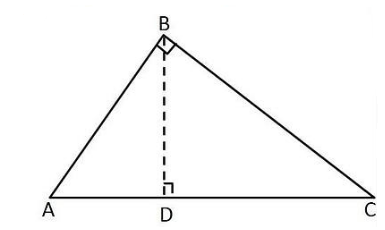
Construction: Draw {tex}B D \perp A C{/tex}
Proof:In {tex}\triangle{/tex}ABC and {tex}\triangle{/tex}ABD
{tex}\angle{/tex}ABC={tex}\angle{/tex}ADB=90
{tex}\angle{/tex}A is common
{tex}\angle{/tex}ABC{tex}\sim{/tex}{tex}\angle{/tex}ADB
{tex}\Rightarrow \frac{A D}{A B}=\frac{A B}{A C}{/tex}
{tex}\Rightarrow{/tex} AD. AC = AB2 ...(i)
Similarly {tex}\Delta \mathrm{BDC} \sim \Delta \mathrm{ABC}{/tex}
{tex}\Rightarrow \frac{C D}{B C}=\frac{B C}{A C}{/tex}
{tex}\Rightarrow{/tex} CD.AC = BC2 ...(ii)
Adding (i) and (ii)
AD.AC + CD. AC= AB2 + BC2
AC(AD + CD) = AB2 + BC2
AC {tex}\times{/tex} AC = AB2 + BC2
AC2 = AB2 + BC2
Hence Proved
Posted by Furkan Mohmmad 7 years, 1 month ago
- 0 answers
Posted by Abhishek Kumar 7 years, 1 month ago
- 4 answers
Dhirendra Behera 7 years, 1 month ago
Gaurav Seth 7 years, 1 month ago
Here, we have
r = 21 cm and ө = 120°
Let OACBO is the given sector and  is the given length of arc, then
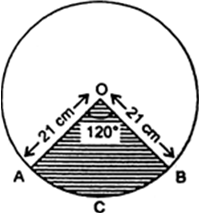
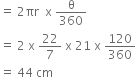
(i) The length of the arc (ACB)
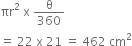
(ii) Area of sector (OACBO)
Posted by Vinay Sahu 7 years, 1 month ago
- 1 answers
Gaurav Seth 7 years, 1 month ago
No , (x - 2) cannot be the remainder on division of a polynomial p(x) by(2x +3) Because degree of remainder must be less than degree of divisor. Here degree of x-2 and 2x-3 is same that is 1.
Posted by Pratibha Sahu 6 years, 7 months ago
- 1 answers
Sia ? 6 years, 7 months ago
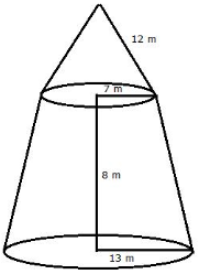
Radius of base of frustum = 13 m (R)
Radius of base of conical cap = 7 m (r)
Slant height of conical cap = 12 m (l)
height of frustum = 8 m (h)
Slant height of frustum
{tex}L = \sqrt { n ^ { 2 } + ( R - r ) ^ { 2 } }{/tex}
{tex}\Rightarrow \quad L = \sqrt { ( 8 ) ^ { 2 } + ( 13 - 7 ) ^ { 2 } }{/tex}
{tex}\Rightarrow \quad L = \sqrt { 64 + 36 } = \sqrt { 100 } = 10 \mathrm { m }{/tex}
therefore, Canvas required for the tent = Curved Surface area of cone + Curved Surface area of the frustum
{tex}= \pi rl + \pi L ( R + r ){/tex}
{tex}= \frac { 22 } { 7 } \times 7 \times 12 + \frac { 22 } { 7 } \times 10 ( 13 + 7 ){/tex}
{tex}= \frac { 22 } { 7 } \times 84 + \frac { 22 } { 7 } \times 10 \times 20{/tex}
{tex}= \frac { 22 } { 7 } ( 84 + 200 ){/tex}
{tex}= \frac { 22 } { 7 } \times 284{/tex}
= 892.57 m2
Posted by Jhalashya Choudhary 7 years, 1 month ago
- 3 answers
Akshaya Chandrasekar 7 years, 1 month ago
Posted by Yogesh Kumar 7 years, 2 months ago
- 2 answers
Paulo Dybala 7 years, 1 month ago
Nishihoney Lodha 7 years, 1 month ago
Posted by Jiya Rana 7 years, 2 months ago
- 0 answers
Posted by Moin Khan 7 years, 2 months ago
- 2 answers
Anushka ??? 7 years, 2 months ago

myCBSEguide
Trusted by 1 Crore+ Students

Test Generator
Create papers online. It's FREE.

CUET Mock Tests
75,000+ questions to practice only on myCBSEguide app

Yogita Ingle 7 years, 1 month ago
Let α, β and ɣ be the roots of the cubic polynomial
The cubic polynomial with roots α, β and ɣ is x3 – (α + β + ɣ)x2 + (αβ+ βɣ + ɣα)x – (αβɣ) = 0
1Thank You