
Ask questions which are clear, concise and easy to understand.
Ask QuestionPosted by Muskan Dixit 6 years, 10 months ago
- 2 answers
Yogita Ingle 6 years, 10 months ago
Given that the sum of two numbers is 9 Let the two numbers be x and 9-x
By the given hypothesis, we have
1/x + 1/9-x = 1/2
(9 - x + x)/x(9-x) = 1/2
18 = 9x - x2
x 2 - 9x + 18 = 0
(x - 6)(x - 3) = 0
x = 6 or x = 3
Therefore the numbers are 3 and 6.
Posted by Anshika Saini 6 years, 10 months ago
- 1 answers
Gaurav Seth 6 years, 10 months ago
I guess the correct question is :
Q: If the points P(-3, 9), Q(a, b) and R(4, -5) are collinear and a+b=1, find the value of a and b.
Posted by Nikita Sharma 6 years, 10 months ago
- 1 answers
Gaurav Seth 6 years, 10 months ago
<font face="Arial, sans-serif"><font style="box-sizing: inherit; outline: none; user-select: initial !important; max-width: 100%; overflow: hidden;">By Euclid's division algorithm
117 = 65x1 + 52.</font></font>
65 = 52x1 + 13
52 = 13x4 + 0
Therefore 13 is the HCF (65, 117).
Now work backwards:
13 = 65 + 52x(-1)
13 = 65 + [117 + 65x(-1)]x(-1)
13 = 65x(2) + 117x(-1).
∴ m = 2 and n = -1.
Posted by Nikita Sharma 6 years, 10 months ago
- 2 answers
Prashant Parihar 6 years, 10 months ago
Gaurav Seth 6 years, 10 months ago
378 = 2x3x3x3x7
180 = 2x2x3x5x7
420 = 2x2x3x5x7.
L.C.M ( 378,180,420) = 2x2x3x3x3x5x7 = 3780
H.C.F ( 378,180,420) = 2x3 = 6
⇒ L.C.M ( 378,180,420) x H.C.F ( 378,180,420) ≠ 378 x 180 x 420.
⇒ 3780 x 6 ≠ 378 x 180 x 420.
∴ 22680 ≠ 28576800.
∴HCF and LCM of three number is not equal to product of three number.
Posted by Nikita Sharma 6 years, 10 months ago
- 2 answers
Gaurav Seth 6 years, 10 months ago
Since, 2520 = 2 x 2 x 2 x 3 x 3 x 5 x 7
= 23 x 32 x 5 x 7
Therefore, p = 2 and q = 5
Posted by Yash Goyal 6 years, 10 months ago
- 1 answers
Yogita Ingle 6 years, 10 months ago
Given, sec θ + tan θ = p ...........1
We know that
sec2 θ - tan2 θ = 1
=> (sec θ - tan θ)(sec θ + tan θ) = 1
=> (sec θ - tan θ) * p = 1
=> sec θ - tan θ = 1/p ............2
Add equation 1 and 2, we get
2 * sec θ = p + 1/p
=> 2 * sec θ = (p2 + 1)/p
=> sec θ = (p2 + 1)/2p
and cos θ = 1/sec θ
=> cos θ = 2p/(p2 + 1)
Subtract equation 1 and 2, we get
2 * tan θ = p - 1/p
=> 2 * tan θ = (p2 - 1)/p
=> tan θ = (p2 - 1)/2p
and cot θ = 1/tan θ
=> cot θ = 2p/(p2 - 1)
We know that
tan θ = sin θ/ cos θ
=> sin θ = tan θ * cos θ
=> sin θ = {(p2 - 1)/2p} * {2p/(p2 + 1)}
=> sin θ = (p2 - 1)/(p2 + 1)
and cosec θ = 1/sin θ
=> cosec θ = (p2 + 1)/(p2 - 1)
Posted by Nikita Sharma 6 years, 10 months ago
- 1 answers
Yogita Ingle 6 years, 10 months ago
Let three consecutive positive integers be, n, n + 1 and n + 2.
When a number is divided by 3, the remainder obtained is either 0 or 1 or 2.
∴ n = 3p or 3p + 1 or 3p + 2, where p is some integer.
If n = 3p, then n is divisible by 3.
If n = 3p + 1, ⇒ n + 2 = 3p + 1 + 2 = 3p + 3 = 3(p + 1) is divisible by 3.
If n = 3p + 2, ⇒ n + 1 = 3p + 2 + 1 = 3p + 3 = 3(p + 1) is divisible by 3.
So, we can say that one of the numbers among n, n + 1 and n + 2 is always divisible by 3.
⇒ n (n + 1) (n + 2) is divisible by 3.
Similarly, when a number is divided 2, the remainder obtained is 0 or 1.
∴ n = 2q or 2q + 1, where q is some integer.
If n = 2q ⇒ n and n + 2 = 2q + 2 = 2(q + 1) are divisible by 2.
If n = 2q + 1 ⇒ n + 1 = 2q + 1 + 1 = 2q + 2 = 2 (q + 1) is divisible by 2.
So, we can say that one of the numbers among n, n + 1 and n + 2 is always divisible by 2.
⇒ n (n + 1) (n + 2) is divisible by 2.
Hence n (n + 1) (n + 2) is divisible by 2 and 3.
∴ n (n + 1) (n + 2) is divisible by 6.
Posted by Nikita Sharma 6 years, 10 months ago
- 1 answers
Posted by Harshita Jaiswal 6 years, 10 months ago
- 1 answers
Areeba Siddiqui 6 years, 10 months ago
Posted by Simple Simplee 6 years, 10 months ago
- 2 answers
Ram Kushwah 6 years, 10 months ago
Arc =150/360×2×22/7×21 cm
=17.5 cm
Area =150/360*πr^2
=150/360×22/7*×21×21
=577.5 cm sq
Chetna Pandey 6 years, 10 months ago
Posted by Aditi Sharma 6 years, 10 months ago
- 1 answers
Arjun Senthil 6 years, 10 months ago
Posted by Sakshi Rathore 6 years, 10 months ago
- 1 answers
Posted by Aarti Sharma 6 years, 10 months ago
- 4 answers
..... ...... 6 years, 10 months ago
Posted by Laxmi Kumari 6 years, 10 months ago
- 1 answers
Chetna Pandey 6 years, 10 months ago
Posted by Suraj Kumar 6 years, 10 months ago
- 3 answers
Chetna Pandey 6 years, 10 months ago
Posted by Vaishnavi Jadhav 6 years, 4 months ago
- 1 answers
Sia ? 6 years, 4 months ago
Given:
f(x) = (2x4 – 9x3 + 5x2 + 3x – 1)
Zeroes = (2 + √3) and (2 – √3)
Given the zeroes, we can write the factors = (x – 2 + √3) and (x – 2 – √3)
{Since, If x = a is zero of a polynomial f(x), we can say that x - a is a factor of f(x)}
Multiplying these two factors, we can get another factor which is:
((x – 2) + √3)((x – 2) – √3) = (x – 2)2 – (√3)2
⇒x2 + 4 – 4x – 3 = x2 – 4x + 1
So, dividing f(x) with (x2 – 4x + 1)
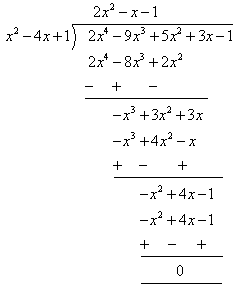
f(x) = (x2 – 4x + 1) (2x2 – x – 1)
Solving (2x2 – x – 1), we get the two remaining roots as
{tex}x = {-b \pm \sqrt{b^2-4ac} \over 2a}{/tex}
where f(x) = ax2 + bx + c = 0(using Quadratic Formula)
{tex}\mathrm{x}=\frac{-(-1) \pm \sqrt{(-1)^{2}-4(2)(-1)}}{2(2)}{/tex}
{tex}\mathrm{x}=\frac{-1 \pm 3}{4}{/tex}
{tex}\Rightarrow \mathrm{x}=1,-\frac{1}{2}{/tex}
Zeros of the polynomial = {tex}1,-\frac{1}{2}, 2+\sqrt{3}, 2-\sqrt{3}{/tex}
Posted by Priyanshu Golu 6 years, 10 months ago
- 2 answers
Sonu Kumar 6 years, 10 months ago
Avinash Saigal 6 years, 10 months ago
Posted by Muskan Muskan 6 years, 10 months ago
- 1 answers
Mayank Mohit Agarwal 6 years, 10 months ago
Posted by Abhishek Maurya 6 years, 10 months ago
- 0 answers
Posted by Milan Deshwal 6 years, 10 months ago
- 1 answers
Gaurav Seth 6 years, 10 months ago
The HCF of k,2k,3k,4k and 5k will be k as the following no.s are consecutive and only k is a common factor as all numbers are multiplied by it.
Posted by Prashant Parihar 6 years, 10 months ago
- 1 answers
Purvanshi Yadav 6 years, 10 months ago
Posted by Shrijith The Artist ??? 6 years, 10 months ago
- 1 answers
Shrijith The Artist ??? 6 years, 10 months ago
Posted by Prajkt Sonkusare 6 years, 10 months ago
- 2 answers
Avinash Saigal 6 years, 10 months ago
Posted by Tripti Saxena 6 years, 10 months ago
- 1 answers
Posted by Khushi Star ? 6 years, 10 months ago
- 1 answers
Puja Sahoo? 6 years, 10 months ago
Posted by Khushi Star ? 6 years, 10 months ago
- 5 answers
Prashant Parihar 6 years, 10 months ago
Posted by Khushi Bhati 5 years, 8 months ago
- 2 answers
Ansh Bhatnagar 6 years, 10 months ago
Avinash Saigal 6 years, 10 months ago
Posted by Yogesh Parihar 6 years, 10 months ago
- 3 answers
Neha Sirur 6 years, 10 months ago
Gaurav Seth 6 years, 10 months ago
Given: ABC is a triangle , DE parallel BC and AD= 3 cm, DB=2 cm and DE=6 cm
To find: AE
sol: Since DE parallel BC
angle ADE= angle ABC (corresponding angles)
and angle AED = angle ACB ( " )
Triangle ADE ≈ triangle ABC ( by AA similarity)
therefore , AD/AB=DE/BC=AE/AC (1)
From (1)
AD/AB=AE/AC
2/5=x/18
2×18=5x
36=5x
x=36/5
x=7.5cm
∵ AE = 7.5 cm
Posted by Aayu... Sad Girl....??? 6 years, 10 months ago
- 1 answers
Purvanshi Yadav 6 years, 10 months ago

myCBSEguide
Trusted by 1 Crore+ Students

Test Generator
Create papers online. It's FREE.

CUET Mock Tests
75,000+ questions to practice only on myCBSEguide app

Muskan Dixit 6 years, 10 months ago
0Thank You