
Ask questions which are clear, concise and easy to understand.
Ask QuestionPosted by Sarika Popli 6 years, 10 months ago
- 3 answers
Posted by Arpit Rawat 6 years, 10 months ago
- 1 answers
Posted by Vishal Ghanghas 6 years, 4 months ago
- 1 answers
Sia ? 6 years, 4 months ago

P is midpoint of QR
or, {tex}\frac { a } { 3 } = \frac { - 5 + ( - 1 ) } { 2 }{/tex}
or, {tex}\frac { a } { 3 } = \frac { - 6 } { 2 }{/tex}
or, a = -9
Posted by Divya Bansal 6 years, 10 months ago
- 2 answers
Honey ??? 6 years, 10 months ago
Posted by Rajan Agrahari 6 years, 10 months ago
- 1 answers
Posted by Parmjeet Singh 6 years, 10 months ago
- 0 answers
Posted by Parmjeet Singh 6 years, 10 months ago
- 1 answers
Deepak Singh 6 years, 10 months ago
Posted by Devika Uday 6 years, 10 months ago
- 1 answers
Shyam Thakur 6 years, 10 months ago
Posted by Parmjeet Singh 6 years, 10 months ago
- 4 answers
Yogita Ingle 6 years, 10 months ago
Mode = 3Median - 2 Mean
= 3 × 8 - 2 × 10
= 24 - 20
= 4
Posted by Jatin Sirohi 6 years, 10 months ago
- 3 answers
Posted by Royal Rupesh 6 years, 10 months ago
- 2 answers
Posted by Anurag Singh 6 years, 10 months ago
- 3 answers
Shiwan Tash 6 years, 10 months ago
Posted by Jagseer Singh 6 years, 10 months ago
- 1 answers
Pratibha Sahu 6 years, 10 months ago
Posted by Sarika Popli 6 years, 10 months ago
- 1 answers
Anushreya Chakraborty 6 years, 10 months ago
Posted by Misbah Saifi 6 years, 10 months ago
- 1 answers
Ram Kushwah 6 years, 10 months ago
y=14-x
From eqn(2)
x-(14-x)=4
2x=18, X=9
From(1)
y=14-x=14-9=5
Posted by Gaurav Marathe 6 years, 10 months ago
- 0 answers
Posted by Damanpreet Singh Sodhi 6 years, 4 months ago
- 1 answers
Sia ? 6 years, 4 months ago
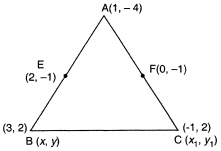
Let E be the midpoint of AB.
{tex}\therefore \quad \frac { x + 1 } { 2 } = 2{/tex} or x = 3
and {tex}\frac { y + ( - 4 ) } { 2 } = - 1{/tex} or, y = 2
or, B(3, 2)
Let F be the mid-point of AC.Then,
{tex}0=\frac{x_1+1}{2}{/tex} or {tex}x_1=-1{/tex}
and {tex}\frac { y _ { 1 } + ( - 4 ) } { 2 }{/tex} = -1 or, y1 = 2
or, C= (-1, 2)
Now the co-ordinates are A(1, - 4), B(3,2), C (-1,2)
Area of triangle
{tex}= \frac { 1 } { 2 } \left[ x _ { 1 } \left( y _ { 2 } - y _ { 3 } \right) + x _ { 2 } \left( y _ { 3 } - y _ { 1 } \right) + x _ { 3 } \left( y _ { 1 } - y _ { 2 } \right) \right]{/tex}
{tex}= \frac { 1 } { 2 } [ 1 ( 2 - 2 ) + 3 ( 2 + 4 ) - 1 ( - 4 - 2 ) ]{/tex}
{tex}= \frac { 1 } { 2 } [ 0 + 18 + 6 ]{/tex}
= 12 sq units.
Posted by Saroj Modi 6 years, 10 months ago
- 2 answers
Posted by Divyanshu Sharma 6 years, 10 months ago
- 2 answers
Posted by Khadija Fatima 6 years, 4 months ago
- 1 answers
Sia ? 6 years, 4 months ago
The least prime factor of a and b is not 2, hence both are odd numbers.
Hence( a+b) is an even number.
So least common factor of( a+b ) is 2.
Posted by Khushi Agrawal 6 years, 4 months ago
- 1 answers
Sia ? 6 years, 4 months ago
Let a and d be the first term and common difference respectively of the given A.P. Then
an = a + (n - 1)d
{tex}\frac { 1 } { n } ={/tex} mth term
{tex}\Rightarrow \frac { 1 } { n } {/tex}= a + ( m - 1 ) d ...(i)
{tex}\frac { 1 } { m }{/tex}= nth term
{tex}\Rightarrow \frac { 1 } { m } {/tex}= a + ( n - 1 ) d ...(ii)
On subtracting equation (ii) from equation (i), we get
{tex}\frac { 1 } { n } - \frac { 1 } { m } = {/tex} [a+ (m-1) d] -[ a+ (n -1)d]
= a + md - d - a - nd + d
{tex}= ( m - n ) d{/tex}
{tex} \Rightarrow \frac { m - n } { m n } = ( m - n ) d {/tex}
{tex}\Rightarrow d = \frac { 1 } { m n }{/tex}
Putting d = {tex}\frac { 1 } { m n }{/tex} in equation (i), we get
{tex}\frac { 1 } { n } = a + \frac { ( m - 1 ) } { m n } {/tex}
{tex}\Rightarrow \frac { 1 } { n } = a + \frac { 1 } { n } - \frac { 1 } { m n } {/tex}
{tex}\Rightarrow a = \frac { 1 } { m n }{/tex}
{tex}\therefore{/tex} (mn)th term = a + (mn - 1) d
= {tex}\frac { 1 } { m n } + ( m n - 1 ) \frac { 1 } { m n } {/tex}{tex}\left[ \because a = \frac { 1 } { m n } = d \right]{/tex}
= {tex}\frac { 1 } { m n } + \frac { mn } { m n } - \frac { 1 } { m n }{/tex}
= 1
Posted by Daud Toppo 6 years, 10 months ago
- 0 answers
Posted by Varun Vaid 6 years, 10 months ago
- 1 answers
Puja Sahoo? 6 years, 10 months ago
Posted by Garv Jain 6 years, 4 months ago
- 1 answers
Sia ? 6 years, 4 months ago
Let AB be the surface of the lake and let P be a point of observation such that AP = h metres. Let C be the position of the cloud and C be its reflection in the lake. Then, CB = C' B. Let PM be perpendicular from P on CB. Then,
{tex}\angle C P M = \alpha{/tex} and {tex}\angle M P C ^ { \prime } = \beta.{/tex}
Let CM = x.
Then, CB = CM + MB = CM + PA = x + h.
In {tex}\triangle \mathrm { CPM },{/tex} we have
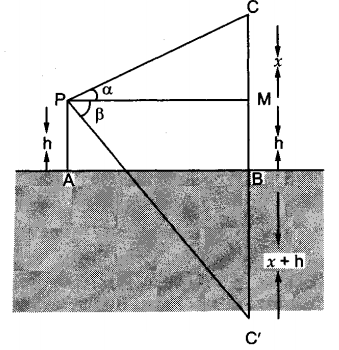
{tex}\tan \alpha = \frac { C M } { P M }{/tex}
{tex}\Rightarrow \quad \tan \alpha = \frac { x } { A B }{/tex}
{tex}\Rightarrow \quad A B = x \cot \alpha{/tex}.....(i)
In {tex}\triangle{/tex}PMC', we have
{tex}\tan \beta = \frac { C ^ { \prime } M } { P M }{/tex}
{tex}\Rightarrow \quad \tan \beta = \frac { x + 2 h } { A B }{/tex} [{tex}\because{/tex}CM = C'B + BM = x + h + h]
{tex}\Rightarrow \quad A B = ( x + 2 h ) \cot \beta{/tex}......(ii)
From (i) and (ii), we have
{tex}x \cot \alpha = ( x + 2 h ) \cot \beta{/tex}
[On equating the values of AB]
{tex}\Rightarrow \quad x ( \cot \alpha - \cot \beta ) = 2 h \cot \beta{/tex}
{tex}\Rightarrow \quad x \left( \frac { 1 } { \tan \alpha } - \frac { 1 } { \tan \beta } \right) = \frac { 2 h } { \tan \beta }{/tex}
{tex}\Rightarrow \quad x \left( \frac { \tan \beta - \tan \alpha } { \tan \alpha \tan \beta } \right) = \frac { 2 h } { \tan \beta }{/tex}
{tex}\Rightarrow \quad x = \frac { 2 h \tan \alpha } { \tan \beta - \tan \alpha }{/tex}
Hence, the height CB of the cloud is given by
CB = x + h
{tex}\Rightarrow \quad C B = \frac { 2 h \tan \alpha } { \tan \beta - \tan \alpha } + h{/tex}
{tex}\Rightarrow \quad C B = \frac { 2 h \tan \alpha + h \tan \beta - h \tan \alpha } { \tan \beta - \tan \alpha } = \frac { h ( \tan \alpha + \tan \beta ) } { \tan \beta - \tan \alpha }{/tex}
Posted by Ashwanip Kumar Pandey 6 years, 10 months ago
- 1 answers
Posted by Anshuman Nagar 6 years, 10 months ago
- 1 answers

myCBSEguide
Trusted by 1 Crore+ Students

Test Generator
Create papers online. It's FREE.

CUET Mock Tests
75,000+ questions to practice only on myCBSEguide app

Puja Sahoo? 6 years, 10 months ago
2Thank You