
Ask questions which are clear, concise and easy to understand.
Ask QuestionPosted by Priyanshu Sharma 6 years, 10 months ago
- 0 answers
Posted by Navi Tiwana 6 years, 10 months ago
- 1 answers
Posted by Aashutosh Pattanaik 6 years, 10 months ago
- 4 answers
Sujal Sahu 6 years, 10 months ago
Harshita Sehgal 6 years, 10 months ago
Posted by Gita Gaur 5 years, 8 months ago
- 1 answers
Posted by Thufail Ahamed 6 years, 10 months ago
- 1 answers
Posted by Mahesh Yadav 6 years, 10 months ago
- 0 answers
Posted by Priyanshu Pandey 6 years, 10 months ago
- 1 answers
Gaurav Seth 6 years, 10 months ago
Assume cube root 6 is rational. Then let cube root 6 = a/b ( a & b are co-prime and b not = 0)
Cubing both sides : 6=a^3/b^3
a^3 = 6b^3
a^3 = 2(3b^3)
Therefore, 2 divides a^3 or a^2 * a . By Euclid's Lemma if a prime number
divides the product of two integers then it must divide one of the two integers
Since all the terms here are the same we conclude that 2 divides a
.
Now there exists an integer k such that a=2k
Substituting 2k in the above equation
8k^3 = 6b^3
b^3 = 2{(2k^3) / 3)}
Therefore, 2 divides b^3. Using the same logic as above. 2 divides b.
Hence 2 is common factor of both a & b. But this is a contradiction of the fact that a & b are co-prime. Therefore, the initial assumption is wrong.
cube root 6 is irrational
Posted by Raj Verma 6 years, 10 months ago
- 0 answers
Posted by Rakesh Kumar 6 years, 10 months ago
- 2 answers
Avika Chaudhary 6 years, 10 months ago
Posted by Thaarini Shree 6 years, 10 months ago
- 1 answers
Posted by Nithin Goud 6 years, 4 months ago
- 1 answers
Sia ? 6 years, 4 months ago
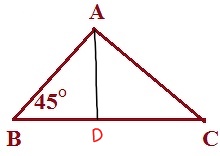
Construction: Draw AD {tex}\perp{/tex} BC
Proof: In right {tex}\triangle{/tex}ADC,
By using pythagoras theorem, we get
AC2 = AD2 + CD2 ...(i)
In right {tex}\triangle{/tex}ADB,
By using pythagoras theorem, we get
AB2 = AD2 + BD2
{tex}\Rightarrow{/tex}AB2 - BD2 = AD2
Putting in (i), we get
AC2 = AB2 - BD2 + CD2
{tex}\Rightarrow{/tex} AC2 = AB2 + CD2 - BD2
= AB2+ (CD - BD)(CD + BD) = AB2 + (CD - BD) BC
= AB2 + (BC - BD - BD).BC = AB2 + BC2 - 2BC.BD
= AB2 + BC2 - 2.AD.BC [ {tex}\because{/tex} AD = BD]
= AB2 + BC2 - 4ar({tex}\triangle{/tex}ABC).
Posted by Vadla Ramana Achari 6 years, 10 months ago
- 1 answers
Posted by Jitender Singh 6 years, 10 months ago
- 3 answers
Priyanshi Mishra 6 years, 10 months ago
Posted by Kajal Yadav 6 years, 10 months ago
- 1 answers
Priyanshi Mishra 6 years, 10 months ago
Posted by Nikhil Raj 6 years, 4 months ago
- 1 answers
Sia ? 6 years, 4 months ago
Given, the roots of the equation (b - c)x2 + (c - a)x + (a - b) = 0 are equal.
Hence, {tex}D = 0{/tex}
{tex}\Rightarrow{/tex} {tex}( c - a )^2 - 4( b - c )( a - b ) = 0{/tex}
{tex}\Rightarrow{/tex} {tex}c^2 + a^2 + 4b^2 - 2ac - 4ab + 4ac - 4bc = 0{/tex}
{tex}\Rightarrow{/tex} {tex}(c + a - 2b)^2 = 0{/tex}
{tex}\Rightarrow{/tex}{tex} c + a - 2b = 0{/tex}
{tex}\Rightarrow{/tex} {tex}2b = a + c{/tex}
Posted by Harsh Rajpoot 6 years, 4 months ago
- 1 answers
Sia ? 6 years, 4 months ago
Let p be any positive integer
By division algorithm, p = 6q + r, where 0 {tex} \leqslant {/tex}r< 6
Here r=0,1,2,3,4,5
Therefore,values of p are : 6q, 6q + 1, 6q + 2, 6q + 3, 6q + 4, 6q + 5
Now 6q+1,6q+3 and 6q+5 are odd numbers because q is a positive integer.
Hence 6q, 6q + 2, 6q + 4 are even integers because they are next positive number to the odd numbers 6q-1,6q+1 and 6q+3 respectively
Posted by Jatin Agarwal 6 years, 4 months ago
- 1 answers
Sia ? 6 years, 4 months ago
Using distance formula, we obtain
SP = {tex}\sqrt { \left( a t ^ { 2 } - a \right) ^ { 2 } + ( 2 a t - 0 ) ^ { 2 } } = a \sqrt { \left( t ^ { 2 } - 1 \right) ^ { 2 } + 4 t ^ { 2 } }{/tex}= a(t2 + 1)
SQ = {tex}\sqrt { \left( \frac { a } { t ^ { 2 } } - a \right) ^ { 2 } + \left( \frac { 2 a } { t } - 0 \right) ^ { 2 } }{/tex}
SQ = {tex}\sqrt { \frac { a ^ { 2 } \left( 1 - t ^ { 2 } \right) ^ { 2 } } { t ^ { 4 } } + \frac { 4 a ^ { 2 } } { t ^ { 2 } } }{/tex}= {tex}\frac { a } { t ^ { 2 } } \sqrt { \left( 1 - t ^ { 2 } \right) ^ { 2 } + 4 t ^ { 2 } } = \frac { a } { t ^ { 2 } } \sqrt { \left( 1 + t ^ { 2 } \right) ^ { 2 } } = \frac { a } { t ^ { 2 } }( 1+ t^2){/tex}
{tex}\therefore \quad \frac { 1 } { S P } + \frac { 1 } { S Q } = \frac { 1 } { a \left( t ^ { 2 } + 1 \right) } + \frac { t ^ { 2 } } { a \left( t ^ { 2 } + 1 \right) }{/tex}
{tex}\Rightarrow \quad \frac { 1 } { S P } + \frac { 1 } { S Q } = \frac { 1 + t ^ { 2 } } { a \left( t ^ { 2 } + 1 \right) } = \frac { 1 } { a }{/tex}, which is independent of t.
Posted by Abbas Ali???? 6 years, 10 months ago
- 1 answers
Posted by Abhishek Jain 6 years, 4 months ago
- 1 answers
Sia ? 6 years, 4 months ago
To prove:
(cosecA - sinA) (secA - cosA) (tanA + cotA) = 1
LHS {tex}= (\cos ecA - \sin A)(\sec A - \cos A)(\tan A + \cot A){/tex}
{tex} = \left( {\frac{1}{{\sin A}} - \sin A} \right)\left( {\frac{1}{{\cos A}} - \cos A} \right)\left( {\frac{{\sin A}}{{\cos A}} + \frac{{\cos A}}{{\sin A}}} \right){/tex} {tex}\left[ \begin{gathered} \because \cos ecA = \frac{1}{{\sin A}},\sec A = \frac{1}{{\cos A}}, \hfill \\ \tan A = \frac{{\sin A}}{{\cos A}},\cot A = \frac{{\cos A}}{{\sin A}} \hfill \\ \end{gathered} \right]{/tex}
{tex} = \left( {\frac{{1 - {{\sin }^2}A}}{{\sin A}}} \right)\left( {\frac{{1 - {{\cos }^2}A}}{{\cos A}}} \right)\left( {\frac{{{{\sin }^2}A + {{\cos }^2}A}}{{\cos A\sin A}}} \right){/tex}
{tex} = \frac{{{{\cos }^2}A}}{{\sin A}} \times \frac{{{{\sin }^2}A}}{{\cos A}} \times \frac{1}{{\cos A\sin A}}{/tex} {tex}\left[ \begin{gathered} \because 1 - {\sin ^2}A = {\cos ^2}A,1 - {\cos ^2}A = {\sin ^2}A, \hfill \\ {\sin ^2}A + {\cos ^2}A = 1 \hfill \\ \end{gathered} \right]{/tex}
{tex} = \frac{{\cos A \times \cos A}}{{\sin A}} \times \frac{{\sin A \times \sin A}}{{\cos A}} \times \frac{1}{{\cos A\sin A}}{/tex}
= 1
= RHS

myCBSEguide
Trusted by 1 Crore+ Students

Test Generator
Create papers online. It's FREE.

CUET Mock Tests
75,000+ questions to practice only on myCBSEguide app
