
Ask questions which are clear, concise and easy to understand.
Ask QuestionPosted by Lionel Messi⚽️ 6 years, 10 months ago
- 3 answers
Posted by Vinayak Sharma 6 years, 10 months ago
- 1 answers
Posted by Dhanush Dhanush 6 years, 10 months ago
- 2 answers
Ram Kushwah 6 years, 10 months ago
{tex}\begin{array}{l}\text{Let r is radius thn d=2r}\\\frac{area\;of\;circle}{area\;of\;trangle\;}=\frac{\pi r^2}{\sqrt3/4\times d^2}=\frac{4\pi r^2}{\sqrt3\times(2r)^2}\\=\frac{4\pi r^2}{\sqrt3\times4r^2}=\frac\pi{\sqrt3}\end{array}{/tex}
Posted by Charan Singh 6 years, 10 months ago
- 2 answers
Gaurav Seth 6 years, 10 months ago
X+a is a factor of 2x²+2ax+5x+10
therefore f(-a)=0;
substituting values,
2(-a)²+2(a)(-a)+5(-a)+10=0
2a²-2a²-5a+10=0
-5a+10=0
therefore a=2
Posted by Sardulbhai Chauhan 6 years, 10 months ago
- 4 answers
Posted by Rishabh Kushwaha 6 years, 10 months ago
- 1 answers
Lakshmi Narayanan 6 years, 10 months ago
Posted by Shagufta Tasnim 5 years, 8 months ago
- 4 answers
Priyanshi Mishra 6 years, 10 months ago
Anuksha Pawar 6 years, 10 months ago
Yash Agarwal 6 years, 10 months ago
Posted by Shagufta Tasnim 6 years, 10 months ago
- 3 answers
Posted by Arun Tiwari 6 years, 6 months ago
- 1 answers
Sia ? 6 years, 6 months ago
|PQ| = |PR
{tex}\begin{aligned} \sqrt { [ x - ( a + b ) ] ^ { 2 } + [ y - ( b - a ) ] ^ { 2 } } = \sqrt { [ x - ( a - b ) ] ^ { 2 } + [ y - ( b + a ) ] ^ { 2 } } \end{aligned}{/tex}
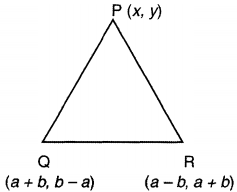
Squaring, we get
[x - (a + b)]2 + [y - (b - a)]2 = [x - (a - b)]2 + [y - (a + b)]2
or, [x - (a + b)]2 - [x - a + b]2 = (y - a - b)2 - (y - b + a)2
or, (x - a - b + x - a + b) ( x - a - b - x + a - b)
= (y - a - b + y - b + a)(y - a - b - y + b - a)
or, (2x - 2a) (- 2b) = (2y - 2b) (- 2a)
or, (x - a)b = (y - b)a
or, bx = ay.
Hence Proved.
Posted by Raviraj Pawar 6 years, 10 months ago
- 1 answers
Posted by Piyush Meena 6 years, 10 months ago
- 1 answers
Posted by Sunil Dat 4 years, 6 months ago
- 1 answers
Sia ? 4 years, 6 months ago
A.P. stands for Arithmetic progression.
A sequence is in AP when the difference between it's termes are common.
In AP number of terms is denoted by small n
'n' - No. of terms. And
'an' means nth term of that sequence.
Posted by Mohit Chawla 6 years, 10 months ago
- 2 answers
Ram Kushwah 6 years, 10 months ago
{tex}\style{font-size:12px}{\begin{array}{l}AB=5,AC=13\\\mathrm{So}\;\mathrm{BC}^2=\mathrm{AC}^2-\mathrm{AB}^2\\=169-25=144\\\mathrm{BC}=12\\\mathrm{Now}\;\mathrm{tanA}+\mathrm{cotC}\\=\frac{\mathrm{BC}}{\mathrm{AB}}+\frac{\mathrm{AB}}{\mathrm{BC}}\\=\frac{12}5+\frac5{12}=\frac{144+25}{60}=\frac{169}{60}\end{array}}{/tex}
Posted by Best Videos By Kratik 6 years, 6 months ago
- 1 answers
Sia ? 6 years, 6 months ago
Let 5 + 3{tex}\sqrt{2}{/tex} be a rational number.
{tex}\Rightarrow{/tex} 5 + 3{tex}\sqrt{2}{/tex} = {tex}\frac{p}{q}{/tex}, p, q {tex}\in{/tex} I, q {tex}\ne{/tex} 0
{tex}\Rightarrow{/tex} 3{tex}\sqrt{2}{/tex} = {tex}\frac{p}{q}{/tex} - 5{tex}\Rightarrow \sqrt{2}{/tex} = {tex}\frac{p - 5q}{3q}{/tex}
{tex}\frac{p - 5q}{3q}{/tex} is rational {tex}\Rightarrow{/tex} {tex}\sqrt{2}{/tex} is rational number which is a contradiction.
5 + 3{tex}\sqrt{2}{/tex} is irrational number.
Posted by Sasi S 6 years, 10 months ago
- 3 answers
Deepak Singla 6 years, 10 months ago
Ram Kushwah 6 years, 10 months ago
A leap year has 366 days or 52 weeks and 2 more days. The two odd days can be
{Sunday,Monday}
,{Monday,Tuesday}
,{Tuesday,Wednesday}
,{Wednesday,Thursday}
,{Thursday,Friday}
,{Friday,Saturday}
,{Saturday,Sunday}.
So there are 7 possibilities out of which 2 have a Sunday.
So the probability of 53 Sundays = {tex}\frac27{/tex}
Posted by Adu ? 6 years, 10 months ago
- 1 answers
Ram Kushwah 6 years, 10 months ago
1.Be calm in exam drink water as possible.May be you get stressed because of board,friend no difference
in this exam than your 9th class exam
2.Attempt easy questions first,Do not waste time for difficult questions first
3.Best thing attempt questions first from your interesting topics
4.Check solution of all question even some questions are left do not worry
5.If possible cross check your answers.
6.After doing all above,write some thing possible for unsolved questions.Now try not to leave
any question unanswered.
All the best for exam
Posted by Shruti Chintawar 6 years, 10 months ago
- 1 answers
Gaurav Seth 6 years, 10 months ago
TSA OF A HEMISPHERE = 3πr²
3πr²=462
3×22/7×r²=462
66/7r²=462
r²=462×7/66
r²=49
r=√49=7
volume of hemisphere = 2/3πr³
2/3×22/7×7×7×7=
718.6cm³
Posted by Arun Tiwari 6 years, 10 months ago
- 5 answers
Gungun_ ?? 6 years, 10 months ago
Gaurav Seth 6 years, 10 months ago
By using diatance formula,√ [ (x2 - x1)2 = (y2 - y1)2 ]
AB = √ ( 3 - 2)2 + ( 4 + 1)2 =√ 12 + 52 =√ 1 + 25 =√26 ...1
BC =√ ( -2 -3)2 + ( 3 - 4)2 =√ 25 = 1 =√26 ...2
CD =√ ( -3 + 2)2 + ( -2 -3)2 =√ 25 + 1 =√26 ...3
DA =√(2 + 3)2 + ( -1 + 2)2 =√ 25 + 1 =√ 26 ...4
from 1, 2, 3 and 4
ABCD is a rhombus.
For a rhombus to be a square, diagonals must be equal
So we need to prove that AB = CD
AC =√( -2 - 2 )2 + (3 + 1)2 =√ (-4)2 + (4)2 =√ 16 + 16 =√32
BD =√ (-3 - 3)2 + (-2 - 4)2 =√ (-6)2 + (-6)2 = √ 36 + 36 = √72
Since AC is not equal to BD, it is not a square
Posted by Arun Tiwari 6 years, 10 months ago
- 5 answers
Anushka Jugran_? 6 years, 10 months ago
Lol No 6 years, 10 months ago
Prashant Kumar 6 years, 10 months ago
Gaurav Seth 6 years, 10 months ago
Given A(3, 0), B(6, 4) and C(–1, 3)
AB^2 = (3 – 6)^2 + (0 – 4)^2
= 9 + 16 = 25
BC^2 = (6 + 1)^2 + (4 – 3)^2
= 49 + 1 = 50
CA^2 = (–1 – 3)^2 + (3 – 0)^2
= 16 + 9 = 25
AB^2 = CA^2 ⇒ AB = CA
Triangle is isosceles
Also,
25 + 25 = 50
⇒ AB^2 + CA^2 = BC^2
Since Pythagoras theorem is verified, therefore
Triangle is a right angled triangle
Posted by Himanshi Verma 6 years, 10 months ago
- 4 answers
Posted by Prashant Kumar 6 years, 10 months ago
- 4 answers
Prashant Kumar 6 years, 10 months ago
Posted by Ayush Mukadam 6 years, 10 months ago
- 3 answers
Aniket Kumar Singh 6 years, 10 months ago
Posted by Raghav Bansal 6 years, 10 months ago
- 1 answers
Posted by Srivastav Karan 6 years, 10 months ago
- 1 answers
Posted by Tobom Damin 6 years, 10 months ago
- 1 answers
Posted by Aniket Anand 6 years, 6 months ago
- 1 answers
Sia ? 6 years, 6 months ago
{tex}sec\ \theta+ tan\ \theta = p{/tex} ...(i)
Also {tex}sec^2 \theta - tan^2 \theta = 1{/tex}
{tex}\Rightarrow{/tex} (sec {tex}\theta{/tex} - tan {tex}\theta{/tex}) (sec {tex}\theta{/tex} + tan {tex}\theta{/tex}) = 1
{tex}\Rightarrow{/tex} p(sec {tex}\theta{/tex} - tan {tex}\theta{/tex}) = 1
[using equation (i)]
{tex}\Rightarrow{/tex} sec {tex}\theta{/tex} - tan {tex}\theta{/tex} {tex}=\frac{1}{p}{/tex} ...(ii)
(ii) - (i) we get
{tex}-2 tan{/tex} {tex}\theta{/tex} {tex}=\frac{1-p^{2}}{p}{/tex}
{tex}\Rightarrow{/tex}- tan {tex}\theta{/tex} {tex}=\frac{1-p^{2}}{2 p}{/tex}
{tex}\Rightarrow{/tex}- cot {tex}\theta{/tex} {tex}=\frac{2 p}{1-p^{2}}{/tex}
cot {tex}\theta{/tex} {tex}=\left(\frac{2 p}{1-p^{2}}\right)^{2}{/tex}
{tex}=\frac{-4 p^{2}}{\left(1-p^{2}\right)^{2}}{/tex}
{tex}\Rightarrow{/tex} {tex}cosec^2{/tex} {tex}\theta{/tex} - 1 {tex}=\frac{-4 p^{2}}{\left(1-p^{2}\right)^{2}}{/tex}
{tex}\Rightarrow{/tex} {tex}cosec^2{/tex} {tex}\theta{/tex} {tex}=\frac{-4 p^{2}}{\left(1-p^{2}\right)^{2}}+1=\frac{-4 p^{2}+\left(1-p^{2}\right)^{2}}{\left(1-p^{2}\right)^{2}}{/tex}
{tex}cosec^2{/tex} {tex}\theta{/tex} {tex}=\frac{-4 p^{2}+1+p^{4}-2 p^{2}}{\left(1-p^{2}\right)^{2}}{/tex}
{tex}=\frac{\left(1+p^{2}\right)^{2}}{\left(1-p^{2}\right)^{2}}{/tex}
{tex}\Rightarrow{/tex} {tex}cosec\ \theta{/tex} {tex}=\frac{1+p^{2}}{1-p^{2}}{/tex}
Posted by Shrijith The Artist ??? 6 years, 10 months ago
- 3 answers
Posted by Karthi Ck 6 years, 10 months ago
- 2 answers

myCBSEguide
Trusted by 1 Crore+ Students

Test Generator
Create papers online. It's FREE.

CUET Mock Tests
75,000+ questions to practice only on myCBSEguide app

Lionel Messi⚽️ 6 years, 10 months ago
2Thank You