
Ask questions which are clear, concise and easy to understand.
Ask QuestionPosted by Dhananjay Malviya 6 years, 10 months ago
- 1 answers
Posted by Faizan Mirza Khan 6 years, 10 months ago
- 5 answers
Ram Kushwah 6 years, 10 months ago
let x and y are sides of cubes
x3/y3=1/27 so x/y=1/3
ratio of SA = 6x2/6y2=x2/y2=(x/y)^2=(1/3)^2=1/9
Posted by Munna Kumar Sharma 6 years, 10 months ago
- 2 answers
Posted by Black Boxer 6 years, 10 months ago
- 1 answers
Posted by Satyanarayan Meena 6 years, 6 months ago
- 1 answers
Sia ? 6 years, 6 months ago
Given, sec {tex}\theta{/tex} = x + {tex}\frac{1}{4 x}{/tex}
We know that, tan {tex}\theta{/tex} = {tex}\pm \sqrt{\sec ^{2} \theta-1}{/tex}
{tex}=\pm \sqrt{\left(x+\frac{1}{4 x}\right)^{2}-1}{/tex}
{tex}=\pm \sqrt{x^2 + \frac{1}{(4x)^2}+2.x. \frac{1}{(4x)}-1}{/tex}
{tex}=\pm \sqrt{x^2 + \frac{1}{(4x)^2}+ \frac{1}{(2)}-1}{/tex}
{tex}=\pm \sqrt{x^2 + \frac{1}{(4x)^2}- \frac{1}{(2)}}{/tex}
{tex}=\pm \sqrt {\left(x-\frac{1}{4 x}\right)^2}{/tex}
{tex}=\pm\left(x-\frac{1}{4 x}\right){/tex}
Now, sec {tex}\theta{/tex} + tan {tex}\theta{/tex} = {tex}\left(x+\frac{1}{4 x}\right) \pm\left(x-\frac{1}{4 x}\right){/tex}
i) sec {tex}\theta{/tex} + tan {tex}\theta{/tex} = {tex}\left(x+\frac{1}{4 x}\right) +\left(x-\frac{1}{4 x}\right){/tex}
{tex}=2x{/tex}
ii) sec {tex}\theta{/tex} + tan {tex}\theta{/tex} = {tex}\left(x+\frac{1}{4 x}\right) -\left(x-\frac{1}{4 x}\right){/tex}
{tex}=\frac{1}{4x}-(-\frac{1}{4x}) \\=\frac{1}{4x}+\frac{1}{4x}\\=\frac{2}{4x}{/tex}
{tex}=\frac{1}{2 x}{/tex}
Posted by Vini Negi 6 years, 10 months ago
- 2 answers
Sudhanshu Yadav 6 years, 10 months ago
Yogita Ingle 6 years, 10 months ago
HCF of 210 & 55
210 = 55× 3 + 45 ….....(i)
55 = 45 × 1 +10 ….........(ii)
45 = 10 ×4 +5 …...........(iii)
10 = 5 ×2 + 0
hence HCF of 210 & 55 = 5
now from (iii), we get
45 = 10 ×4 + 5
so 5 = 45 – 10×4
5 = 45 – (55 – 45)×4
5 = 45 – 55×4 + 45×4
5 = 45 ×5 – 55×4
5 = (210 – 55×3) ×5 – 55×4
5 = 210×5 – 55×15 – 55×4
5 = 210×5 – 55×19
5 = 210 x + 55 y
where x = 5, y = –19
Posted by Jatin Arora 6 years, 10 months ago
- 3 answers
Shivam Sharma 6 years, 10 months ago
Shivam Sharma 6 years, 10 months ago
Posted by Aryan Rawat 6 years, 10 months ago
- 1 answers
Nikita Sharma 6 years, 10 months ago
Posted by Vishwash Jain 6 years, 10 months ago
- 1 answers
Gaurav Seth 6 years, 10 months ago
Secθ+tanθ=p ----------------------(1)
∵, sec²θ-tan²θ=1
or, (secθ+tanθ)(secθ-tanθ)=1
or, secθ-tanθ=1/p ----------------(2)
Adding (1) and (2) we get,
2secθ=p+1/p
or, secθ=(p²+1)/2p
∴, cosθ=1/secθ=2p/(p²+1)
∴, sinθ=√(1-cos²θ)
=√[1-{2p/(p²+1)}²]
=√[1-4p²/(p²+1)²]
=√[{(p²+1)²-4p²}/(p²+1)²]
=√[(p⁴+2p²+1-4p²)/(p²+1)²]
=√(p⁴-2p²+1)/(p²+1)
=√(p²-1)²/(p²+1)
=(p²-1)/(p²+1)
∴, cosecθ=1/sinθ=1/[(p²-1)/(p²+1)]=(p²+1)/(p²-1)
Posted by Vitthal Gajjal 6 years, 10 months ago
- 1 answers
Puja Sahoo? 6 years, 10 months ago
Posted by Robin Rawat 6 years, 10 months ago
- 1 answers
Posted by Ayush Singh 6 years, 10 months ago
- 1 answers
Mansa Gaur 6 years, 10 months ago
Posted by Yuvraj Bhati 6 years, 10 months ago
- 0 answers
Posted by Shaikh Ahmad 6 years, 10 months ago
- 1 answers
Mohit Dhillon 6 years, 10 months ago
Posted by Last Bencher 6 years, 10 months ago
- 2 answers
Posted by Sahil Kumar 6 years, 10 months ago
- 1 answers
Dr Devesh Parchwani 6 years, 10 months ago
Posted by Md Danish 6 years, 10 months ago
- 3 answers
Posted by Md Danish 6 years, 10 months ago
- 0 answers
Posted by Birjesh Goyal 6 years, 10 months ago
- 1 answers
Posted by Tript Preet???? 6 years, 10 months ago
- 1 answers
Posted by Riya Rao 6 years, 10 months ago
- 1 answers
Gaurav Seth 6 years, 10 months ago
capacity or volume of a frustum of a cone is given by

here we have R= 20cm r = 10 cm , h = 30 cm
putting all these values in the volume formula

Now the for the surface area calculate first the slant height l
using Pythagorean theorem as

now surface area is given as

and total surface area is

Now the capacity of the bucket is 22 ltr
so cost of 1 ltr milk is Rs 25 so
cost of 22 Ltr milk will be = 25×22 Rs.
= Rs. 550
Posted by Deepanshu Nawab 6 years, 10 months ago
- 3 answers
Gaurav Seth 6 years, 10 months ago

Radius of the circle, r = 14 cm
The chord AB subtends an angle 60o at the centre of the circle.
Now,
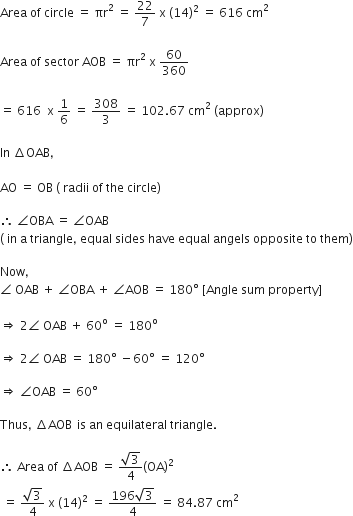
Area of the minor segment = Area of the sector AOB - Area of ΔAOB
= 102.67 - 84.87
= 17.85 cm2
Now,
Area of the major segment = Area of the circle - Area of the minor segment
=616 - 17.8
= 598.2 cm2
Posted by Vipul Amrania 6 years, 10 months ago
- 2 answers
Gaurav Seth 6 years, 10 months ago
Let the police catch the thief in ‘n’ minutes
Since the thief ran 1 min before the police start running.
Time taken by the thief before he was caught = (n + 1) min
Distance travelled by the thief in (n+1) min = 100(n+1)m
Given speed of policeman increased by 10m per minute.
Speed of police in the 1st min = 100m/min
Speed of police in the 2nd min = 110m/min
Speed of police in the 3rd min = 120m/min
Hence 100, 110, 120… are in AP
Total distance travelled by the police in n minutes =(n/2)[2a+(n – 1)d]
= (n/2)[2 x 100 +(n – 1)10]
After the thief was caught by the police,
Distance traveled by the thief = distance travelled by the police
100(n+1)= (n/2)[2 x 100 +(n-1)10]
200(n + 1) = n[200 + 10n – 10]
200n + 200= 200n + n(10n – 10 )
200 = n(n – 1)10
n(n – 1) – 20 = 0
n<font size="2"><font style="box-sizing: inherit; outline: none; user-select: initial !important; max-width: 100%; overflow: hidden;">2 </font></font>– n– 20 = 0
n<font size="2"><font style="box-sizing: inherit; outline: none; user-select: initial !important; max-width: 100%; overflow: hidden;">2 </font></font>– 5n + 4n – 20 = 0
n(n – 5) + 4(n – 5) = 0
(n – 5) (n+4) = 0
(n – 5) = 0 or (n + 4) = 0
n= 5 or n= -4
Hence n= 5 since n cannot be negative
Therefore the time taken by the policeman to catch the thief = 5minutes
Posted by Prabh Singh 6 years, 6 months ago
- 1 answers
Sia ? 6 years, 6 months ago
n3 - n = n (n2 - 1) = n (n - 1) (n + 1)
Whenever a number is divided by 3, the remainder obtained is either 0 or 1 or 2.
∴ n = 3p or 3p + 1 or 3p + 2, where p is some integer.
If n = 3p, then n is divisible by 3.
If n = 3p + 1, then n – 1 = 3p + 1 –1 = 3p is divisible by 3.
If n = 3p + 2, then n + 1 = 3p + 2 + 1 = 3p + 3 = 3(p + 1) is divisible by 3.
So, we can say that one of the numbers among n, n – 1 and n + 1 is always divisible by 3.
⇒ n (n – 1) (n + 1) is divisible by 3.
Similarly, whenever a number is divided by 2, the remainder obtained is 0 or 1.
∴ n = 2q or 2q + 1, where q is some integer.
If n = 2q, then n is divisible by 2.
If n = 2q + 1, then n – 1 = 2q + 1 – 1 = 2q is divisible by 2 and n + 1 = 2q + 1 + 1 = 2q + 2 = 2 (q + 1) is divisible by 2.
So, we can say that one of the numbers among n, n – 1 and n + 1 is always divisible by 2.
⇒ n (n – 1) (n + 1) is divisible by 2.
Since, n (n – 1) (n + 1) is divisible by 2 and 3.
∴ n (n-1) (n+1) = n3 - n is divisible by 6.( If a number is divisible by both 2 and 3 , then it is divisible by 6)
Posted by Abhishek Tyagi 6 years, 10 months ago
- 1 answers
Posted by Vaishnavi Bhangale 6 years, 10 months ago
- 5 answers
Rohan Yadav 6 years, 10 months ago
Ram Kushwah 6 years, 10 months ago
T9=a+8d=-32
a=-32-8d-----------(1)
T11+T13=a+10d+a+12d=-94
2a+22d=-94
a+11d=-47
-32-8d+11d=-47
3d=-15
d=-5
now from (1)
a=-32+11(-5)
=-32-8(-5
=-32+40=8
so AP is
8,3,-2,-7,-12,-17........
Gaurav Seth 6 years, 10 months ago
Let a be the first term and d be the common difference of the AP. Then,
Hence, the common difference of the AP is -5.

myCBSEguide
Trusted by 1 Crore+ Students

Test Generator
Create papers online. It's FREE.

CUET Mock Tests
75,000+ questions to practice only on myCBSEguide app

Damini Goud 6 years, 10 months ago
0Thank You