
Ask questions which are clear, concise and easy to understand.
Ask QuestionPosted by Pratham Saini 6 years, 9 months ago
- 1 answers
Gaurav Seth 6 years, 9 months ago
Solution :
Given A(-2,1), B(a,0),C(4,b),
and D(1,2) are vertices of a
Parallelogram ABCD.
We know that the diagonals
of a parallelogram bisects each
other .
So the midpoint of the diagonals
AC and DB should be same.
Now , we find the midpoint of
AC and DB by using
[ (x1+x2)/2 , (y1+y2)/2 ] formula.
Midpoint of AC=[(-2+4)/2,(1+b)/2]
= [ 1 , (1+b)/2 ] ----( 1 )
Midpoint of BD =[(a+1)/2,(0+2)/2]
= [ (a+1)/2 , 1 ] ---( 2 )
Midpoint of AC= midpoint of BD
i ) ( a + 1 )/2 = 1
=> a + 1 = 2
=> a = 1
ii ) ( 1 + b )/2 = 1
=> 1 + b = 2
=> b = 1
Therefore ,
a = 1 , b = 1
iii ) length of the side AB
A(-2,1) = ( x1, y1)
B(1,0) = ( x2, y2 )
AB = √(x2-x1)² + (y2-y1)²
= √(1+2)²+(0-1)²
= √3²+1²
= √10
iv ) Length of the side BC
BC = √(4-1)²+(1-0)²
= √3²+1²
= √10
Therefore ,
AB = CD = √10
BC = AD = √10
Posted by Thunder ?Yashwanth??? 6 years, 9 months ago
- 1 answers
Gaurav Seth 6 years, 9 months ago
5050 can be expressed as
2×5×5×101=5050
2×5²×101
yes, it is unique because it can be expressed as product of its prime factors
Posted by Aman Shuklq 6 years, 9 months ago
- 2 answers
Gaurav Seth 6 years, 9 months ago
The number which is divisible by 8, 15 and 21 is also divisible by the L.C.M. of the number.
The L.C.M. of 8, 15 and 21 is =
8 = 2 × 2 × 2
15 = 3 × 5
21 = 3 × 7
L.C.M. = 2 × 2 × 2 × 3 × 5 × 7 = 840
If we divide 110000 by 840, we will find out that it is not exactly divisible and we get 800 as remainder.
Thus the number nearest to 110000 but greater than 100000 which is exactly divisible by 840 and also divisible by 8, 15 and 21 is
= 110000 - 840 = 109200
Hence 109200 is exactly divisible by 8, 15 and 21.
Thunder ?Yashwanth??? 6 years, 9 months ago
Posted by Mahira Rana 6 years, 9 months ago
- 1 answers
Gaurav Seth 6 years, 9 months ago
Steps of Construction :
(i) Draw AB = 5.6 cm
(ii) At a draw an acute ∠BAX below base AB.
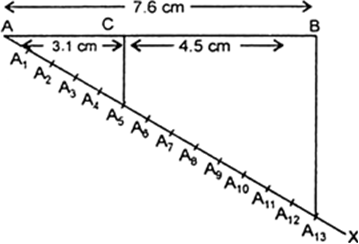
(iii) On AX make 5 + 8 i.e. 13 equal parts and mark them as A1, A2, A3, A4,... A13
(iv) Join B to A13. From A5 draw A5C || A13B. C is the required point of division and AC : CB = 5 : 8.
On measuring, we get
AC = 3.1 cm,
CB = 4.5 cm
Justification :
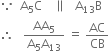
[Using basic proportionally theorem]
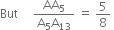
Therefore, 
This shows that C divides AB in the ratio 5 : 8.
Posted by Sowmya Sundararajan 6 years, 9 months ago
- 1 answers
Gaurav Seth 6 years, 9 months ago
Given it's one root of the equation x² - 2kx - 6 = 0
one of its root x = 3
for finding the value of k put the value of x in this equation.
(3)² - 2k(3) - 6 = 0
9 - 6k - 6 = 0
6k = 3
k = 3/6
k = 1/2
hence,the value of k = 1/2
x² - 2(1/2)x - 6 = 0
x² - x - 6 = 0
x² - 3x + 2x - 6 = 0
x(x - 3) + 2(x - 3) = 0
(x + 2)(x - 3) = 0
x = 3 , x = -2
Posted by Kanika Kumar 6 years, 9 months ago
- 1 answers
Gaurav Seth 6 years, 9 months ago

or
1+ sin2 theta =3sin theta cos theta
sin2 theta + cos2 theta +sin2 theta=3sincos theta
2sin2 theta+cos2 theta=3sincos theta
2sin2 - 3 sincos + cos2=0
solve this quadratic u will get 2 factors
(sin-cos)(2sin-cos)=0
sin-cos=0
sin=cos
tan=1
2sin-cos=0
sin/cos=1/2
tan=1/2
Posted by #Aditi~ Angel???? 6 years, 9 months ago
- 1 answers
Posted by Mohit Choudhary 5 years, 8 months ago
- 4 answers
Posted by Kiranpreet S 6 years, 9 months ago
- 1 answers
Aman Soni 6 years, 9 months ago
Posted by Colonel Oo7 6 years, 9 months ago
- 0 answers
Posted by Md Rehan Ansari 6 years, 9 months ago
- 1 answers
Posted by Asdan Ahmad 6 years, 9 months ago
- 4 answers
Kriti Kumari 6 years, 9 months ago
Posted by Belal Khan 6 years, 9 months ago
- 1 answers
Colonel Oo7 6 years, 9 months ago
Posted by Aman Soni 6 years, 4 months ago
- 1 answers
Sia ? 6 years, 4 months ago
Lets suppose there are (2n + 1) stones. Clearly, one stone lies in the middle and n stones on each side of it in a row. Let P be the mid-stone and let A and B be the end stones on the left and right of P respectively.

Clearly, there are n intervals each of length 10 metres on both the sides of P. Now, suppose the man starts from A. He picks up the end stone on the left of mid-stone and goes to the mid-stone, drops it and goes to (n - 1)th stone on left, picks it up, goes to the mid-stone and drops it. This process is repeated till he collects all stones on the left of the mid-stone at the mid-stone. So, distance covered in collecting stones on the left of the mid-stones is
10 {tex} \times{/tex} n + 2 [10 {tex} \times{/tex} (n - 1) + 10 {tex} \times{/tex} (n - 2) + ... + 10 {tex} \times{/tex} 2 + 10 {tex} \times{/tex} 1].After collecting all stones on left of the mid-stone the man goes to the stone B on the right side of the mid-stone, picks it up, goes to the mid-stone and drops it. Then, he goes to (n - 1)th stone on the right and the process is repeated till he collects all stones at the mid-stone.So that distance covered in collecting the stones on the right side of the mid-stone is equal to 2 [10 {tex} \times{/tex} n + 10 {tex} \times{/tex} (n - 1) + 10 {tex} \times{/tex} (n - 2)+ ... +10 {tex} \times{/tex} 2 + 10 {tex} \times{/tex} 1].
Therefore,total distance covered
= 10 {tex} \times{/tex} n + 2 [10 {tex} \times{/tex} (n - 1) + 10 {tex} \times{/tex} (n - 2) + ... + 10 {tex} \times{/tex} 2 + 10 {tex} \times{/tex} 1]+ 2 [10 {tex} \times{/tex} n + 10 {tex} \times{/tex} (n - 1) + ... + 10 {tex} \times{/tex} 2 + 10 {tex} \times{/tex} 1]= 4 [10 {tex} \times{/tex} n + 10 {tex} \times{/tex} (n - 1) + ... +10 {tex} \times{/tex} 2 + 10 {tex} \times{/tex} 1] -10 {tex} \times{/tex} n
{tex} = 40 \{ 1 + 2 + 3 + \ldots + n \} - 10 n = 40 \left\{ \frac { n } { 2 } ( 1 + n ) \right\} - 10 n = 20 n ( n + 1 ) - 10 n = 20 n ^ { 2 } + 10 n{/tex}But, the total distance that a man covered in collecting stones is 3 km.i.e;3000m.
Therefore, 20 n2 + 10n = 3000
{tex} \Rightarrow{/tex} 2n2 + n - 300 = 0.{tex}\implies{2n^2+25n+24n-300=0}{/tex}
{tex} \Rightarrow{/tex} (n - 12) (2n + 25) = 0 [Therefore, 2n + 25 {tex} \neq{/tex} 0]{tex}\implies {n-12=0}{/tex}
{tex} \Rightarrow{/tex} n = 12.Hence, the number of stones is equal to 12.Which is the required answer.
Posted by Hunny Bhai 6 years, 9 months ago
- 1 answers
Posted by Shubham Sharma 6 years, 9 months ago
- 1 answers
Yogita Ingle 6 years, 9 months ago
a = 3 and d = 15 - 3 = 12
Let the required term be nth term
54th term = a +(n-1)d
= 3 + 53x12 = 3 + 636 = 639
therefore 132 + 639 = 771 will be the nth term.
771 = 3 + (n-1)12
768/12 +1 = n
therefore n = 64 +1 = 65
therefore the 65th term will be 132 more than the 54th term.
Posted by Dhruva Gupta 6 years, 4 months ago
- 1 answers
Sia ? 6 years, 4 months ago
Construction:
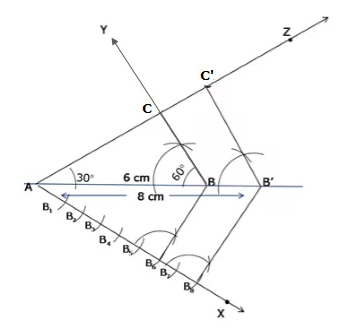
Steps of construction:
- Draw a line segment {tex}AB = 6 \ cm.{/tex}
- At A, construct {tex}\angle{/tex}{tex}BAZ{/tex} = {tex}30 ^ { \circ }{/tex} and at B, construct {tex}\angle{/tex}{tex}ABY {/tex}= {tex}60 ^ { \circ }{/tex}
Suppose AZ and BY intersect at C.
{tex}\triangle{/tex}{tex}ABC {/tex} so obtained is the given triangle. - Below AB, make an acute {tex}\angle{/tex}BAX.
- Along AX, mark off 8 points {tex}B_1, B_2, B_3, B_4, B_5, B_6, B_7, B_8{/tex}
such that {tex}AB_1 = B_1B_2 = B_2B_3 = B_3B_4 = B_4B_5 = B_5B_6 = B_6B_7 = B_7B_8{/tex} - Join B6B.
- From B8, draw {tex}B_8B'||B_6B {/tex} meeting AB produced at B'.
- From B', draw B'C'{tex}\|{/tex}BC, meeting AZ at C'.
Thus, {tex}\triangle{/tex}AB'C' is the required similar triangle.
Posted by Rajat Goel 6 years, 9 months ago
- 0 answers
Posted by Prayansh Singh 6 years, 9 months ago
- 2 answers
Posted by Sheethal Ps 6 years, 9 months ago
- 2 answers
Harsh Rajput 6 years, 9 months ago
Posted by Ranj Ana 6 years, 9 months ago
- 4 answers
Yogita Ingle 6 years, 9 months ago
√ 3x2 + 10x + 7 √ 3
√ 3x2 + 3x + 7x + 7 √ 3 =0
√ 3x( x + √ 3) + 7 ( x + √ 3) = 0
( x + √ 3) ( √ 3x + 7) = 0
x + √ 3 = 0 and √ 3x + 7 = 0
x = - √3 and x = -7/ √3
Harsh Rajput 6 years, 9 months ago
Posted by Ansh Chhabra 6 years, 9 months ago
- 2 answers
Ansh Chhabra 6 years, 9 months ago
Posted by Suhailking Ansari 6 years, 9 months ago
- 1 answers
Shubhendra Pratap Singh 6 years, 9 months ago
Posted by Karan Shukla 6 years, 9 months ago
- 3 answers

myCBSEguide
Trusted by 1 Crore+ Students

Test Generator
Create papers online. It's FREE.

CUET Mock Tests
75,000+ questions to practice only on myCBSEguide app

Gaurav Seth 6 years, 9 months ago
Steps of Construction:
1. Draw a line segment AB of 12 cm
2. Through the points A and B draw two parallel line on the opposite side of AB
3. Cut 2 equal parts on AX and 3 equal parts on BY such that AX1=X1X2 and BX1=Y1Y2=Y2Y3.
4. Join X2Y3 which intersects AB at P∴APPB=23.
Justification:
In ΔAX2P and ΔBY3P, we have
∠APX2=∠BPY3 { Because they are vertically opposite angle}
∠X2AP=∠Y3BP { Because they are alternate interior angles }
ΔAX2P ΔBY3P { Because AA similarity }
∴ APBP=AX2BY3=23 { Because of C.P.C.T }
0Thank You