
Ask questions which are clear, concise and easy to understand.
Ask QuestionPosted by Vishu Gupta 6 years, 9 months ago
- 2 answers
Anushka Jugran❣️ 6 years, 9 months ago
Posted by Akash Sharma 6 years, 9 months ago
- 1 answers
Anushka Jugran❣️ 6 years, 9 months ago
Posted by Ketan Holkar 6 years, 9 months ago
- 2 answers
Puja Sahoo 6 years, 9 months ago
Puja Sahoo 6 years, 9 months ago
Posted by Swathi Poojary 6 years, 9 months ago
- 3 answers
Posted by __@___ Goel 6 years, 9 months ago
- 2 answers
Ishit__ __? 6 years, 9 months ago
Posted by Haris Ansari 6 years, 9 months ago
- 3 answers
Parul Sharma 6 years, 9 months ago
Posted by @ __R Rajput? 6 years, 4 months ago
- 1 answers
Sia ? 6 years, 4 months ago
Let us prove {tex}\sqrt 5 {/tex} irrational by contradiction.
Let us suppose that {tex}\sqrt 5 {/tex} is rational. It means that we have co-prime integers a and b (b ≠ 0)
Such that {tex}\sqrt 5 = \frac{a}{b}{/tex}
{tex}\Rightarrow {/tex} b {tex}\sqrt 5 {/tex}=a
Squaring both sides, we get
{tex}\Rightarrow {/tex} 5b 2 =a 2 ... (1)
It means that 5 is factor of a2
Hence, 5 is also factor of a by Theorem. ... (2)
If, 5 is factor of a , it means that we can write a = 5c for some integer c .
Substituting value of a in (1) ,
5b2 = 25c2
⇒ b2 =5c2
It means that 5 is factor of b2 .
Hence, 5 is also factor of b by Theorem. ... (3)
From (2) and (3) , we can say that 5 is factor of both a and b .
But, a and b are co-prime .
Therefore, our assumption was wrong. {tex}\sqrt 5 {/tex} cannot be rational. Hence, it is irrational.
Posted by Priyaska Biswas 6 years, 9 months ago
- 1 answers
Ram Kushwah 6 years, 9 months ago
Let us assume that {tex}\sqrt 2{/tex} is rational
so let {tex}\sqrt 2{/tex} ={tex}\frac pq{/tex}
where p and q are integers and also let p and q are not having any common factor
{tex}\begin{array}{l}2=\frac{\mathrm p^2}{\mathrm q^2}\\\mathrm p^2=2\mathrm q^2---(1)\\\mathrm{Hence}\;\mathrm p^{\;2}\;\mathrm{is}\;\mathrm{divisble}\;\mathrm{by}\;2\\\mathrm{so}\;\mathrm p^\;\;\mathrm{is}\;\mathrm{divisble}\;\mathrm{by}\;2---(2)\\\mathrm{let}\;\mathrm p=2\mathrm t\;(\;\mathrm t\;\;\mathrm{is}\;\mathrm a\;\mathrm{positive}\;\mathrm{integer})\\\mathrm{So}\;\mathrm{from}(1)\\2\mathrm q^2=4\mathrm t^2\\\mathrm q^2=2\mathrm t^2\\\mathrm{Hence}\;\mathrm q^{\;2}\;\mathrm{is}\;\mathrm{divisble}\;\mathrm{by}\;2\\\mathrm{so}\;\mathrm q^\;\;\mathrm{is}\;\mathrm{divisble}\;\mathrm{by}\;2---(3)\end{array}{/tex}
From (2) and (3) it follows that
p and q both having 2 as the common factor
But this makes wrong our assumption that p and q are not having any common factor
This has come as we assumed that {tex}\sqrt 2{/tex} is rational.
Hence {tex}\sqrt 2{/tex} is a irrational number
Posted by Harshita Swami 6 years, 9 months ago
- 1 answers
Ram Kushwah 6 years, 9 months ago
Let angle of arc ={tex}\theta{/tex}
{tex}\begin{array}{l}\mathrm{Length}\;\mathrm{of}\;\mathrm{arc}=\frac{\mathrm\theta}{360}\times2\mathrm{πr}\\\mathrm{so}\;\frac{\mathrm\theta}{360}\times2\mathrm\pi\times6=12\\\frac{\mathrm{θπ}}{360}=1.....(1)\\\mathrm{now}\;\mathrm{area}\;\mathrm{of}\;\mathrm{sector}\\=\frac{\mathrm\theta}{360}\times\mathrm{πr}^2=1\times\mathrm r^2=\mathrm r^2\;(\;\mathrm{from}\;(1))\\=6^2=36\;\mathrm{cm}^2\end{array}{/tex}
Posted by Ashish Singh 6 years, 9 months ago
- 1 answers
#@Prince Arya 6 years, 9 months ago
Posted by Neeraj Raj 6 years, 4 months ago
- 1 answers
Sia ? 6 years, 4 months ago
Given: ABCD is a quadrilateral circumscribing a circle whose centre is O.
To prove:
- {tex}\angle{/tex}AOB + {tex}\angle{/tex}COD = 180o
- {tex}\angle{/tex}BOC + {tex}\angle{/tex}AOD = 180o
Construction: Join OP, OQ, OR and OS.
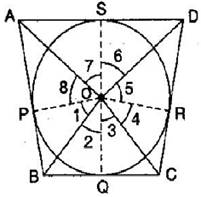
Proof: Since tangents from an external point to a circle are equal.
{tex}\therefore{/tex} AP = AS,
BP = BQ ........ (i)
CQ = CR
DR = DS
In {tex}\triangle{/tex}OBP and {tex}\triangle{/tex}OBQ,
OP = OQ [Radii of the same circle]
OB = OB [Common]
BP = BQ [From eq. (i)]
{tex}\therefore{/tex} {tex}\triangle{/tex}OPB {tex}\cong{/tex} {tex}\triangle{/tex}OBQ [By SSS congruence criterion]
{tex}\therefore{/tex} {tex}\angle{/tex}1 = {tex}\angle{/tex}2 [By C.P.C.T.]
Similarly, {tex}\angle{/tex}3 = {tex}\angle{/tex}4, {tex}\angle{/tex}5 = {tex}\angle{/tex}6, {tex}\angle{/tex}7 = {tex}\angle{/tex}8
Since, the sum of all the angles round a point is equal to 360o.
{tex}\therefore{/tex} {tex}\angle{/tex}1 + {tex}\angle{/tex}2 + {tex}\angle{/tex}3 + {tex}\angle{/tex}4+ {tex}\angle{/tex}5 + {tex}\angle{/tex}6 + {tex}\angle{/tex}7 + {tex}\angle{/tex}8 = 360o
{tex}\Rightarrow{/tex} {tex}\angle{/tex}1 + {tex}\angle{/tex}1 + {tex}\angle{/tex}4 + {tex}\angle{/tex}4+ {tex}\angle{/tex}5 + {tex}\angle{/tex}5 + {tex}\angle{/tex}8 + {tex}\angle{/tex}8 = 360o
{tex}\Rightarrow{/tex} 2 ({tex}\angle{/tex}1 + {tex}\angle{/tex}4 + {tex}\angle{/tex}5 + {tex}\angle{/tex}8) = 360o
{tex}\Rightarrow{/tex} {tex}\angle{/tex}1 + {tex}\angle{/tex}4 + {tex}\angle{/tex}5 + {tex}\angle{/tex}8 = 180o
{tex}\Rightarrow{/tex} ({tex}\angle{/tex}1 + {tex}\angle{/tex}5) + ({tex}\angle{/tex}4 + {tex}\angle{/tex}8) = 180o
{tex}\Rightarrow{/tex} {tex}\angle{/tex}AOB + {tex}\angle{/tex}COD = 180o
Similarly we can prove that
{tex}\angle{/tex}BOC + {tex}\angle{/tex}AOD = 180o
Posted by Mona Sharma ? 6 years, 9 months ago
- 2 answers
Yash Malviya 6 years, 9 months ago
Posted by Sai Ram 6 years, 9 months ago
- 0 answers
Posted by Sahil Rajput 6 years, 9 months ago
- 2 answers
Khushi Agrawal 6 years, 9 months ago
Posted by Ayushi Jain 6 years, 9 months ago
- 1 answers
Posted by Ayushi Jain 6 years, 9 months ago
- 1 answers
Ram Kushwah 6 years, 9 months ago
{tex}\begin{array}{l}\text{∠A=57°,∠B=∠E=83°}\\\text{So ∠C=180-(∠A+∠B)}\\\text{=180-(57+83)=180-140=40°}\end{array}{/tex}
Posted by Ayushi Jain 6 years, 9 months ago
- 2 answers
Posted by Rajesh Patodia 6 years, 9 months ago
- 3 answers
#@Prince Arya 6 years, 9 months ago
Posted by Abhishek Kumar Shah 6 years, 9 months ago
- 1 answers
Posted by Nayah Khan 6 years, 9 months ago
- 2 answers
Posted by Vishnu Ap 6 years, 9 months ago
- 1 answers
Zarfa Umer 6 years, 9 months ago

myCBSEguide
Trusted by 1 Crore+ Students

Test Generator
Create papers online. It's FREE.

CUET Mock Tests
75,000+ questions to practice only on myCBSEguide app

Puja Sahoo 6 years, 9 months ago
2Thank You