
Ask questions which are clear, concise and easy to understand.
Ask QuestionPosted by Shraddha Gupta 5 years, 8 months ago
- 1 answers
Krishna Yadav 6 years, 9 months ago
Posted by Mukesh Bhagat 6 years, 9 months ago
- 3 answers
Posted by Hritik Gupta 6 years, 9 months ago
- 2 answers
Usha ❤❤❤ 6 years, 9 months ago
Ashwani Maurya 6 years, 9 months ago
Posted by Madhu Goel 6 years, 9 months ago
- 2 answers
Posted by Awesome_Rose? Choudhary 6 years, 9 months ago
- 2 answers
Posted by Shankar Rajak 6 years, 9 months ago
- 0 answers
Posted by Namaste Namaste 6 years, 9 months ago
- 0 answers
Posted by Saksham Garg 6 years, 4 months ago
- 1 answers
Sia ? 6 years, 4 months ago
Construction:
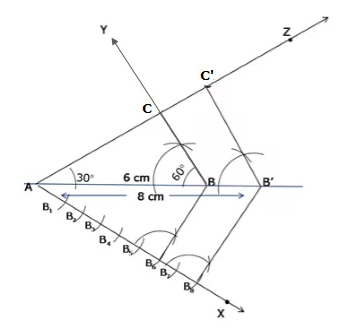
Steps of construction:
- Draw a line segment {tex}AB = 6 \ cm.{/tex}
- At A, construct {tex}\angle{/tex}{tex}BAZ{/tex} = {tex}30 ^ { \circ }{/tex} and at B, construct {tex}\angle{/tex}{tex}ABY {/tex}= {tex}60 ^ { \circ }{/tex}
Suppose AZ and BY intersect at C.
{tex}\triangle{/tex}{tex}ABC {/tex} so obtained is the given triangle. - Below AB, make an acute {tex}\angle{/tex}BAX.
- Along AX, mark off 8 points {tex}B_1, B_2, B_3, B_4, B_5, B_6, B_7, B_8{/tex}
such that {tex}AB_1 = B_1B_2 = B_2B_3 = B_3B_4 = B_4B_5 = B_5B_6 = B_6B_7 = B_7B_8{/tex} - Join B6B.
- From B8, draw {tex}B_8B'||B_6B {/tex} meeting AB produced at B'.
- From B', draw B'C'{tex}\|{/tex}BC, meeting AZ at C'.
Thus, {tex}\triangle{/tex}AB'C' is the required similar triangle.
Posted by Khushi Agrawal 6 years, 4 months ago
- 1 answers
Sia ? 6 years, 4 months ago
Let the given points are A(6,-6), B(3,-7), C(3,3)
And P(x,y) be the centre of the circle. So, AP = BP = CP (radii of the circle)
Taking AP = BP and Squaring both sides, we get,
{tex}\Rightarrow A P ^ { 2 } = B P ^ { 2 }{/tex}
{tex}\Rightarrow ( x - 6 ) ^ { 2 } + ( y + 6 ) ^ { 2 } = ( x - 3 ) ^ { 2 } + ( y + 7 ) ^ { 2 }{/tex}(by using distance formula)
{tex}\Rightarrow x ^ { 2 } - 12 x + 36 + y ^ { 2 } + 12 y + 36{/tex} ={tex}x ^ { 2 } - 6 x + 9 + y ^ { 2 } + 14 y + 49{/tex}
{tex}\Rightarrow - 12 x + 6 x + 12 y - 14 y + 72 - 58 = 0{/tex}
{tex}\Rightarrow - 6 x - 2 y + 14 = 0{/tex}
{tex}\Rightarrow 3 x + y - 7 = 0{/tex} ……….(i)
Again, taking BP = CP and squaring both sides, we get,
{tex}\Rightarrow B P ^ { 2 } = C P ^ { 2 }{/tex}
{tex}\Rightarrow ( x - 3 ) ^ { 2 } + ( y + 7 ) ^ { 2 } = ( x - 3 ) ^ { 2 } + ( y - 3 ) ^ { 2 }{/tex}
{tex}\Rightarrow x ^ { 2 } - 6 x + 9 + y ^ { 2 } + 14 y + 49{/tex} ={tex}x ^ { 2 } - 6 x + 9 + y ^ { 2 } - 6 y + 9{/tex}
{tex}\Rightarrow - 6 x + 6 x + 14 y + 6 y + 58 - 18 = 0{/tex}
{tex}\Rightarrow 20 y + 40 = 0{/tex}
{tex}\Rightarrow y = - 2{/tex}
Putting the value of y in eq. (i),
{tex}3x + y - 7 = 0{/tex}
{tex}\Rightarrow 3 x = 9{/tex}
{tex}\Rightarrow x = 3{/tex}
Hence the coordinates of P i.e. centre of circle are (3,-2).
Posted by Jayjagdish Rout 6 years, 9 months ago
- 0 answers
Posted by Ishant Kumawat 6 years, 9 months ago
- 2 answers
Aryan Yadav 6 years, 9 months ago
Posted by Swati Garhewal 6 years, 9 months ago
- 2 answers
Usha ❤❤❤ 6 years, 9 months ago
Posted by Xyz Abc 6 years, 9 months ago
- 3 answers
Vaibhav Verma 6 years, 9 months ago
Shashi Prabha 6 years, 9 months ago
Posted by Pragya Bharti 6 years, 9 months ago
- 2 answers
Alok Kumar 6 years, 9 months ago
Posted by Mohd Moazzam 6 years, 9 months ago
- 1 answers
Posted by Anushka Tiwari 6 years, 4 months ago
- 1 answers
Sia ? 6 years, 4 months ago

Let PQ be the ladder such that is top Q is on the wall OQ.
The ladder is pulled away from the wall through a distance a, so Q slides and takes position Q'.
Clearly, {tex}PQ = P'Q'.{/tex}
In {tex}\Delta 's{/tex} {tex}POQ \ and \ P'OQ', {/tex}we have
{tex}\sin \alpha = \frac{{OQ}}{{PQ}},\cos \alpha = \frac{{OP}}{{PQ}},\sin \beta = \frac{{OQ'}}{{P'Q'}},\cos \beta = \frac{{OP'}}{{P'Q'}}{/tex}
{tex} \Rightarrow \sin \alpha = \frac{{b + y}}{{PQ}},\cos \alpha \frac{x}{{PQ}},\sin \beta = \frac{y}{{PQ}},\cos \beta = \frac{{a + x}}{{PQ}}{/tex}
{tex} \Rightarrow \sin \alpha - \sin \beta = \frac{{b + y}}{{PQ}} - \frac{y}{{PQ}}{/tex} and
{tex}\cos \beta - \cos \alpha = \frac{{a + x}}{{PQ}} - \frac{x}{{PQ}}{/tex}
{tex} \Rightarrow \sin \alpha - \sin \beta = \frac{b}{{PQ}}{/tex} and
{tex}\cos \beta - \cos \alpha = \frac{a}{{PQ}}{/tex}
{tex} \Rightarrow \frac{a}{b} = \frac{{\cos \alpha - \cos \beta }}{{\sin \beta - \sin \alpha }}{/tex}
Posted by Saurav Kumar Singh 6 years, 9 months ago
- 0 answers
Posted by Jayesh Gur 6 years, 9 months ago
- 0 answers
Posted by Sharan Reddy 6 years, 9 months ago
- 1 answers
Posted by Shafna Shirin 6 years, 9 months ago
- 1 answers
Posted by Rishi Kumar 6 years, 9 months ago
- 3 answers
Bahubali Gaming 6 years, 9 months ago
Siddhartha Jain 6 years, 9 months ago

myCBSEguide
Trusted by 1 Crore+ Students

Test Generator
Create papers online. It's FREE.

CUET Mock Tests
75,000+ questions to practice only on myCBSEguide app

Ashi Jain 6 years, 9 months ago
0Thank You