
Ask questions which are clear, concise and easy to understand.
Ask QuestionPosted by Ramkrishna Karmakar 6 years, 9 months ago
- 3 answers
Posted by ##Little Rock Star## 6 years, 9 months ago
- 2 answers
Posted by Zuhra Rashi 6 years, 9 months ago
- 1 answers
Posted by Sachin Khare 6 years, 9 months ago
- 0 answers
Posted by Narendra Mule 6 years, 9 months ago
- 0 answers
Posted by Yuvraj Chahal 5 years, 8 months ago
- 0 answers
Posted by Harshit Kesharwani 6 years, 9 months ago
- 1 answers
Posted by Ankit Yadav 6 years, 9 months ago
- 0 answers
Posted by Vishakha Singh? 6 years, 9 months ago
- 3 answers
Gungun ? 6 years, 9 months ago
Siddhartha Jain 6 years, 9 months ago
Posted by Sourav Rathee 6 years, 9 months ago
- 0 answers
Posted by Vaibhav Verma 6 years, 9 months ago
- 3 answers
Diksha Kharwal 6 years, 9 months ago
Posted by Atul Kumar 6 years, 9 months ago
- 3 answers
Siddhartha Jain 6 years, 9 months ago
Diksha Kharwal 6 years, 9 months ago
Posted by Shri Krishan 6 years, 9 months ago
- 3 answers
Diksha Kharwal 6 years, 9 months ago
Posted by Kirankalra Kalra 6 years, 9 months ago
- 1 answers
Posted by Ram Gopal 6 years, 4 months ago
- 1 answers
Sia ? 6 years, 4 months ago
Given points are collinear. Therefore
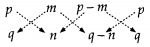
[p {tex}\times{/tex} n + m(q - n) + (p - m) q] - [m {tex}\times{/tex} q + (p - m) n + p (q - n)] = 0
{tex}\Rightarrow{/tex} (pn + qm - mn + pq - mq) - (mq + pn - mn + pq - pn) = 0
{tex}\Rightarrow{/tex} (pn + p q - mn) - (mq - mn + pq) = 0
{tex}\Rightarrow{/tex} pn - mq = 0
{tex}\Rightarrow{/tex} pn = qm
Posted by Nithya Nagaraj 6 years, 9 months ago
- 0 answers
Posted by Nithya Nagaraj 6 years, 9 months ago
- 0 answers
Posted by Nithya Nagaraj 6 years, 9 months ago
- 1 answers
Posted by Prabhat Bolia 6 years, 9 months ago
- 3 answers
Posted by Anil Verma 6 years, 9 months ago
- 1 answers
Posted by Khushi Modi 6 years, 9 months ago
- 2 answers
Posted by Khushi Modi 6 years, 9 months ago
- 3 answers
Posted by Krishna Kant Mishra 6 years, 4 months ago
- 1 answers
Sia ? 6 years, 4 months ago
Given: Right triangles {tex}\triangle ABC{/tex} and {tex}\triangle DBC{/tex} are drawn on the same hypotenuse BC on the same side of BC.
Also, AC and BD intersect at P.
To Prove: {tex}A P \times P C = B P \times P D{/tex}
Proof: In {tex}\triangle BAP{/tex} and {tex}\triangle CDP{/tex}, we have
{tex}\angle B A P = \angle C D P = 90 ^ { \circ }{/tex}
{tex}\angle B P A = \angle C P D{/tex} (vertically opposite angles)
{tex}\therefore \quad \triangle B A P \sim \triangle C D P{/tex} [by AA-similarity]
{tex}\therefore \quad \frac { A P } { D P } = \frac { B P } { C P }{/tex}
{tex}\Rightarrow A P \times C P = B P \times D P{/tex}
{tex}\Rightarrow A P \times P C = B P \times P D{/tex}
Hence, {tex}A P \times P C = B P \times P D{/tex}.
Posted by Suman Das 6 years, 9 months ago
- 4 answers

myCBSEguide
Trusted by 1 Crore+ Students

Test Generator
Create papers online. It's FREE.

CUET Mock Tests
75,000+ questions to practice only on myCBSEguide app

#Miss_Raagini ???? 6 years, 9 months ago
1Thank You