
Ask questions which are clear, concise and easy to understand.
Ask QuestionPosted by Hardik Panwar 6 years, 9 months ago
- 1 answers
Posted by Sahana Shree 6 years, 9 months ago
- 1 answers
#Miss_Raagini ???? 6 years, 9 months ago
Posted by Inayat Ali Ali 6 years, 9 months ago
- 1 answers
Posted by Tenzin Deki 6 years, 4 months ago
- 1 answers
Sia ? 6 years, 4 months ago
Since x + a is a factor of x2+ px + q
then (-a)2 - pa + q = 0
{tex}\Rightarrow{/tex}a2 = pa -q ..........(i)
also (x + a) is a factor of x2+ mx + n then we get
(-a )2 - am + n = 0
{tex}\Rightarrow{/tex} a2 - am + n= 0
{tex}\Rightarrow{/tex}a2 = am - n........(ii)
From eq(i) and (ii), we get
am - n = ap - q
{tex}\Rightarrow{/tex}am - ap = n - q
Hence, a = {tex}\left[ \frac { n - q } { m - p } \right]{/tex}
Posted by Reena Goyal 6 years, 9 months ago
- 1 answers
Gaurav Seth 6 years, 9 months ago
Q. One zero of the polynomial 3x3 + 16x2 + 15x - 18 is 2/3 find the other zero of the polynomial
Answer:
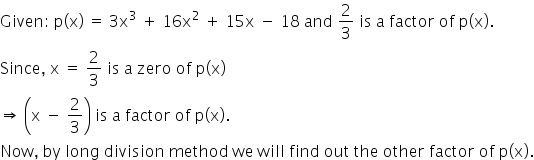
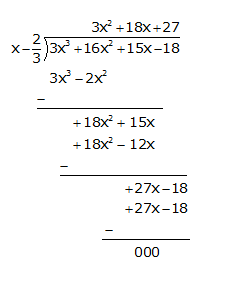
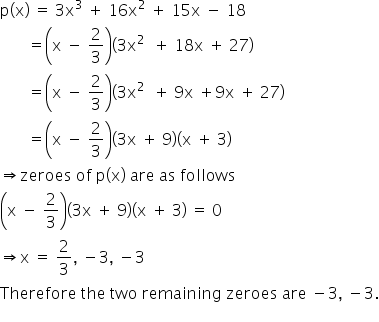
Posted by Raaj Meena 6 years, 9 months ago
- 2 answers
Posted by Kushal Gandhi 6 years, 9 months ago
- 0 answers
Posted by Harsha Theja 6 years, 9 months ago
- 1 answers
Ram Kushwah 6 years, 9 months ago
sin(70+85)
=sin 155
=sin(180-25)
=sin (2x90-25)
=sin 25
Posted by Jatin Yadav 6 years, 9 months ago
- 2 answers
Gaurav Seth 6 years, 9 months ago
Pythagoras Theorem
Statement: In a right angled triangle, the square of the hypotenuse is equal to the sum of squares of the other two sides.
Given: A right triangle ABC right angled at B.
To prove: AC2 = AB2 + BC2
Construction: Draw BD AC
AC

Proof :
We know that: If a perpendicular is drawn from the vertex of the right angle of a right triangle to the hypotenuse, then triangles on both sides of the perpendicular are similar to the whole triangle and to each other.
 ADB
ADB ABC
ABC
So, (Sides are proportional)
Or, AD.AC = AB2 ... (1)
Also,BDCABC
So,
Or, CD. AC = BC2 ... (2)
Adding (1) and (2),
AD. AC + CD. AC = AB2 + BC2
AC (AD + CD) = AB2 + BC2
AC.AC = AB2 + BC2
AC2 = AB2 + BC2
Hence Proved.
Posted by Raj Goswami 6 years, 9 months ago
- 1 answers
Gaurav Seth 6 years, 9 months ago
a=2,sum of first five terms =1/4th sum of next five terms
this gives,, 4 times of sum of first five terms =sum of next five terms
sum of first five terms + sum of next five terms = to sum of first ten terms
sum of first five terms + 4 times of sum of first five terms=sum of first ten terms
5 times of sum of first five terms =sum of first ten terms
5*n/2[2a+4d]=n/2[2a+9d] :(a=2}
5*5/2[4+4d]=10/2[4+9d]
25/2[4+4d]=5[4+9d]
5[4+4d]=2[4+9d]
20+20d=8+18d
so,d= -6
a20 = a+ 19d
= 2 + 19(-6)
= 2 - 114
= -112
Posted by Rajesh Kumar Didwadiya 6 years, 9 months ago
- 1 answers
Gaurav Seth 6 years, 9 months ago
Prove that the line segments joining the mid-points of the adjacent sides of a quadrilateral form a parallelogram
 GIVEN A quadrilateral ABCD in which P. Q, R and S are the mid-points of sides AB, BC, CD and DA respectively. TO PROVE PQRS is a parallelogram.
CONSTRUCTION Join AC.
PROOF In A ABC, P and Q are the mid-points of AB and BC respectively.
PQ || AC
In Δ ACD, R and S are the mid-points of CD and DA
respectively.
SR || AC
From equations (i) and (ii), we have
PQ II AC and SR || AC
PQ || SR.
Similarly, by considering triangles ABD and BCD, we can prove that PS || QR.
Posted by Vivek Patidar 6 years, 9 months ago
- 1 answers
#Miss_Raagini ???? 6 years, 9 months ago
Posted by Jain Ramesh 6 years, 9 months ago
- 2 answers
Posted by Dharmendra Kumar 6 years, 9 months ago
- 1 answers
Gaurav Seth 6 years, 9 months ago
Let hypotenuse be a
Given, base = a-2 ---------------- (1)
Given, altitude = (a-1)/2. ---------------- (2)
By Pythagoras theorem
a^2 = (a-2) + ((a-1)/2)^2
a^2 = (a^2-2a+1)/4 + a^2-4a+4
4a^2 = a^2-2a+1+4(a^2-4a+4)
4a^2 = a^2-2a+1+4a^2-16a+16
a^2 - 18a + 17 =0
(a-17)(a-1) = 0
a = 17
Substitute a = 17 in (2) we get
and lenght of each side = 17 - 1/2
= 16/2
= 8
Posted by Rajmohan Singh 6 years, 9 months ago
- 2 answers
Posted by Ranjan Bhai 6 years, 9 months ago
- 1 answers
Posted by Prashant Kumar 6 years, 9 months ago
- 1 answers
Ram Kushwah 6 years, 9 months ago
{tex}\begin{array}{l}\sin^4\theta-\cos^4\theta\\=(\sin^2\theta+\cos^2\theta)((\sin^2\theta-\cos^2\theta)\\\sin^4\theta-\cos^4\theta=\sin^2\theta-\cos^2\theta\\or\;\;\sin^4\theta+\cos^2\theta=\cos^4\theta+\sin^2\theta\\or\;\sin^2\theta+\cos^4\theta=\;\sin^4\theta+\cos^2\theta\end{array}{/tex}
Hence proved
Posted by Rohit Singh 6 years, 9 months ago
- 1 answers
Simmiii ?? 6 years, 9 months ago
Posted by Yash Goswami 6 years, 9 months ago
- 1 answers
Divya Yadav 6 years, 9 months ago
Posted by Pr!Nce Pr@J@P@T! 6 years, 9 months ago
- 3 answers
Usha Yadav 6 years, 9 months ago
Posted by Zindagi Aayat 6 years, 9 months ago
- 1 answers
Usha Yadav 6 years, 9 months ago
Posted by Shubham Jangra 6 years, 9 months ago
- 3 answers
Simmiii ?? 6 years, 9 months ago
Ship.. ??? 6 years, 9 months ago
Posted by Vibhanshi Jain 6 years, 9 months ago
- 2 answers
Shikhar Singh 6 years, 9 months ago
Posted by Shikhar Singh 6 years, 9 months ago
- 1 answers
Ram Kushwah 6 years, 9 months ago
Let the numbers are xy=10x+y and ab=10a+b
then 4 digit no=xyab=1000x+100y+10a+b
Now 1000x+100y+10a+b-(10x+y+10a+b)=5742
990x+99y=5782
or 10x+y=58
so first No=58
For 2nd No . other condition is required so the question is incomplete
By trial and error method:
take a=1 and b=1
Then 5811-(58+11)=5811-69=5742
again if a-=1 b=2
Then 5812-(58+12)=5812-70=5742
again if a-=2 b=3
Then 5823-(58+23)=
=5800+23-58-23=5800-58=5742
So So many solutions are possible but fist number 58 is sure
Posted by Sahil Ansari 6 years, 4 months ago
- 1 answers
Sia ? 6 years, 4 months ago
Given : {tex}\triangle \mathrm{ABC}{/tex} is right angle at B
To prove: {tex}A C^{2}=A B^{2}+B C^{2}{/tex}
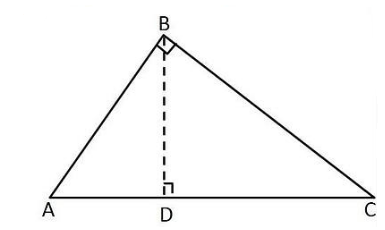
Construction: Draw {tex}B D \perp A C{/tex}
Proof:In {tex}\triangle{/tex}ABC and {tex}\triangle{/tex}ABD
{tex}\angle{/tex}ABC={tex}\angle{/tex}ADB=90
{tex}\angle{/tex}A is common
{tex}\angle{/tex}ABC{tex}\sim{/tex}{tex}\angle{/tex}ADB
{tex}\Rightarrow \frac{A D}{A B}=\frac{A B}{A C}{/tex}
{tex}\Rightarrow{/tex} AD. AC = AB2 ...(i)
Similarly {tex}\Delta \mathrm{BDC} \sim \Delta \mathrm{ABC}{/tex}
{tex}\Rightarrow \frac{C D}{B C}=\frac{B C}{A C}{/tex}
{tex}\Rightarrow{/tex} CD.AC = BC2 ...(ii)
Adding (i) and (ii)
AD.AC + CD. AC= AB2 + BC2
AC(AD + CD) = AB2 + BC2
AC {tex}\times{/tex} AC = AB2 + BC2
AC2 = AB2 + BC2
Hence Proved
Posted by Rahul Kumar 6 years, 9 months ago
- 0 answers
Posted by Sanjay Chouan 6 years, 9 months ago
- 1 answers

myCBSEguide
Trusted by 1 Crore+ Students

Test Generator
Create papers online. It's FREE.

CUET Mock Tests
75,000+ questions to practice only on myCBSEguide app

Bhavya Vardhan Jain 6 years, 9 months ago
0Thank You