
Ask questions which are clear, concise and easy to understand.
Ask QuestionPosted by Deepak Mishra 6 years, 9 months ago
- 0 answers
Posted by Sandeep Rawat 6 years, 9 months ago
- 1 answers
Posted by Mansi R 6 years, 4 months ago
- 1 answers
Sia ? 6 years, 4 months ago
{tex}\sin ^ { 6 } \theta + \cos ^ { 6 } \theta = 1 - 3 \sin ^ { 2 } \theta \cos ^ { 2 } \theta{/tex}
{tex}\text { L.H.S. } = \sin ^ { 6 } \theta + \cos ^ { 6 } \theta{/tex}
{tex}= \left( \sin ^ { 2 } \theta \right) ^ { 3 } + \left( \cos ^ { 2 } \theta \right) ^ { 3 }{/tex}
{tex}= \left( \sin ^ { 2 } \theta + \cos ^ { 2 } \theta \right) \left( \sin ^ { 4 } \theta + \cos ^ { 4 } \theta - \sin ^ { 2 } \theta \cos ^ { 2 } \theta \right){/tex}{tex}\left[ \because a ^ { 3 } + b ^ { 3 } = ( a + b ) \left( a ^ { 2 } + b ^ { 2 } - a b \right) \right]{/tex}
{tex}= 1 \left( \sin ^ { 4 } \theta + \cos ^ { 4 } \theta + 2 \sin ^ { 2 } \theta \cdot \cos ^ { 2 } \theta - 2 \sin ^ { 2 } \theta \cos ^ { 2 } \theta - \sin ^ { 2 } \theta \cos ^ { 2 } \theta \right]{/tex}{tex}\text { since, } \sin ^ { 2 } A + \cos ^ { 2 } A = 1{/tex}
{tex}= \left( \sin ^ { 2 } \theta + \cos ^ { 2 } \theta \right) ^ { 2 } - 3 \sin ^ { 2 } \theta \cos ^ { 2 } \theta{/tex}
{tex}= 1 - 3 \sin ^ { 2 } \theta \cos ^ { 2 } \theta{/tex}
= R.H.S. proved.
Posted by Fatma Naayab 6 years, 9 months ago
- 1 answers
✨Raagini ?? 6 years, 9 months ago
Posted by Nasim Ali 6 years, 9 months ago
- 1 answers
Mehak Rathore 6 years, 9 months ago
Posted by Kishan Sengar 6 years, 9 months ago
- 0 answers
Posted by Himank Chopra 6 years, 9 months ago
- 1 answers
✨Raagini ?? 6 years, 9 months ago
Posted by Tanisha Jain 6 years, 9 months ago
- 1 answers
Fatma Naayab 6 years, 9 months ago
Posted by Aman Sharma 6 years, 9 months ago
- 1 answers
Posted by Kulbeer Dhull 6 years, 9 months ago
- 1 answers
Posted by Sparsh Thakur 6 years, 9 months ago
- 2 answers
Posted by Viraj Shinde 6 years, 9 months ago
- 2 answers
Ani J 6 years, 9 months ago
Posted by Deepanshu Singh 6 years, 9 months ago
- 1 answers
Ram Kushwah 6 years, 9 months ago
If x-1, x-4 and x-7 are in AP
then x-4 will be average of x-1 and x-7
[(x-1)+(x-7)]*1/2=x-4
2x-1-7=2(x-4)
2x-8=2x-8
2x-2x=-8+8
0=0
Hence there is no solution
Statement in your question is not a question this shows that
x-1, x-4 and x-7 are in AP for all real values of x
So x =.-infinite........-5,-4,-3,-2,-1,0,1,2,3.......................infinite
Posted by Boy 4 You 6 years, 9 months ago
- 1 answers
Posted by Muskan Singh 6 years, 9 months ago
- 2 answers
Posted by Mansi Gupta 6 years, 9 months ago
- 5 answers
Rohit Sreeram 6 years, 9 months ago
Posted by Adiii Agrawal 6 years, 9 months ago
- 1 answers
Posted by Anish Khan 6 years, 4 months ago
- 1 answers
Sia ? 6 years, 4 months ago
Volume of concrete required to build the first step, second step, third step, ..... (in m2) are
{tex}\frac{1}{4} \times \frac{1}{2} \times 50,\left( {2 \times \frac{1}{4}} \right) \times \frac{1}{2} \times 50,\left( {3 \times \frac{1}{4}} \right) \times \frac{1}{2} \times 50{/tex}
{tex} \Rightarrow \frac{{50}}{8},2 \times \frac{{50}}{8},3 \times \frac{{50}}{8},.....{/tex}
{tex}\therefore {/tex} Total volume of concrete required = {tex}\frac{{50}}{8} + 2 \times \frac{{50}}{8} + 3 \times \frac{{50}}{8} + ....{/tex}
{tex} = \frac{{50}}{8}\left[ {1 + 2 + 3 + .......} \right]{/tex}
Sn = {tex}\frac{{n}}{2}{/tex} [(2a + (n - 1)d]
S15 {tex} = \frac{{50}}{8} \times \frac{{15}}{2}\left[ {2 \times 1 + (15 - 1) \times 1} \right]\left[ {\because n = 15} \right]{/tex}
{tex} = \frac{{50}}{8} \times \frac{{15}}{2} \times 16{/tex}
= 750 m3
Posted by Sushant Thareja 6 years, 9 months ago
- 3 answers
Posted by Tanushree Maity 6 years, 9 months ago
- 2 answers
Ram Kushwah 6 years, 9 months ago
AS The man planned to pay Rs 3600 in 40 installmetnts
So S40=3600=40/2(2a+39d)
3600 / 20 = 2a+39d
2a+39d=180 -------(1)
Now as 1/3rd of debt is left to pay,so paid by man
=(1-1/3)*3600=2/3*3600=2400
So S30=2400
30/2(2a+29d)=2400
2a+29d=2400/15
2a+29d=160-------(2)
Now subtracting (02 ) from (1)
10d=20
d=2 Rs
Now putting d=20 in (1)
2a+39*2=180
2a=180-78=102
a=51 Rs
So first installment =Rs 51
Posted by Jot Jass 6 years, 9 months ago
- 1 answers
Posted by Thunder ?Yashwanth??? 6 years, 9 months ago
- 1 answers
Ram Kushwah 6 years, 9 months ago
The question is like this:
Show that n2 - 1 is divisible by 8, if n is an odd positive integer
Soln:Any odd positive integer n can be written in form of 4q + 1 or 4q + 3.
If n = 4q + 1, then
n2 - 1 = (4q + 1)2 - 1 = 16q2 + 8q + 1 - 1 = 8q(2q + 1) which is divisible by 8.
If n = 4q + 3,then
n2 - 1 = (4q + 3)2 - 1 = 16q2 + 24q + 9 - 1 = 8(2q2 + 3q + 1) which is divisible by 8.
So, n2 - 1 is divisible by 8, if n is an odd positive integer.
Posted by Keerthi . 6 years, 9 months ago
- 3 answers
Posted by Aayushi Gurjar 6 years, 4 months ago
- 1 answers
Sia ? 6 years, 4 months ago
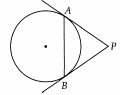
In Triangle APB
Since PA = PB (Tangents from same external point are euqal)
{tex}\therefore {/tex} {tex}\angle P A B = \angle P B A{/tex}
(Opposite angles to equal sides are equal)
Posted by Abinash Thakur 6 years, 9 months ago
- 0 answers
Posted by Anand Shinare 6 years, 9 months ago
- 1 answers
Posted by Anil Verma 6 years, 9 months ago
- 1 answers
Posted by Muskan Singh 6 years, 9 months ago
- 3 answers

myCBSEguide
Trusted by 1 Crore+ Students

Test Generator
Create papers online. It's FREE.

CUET Mock Tests
75,000+ questions to practice only on myCBSEguide app
