
Ask questions which are clear, concise and easy to understand.
Ask QuestionPosted by Anisz Bodo 6 years, 10 months ago
- 1 answers
Rohan Gupta 6 years, 10 months ago
Posted by Anisz Bodo 6 years, 10 months ago
- 1 answers
Posted by Anisz Bodo 6 years, 10 months ago
- 2 answers
Posted by Saurabh Gupta Gupta 6 years, 10 months ago
- 0 answers
Posted by Abc Royal 6 years, 10 months ago
- 0 answers
Posted by Qwerty ...... 6 years, 10 months ago
- 1 answers
Posted by Samyukta ... 6 years, 10 months ago
- 4 answers
Siddhartha Jain 6 years, 10 months ago
Posted by Krishna Rajani 6 years, 10 months ago
- 0 answers
Posted by Johnish Shaji 6 years, 4 months ago
- 1 answers
Sia ? 6 years, 4 months ago
Let the number be (3q + r)
{tex}n = 3 q + r \quad 0 \leq r < 3{/tex}
{tex}\text { or } 3 q , 3 q + 1,3 q + 2{/tex}
{tex}\text { If } n = 3 q \text { then, numbers are } 3 q , ( 3 q + 1 ) , ( 3 q + 2 ){/tex}
{tex}3 q \text { is divisible by } 3{/tex}.
{tex}\text { If } n = 3 q + 1 \text { then, numbers are } ( 3 q + 1 ) , ( 3 q + 3 ) , ( 3 q + 4 ){/tex}
{tex}( 3 q + 3 ) \text { is divisible by } 3{/tex}.
{tex}\text { If } n = 3 q + 2 \text { then, numbers are } ( 3 q + 2 ) , ( 3 q + 4 ) , ( 3 q + 6 ){/tex}
{tex}( 3 q + 6 ) \text { is divisible by } 3{/tex}.
{tex}\therefore \text { out of } n , ( n + 2 ) \text { and } ( n + 4 ) \text { only one is divisible by } 3{/tex}.
Posted by Malta Ghodki 6 years, 10 months ago
- 2 answers
Posted by Anjali Koli 6 years, 10 months ago
- 0 answers
Posted by Aryan Meghani 6 years, 10 months ago
- 1 answers
Malta Ghodki 6 years, 10 months ago
Posted by Nilmani Raj 6 years, 10 months ago
- 1 answers
Posted by Surjeet Singh 6 years, 10 months ago
- 1 answers
Gaurav Seth 6 years, 10 months ago
We know that tangent is always perpendicular to the radius at the point of contact.
So, ∠OAP = 90
We know that if 2 tangents are drawn from an external point, then they are equally inclined to the line segment joining the centre to that point.
So, ∠OPA = 12∠APB = 12×60° = 30°
According to the angle sum property of triangle-
In ∆AOP,∠AOP + ∠OAP + ∠OPA = 180°⇒∠AOP + 90° + 30° = 180°⇒∠AOP = 60°
So, in triangle AOP
tan angle AOP = AP/ OA
√ 3= AP/a
therefore, AP = √ 3a
Posted by Aman Ranjan 6 years, 10 months ago
- 3 answers
Aarmaan Bedil 6 years, 10 months ago
#Itz_Desi_Gujjar_Ravi???? (Gujjar_Sarkar??????) 6 years, 10 months ago
Posted by Samrat Roy 6 years, 10 months ago
- 1 answers
Gaurav Seth 6 years, 10 months ago
|
The Theorem
D, E, F are mid-points of BC, CA, AB. AD, BE and CF are medians. The medians cut each others are centroid G . We need to show that:
AG : GD = BG : GE = CG : GF = 2 : 1 |
|
|
|
|
Simple Proof
Reflect the triangle along AC, you can get a diagram below:
ABCB1 is a parallelogram. BEB1 is a straight line . Since CD = AD1 and CD // AD1, DCD<st1:chmetcnv hasspace="False" negative="False" numbertype="1" sourcevalue="1" tcsc="0" unitname="a" w:st="on">1A</st1:chmetcnv> is a parallelogram. (opposite sides equal and parallel.) \ DG // CG1 BG : GG1 = 1 : 1 Since GE = EG1 , BG : GE = 2 : 1. |


Posted by Bhumika Khajuria 6 years, 10 months ago
- 1 answers
Gaurav Seth 6 years, 10 months ago
Given : A circle with centre O touches the sides AB, BC, CD and DA of a quadrilateral ABCD at the points P, Q, R and S respectively.
To prove : ∠AOB + ∠COD = 180°
∠AOD + ∠BOC = 180°
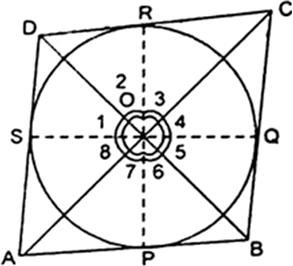
Const. : Join OP, OQ, OR and OS.
Proof : Since, the two tangents drawn from an external point to a circle subtend equal angles at the centre.
∴ ∠1 = ∠2, ∠3 = ∠4, ∠5 = ∠6, ∠7 = ∠8
Since sum of all the angles subtended at a point is 360°.
∠1 + ∠2 + ∠3 + ∠4 + ∠5 + ∠6 + ∠7 + ∠8
= 360°
⇒2 ∠2 + 2 ∠3 + 2 ∠6 + 2 ∠7) = 360°
⇒ 2 (∠2 + ∠3 + ∠6 + ∠7) = 360°
⇒ ∠2 + ∠3 + ∠6 + ∠7) = 180°
⇒ (∠6 + ∠7) + (∠2 + ∠3) = 180°
⇒ ∠AOB + ∠COD = 180°
Similarly, we can prove ∠AOD + ∠BOC = 180°
Posted by Ritesh Sharma 6 years, 10 months ago
- 0 answers
Posted by Vishishta Huggi Vishishta 6 years, 10 months ago
- 3 answers
Gaurav Seth 6 years, 10 months ago
We know that sum = n/2(2a + (n-1) d)
0 = n/2(2 * 18 + (n - 1) * (-2))
0 = n/2(36-2n+2)
0 = 38n - 2n^2
2n^2 - 38n = 0
2n(n-19) = 0
n - 19 = 0
n = 19.
Posted by Davil Sønu 6 years, 10 months ago
- 0 answers
Posted by Vanshika Sharma 6 years, 10 months ago
- 2 answers
Gaurav Seth 6 years, 10 months ago
Let us assume that Prema invests Rs x @10% and Rs y @8% in the first year.
We know that
Interest =
ATQ,
 +
+ =1640
=1640
Þ 10x+8y=164000………..(i)
Next,
After interchanging,
 +
+ =1600
=1600
we get 10y+8x=160000..
8x+10y=160000...(ii)
Adding (i) and (ii)
18x+18y=324000
18x+18y=324000
Þ x + y = 18000 ..(iii)
Subtracting (ii) from (i)
2x-2y=4000
Þ x - y = 2000...(4)
Adding (3) and (4)
2x=20000
Þ x = 10000
Substituting this value of x in (3)
y=8000
So the sums invested in the first year at the rate 10% and 8% are Rs 10000 and Rs 8000 respectively.
Posted by Aman Ranjan 6 years, 10 months ago
- 2 answers
Gaurav Seth 6 years, 10 months ago
Question: PROVE THAT (sin^8A + cos^8A) = (sin^2A - cos^2A)(1 - 2sin^2Acos^2A)
Answer:


myCBSEguide
Trusted by 1 Crore+ Students

Test Generator
Create papers online. It's FREE.

CUET Mock Tests
75,000+ questions to practice only on myCBSEguide app

Sia ? 6 years, 4 months ago
Let perimeter of first square = x metres
Let perimeter of second square = (x +24) metres
Length of side of first square = {tex}\frac { x } { 4 }{/tex}metres {Perimeter of square = 4 × length of side}
Length of side of second square = {tex}\left( \frac { x + 24 } { 4 } \right){/tex}metres
Area of first square = side × side = {tex}\frac { x } { 4 } \times \frac { x } { 4 } = \frac { x ^ { 2 } } { 16 } m ^ { 2 }{/tex}
Area of second square = {tex}\left( \frac { x + 24 } { 4 } \right) ^ { 2 } m ^ { 2 }{/tex}
According to given condition:
{tex}\frac { x^{ 2 } } { 16 } + \left( \frac { x + 24 } { 4 } \right) ^ { 2 } = 468{/tex} {tex}\Rightarrow \frac { x ^ { 2 } } { 16 } + \frac { x ^ { 2 } + 576 + 48 x } { 16 } = 468{/tex}
{tex}\Rightarrow \frac { x ^ { 2 } + x ^ { 2 } + 576 + 48 x } { 16 } = 468{/tex} {tex}\Rightarrow{/tex} 2x2 + 576 + 48x = 468 × 16
{tex}\Rightarrow{/tex} 2x2 +48x + 576 = 7488 {tex}\Rightarrow{/tex} 2x2 + 48x - 6912 = 0
{tex}\Rightarrow{/tex} x2 + 24x - 3456 = 0
Comparing equation x2 + 24x - 3456 = 0 with standard form ax2 + bx + c = 0,
We get a = 1, b = 24 and c = -3456
Applying Quadratic Formula {tex}x = {-b \pm \sqrt{b^2-4ac} \over 2a}{/tex}
{tex}x = \frac { - 24 \pm \sqrt { ( 24 ) ^ { 2 } - 4 ( 1 ) ( - 3456 ) } } { 2 \times 1 }{/tex}
{tex}\Rightarrow x = \frac { - 24 \pm \sqrt { 576 + 13824 } } { 2 }{/tex}
{tex}\Rightarrow x = \frac { - 24 \pm \sqrt { 14400 } } { 2 } = \frac { - 24 \pm 120 } { 2 }{/tex}
{tex}\Rightarrow x = \frac { - 24 + 120 } { 2 } , \frac { - 24 - 120 } { 2 }{/tex}
{tex}\Rightarrow{/tex} x = 48, -72
Perimeter of square cannot be in negative. Therefore, we discard x = -72
Therefore, perimeter of first square = 48 metres
And, Perimeter of second square = x + 24 = 48 + 24 = 72 metres
{tex}\Rightarrow{/tex} Side of First square {tex}= \frac { \text { Perimeter } } { 4 } = \frac { 48 } { 4 } = 12 \mathrm { m }{/tex}
And, Side of second Square {tex}= \frac { \text { Permeter } } { 4 } = \frac { 72 } { 4 } = 18 \mathrm { m }{/tex}
0Thank You