
Ask questions which are clear, concise and easy to understand.
Ask QuestionPosted by Aman Bhardwaj 6 years, 10 months ago
- 1 answers
Posted by Amar Konwar 6 years, 10 months ago
- 7 answers
Priya Darshni 6 years, 10 months ago
Posted by Lilima Chhetri 6 years, 10 months ago
- 2 answers
Priyanka Bisht0803 6 years, 10 months ago
Posted by Thunder ?Yashwanth??? 6 years, 10 months ago
- 1 answers
Posted by Xyz Abc 6 years, 10 months ago
- 1 answers
Arpan Sinha 6 years, 10 months ago
Posted by Ankit Singh Rajput 6 years, 10 months ago
- 0 answers
Posted by Aillef Rai 6 years, 4 months ago
- 1 answers
Sia ? 6 years, 4 months ago
Given: In figure, XY and X'Y' are two parallel tangents to a circle with centre O and another tangent AB with point of contact C intersecting XY at A and X'Y' at B.
To Prove : {tex}\angle{/tex}AOB = 90o
Construction: Join OC

Proof: {tex}\angle{/tex}OPA = 90o ........ (i)
{tex}\angle{/tex}OCA = 90o........ (ii)
[Tangent at any point of a circle is ⊥ to the radius through the point of contact]
In right angled triangles OPA and OCA,
OA = OA [Common]
AP = AC [Tangents from an external
point to a circle are equal]
{tex}\therefore{/tex} {tex}\triangle{/tex}OPA {tex}\cong{/tex} {tex}\triangle{/tex}OCA [RHS congruence criterion]
{tex}\therefore{/tex} {tex}\angle{/tex}OAP = {tex}\angle{/tex}OAC [By C.P.C.T.]
{tex}\Rightarrow{/tex} {tex}\angle{/tex}OAC = {tex}\frac12{/tex}{tex}\angle{/tex}PAB ....... (iii)
Similarly, {tex}\angle{/tex}OBQ = {tex}\angle{/tex}OBC
{tex}\Rightarrow{/tex} {tex}\angle{/tex}OBC = {tex}\frac12{/tex}{tex}\angle{/tex}QBA .......... (iv)
{tex}\because{/tex} XY ∥ X'Y' and a transversal AB intersects them.
{tex}\therefore{/tex} {tex}\angle{/tex}PAB + {tex}\angle{/tex}QBA = 180o [Sum of the consecutive interior angles on the same side
of the transversal is 180o
{tex}\Rightarrow{/tex} {tex}\frac12{/tex}{tex}\angle{/tex}PAB + {tex}\frac12{/tex}{tex}\angle{/tex}QBA = {tex}\frac12{/tex}{tex}\times{/tex} 180o.......... (v)
{tex}\Rightarrow{/tex} {tex}\angle{/tex}OAC + {tex}\angle{/tex}OBC = 90o [From eq. (iii) & (iv)]
In {tex}\triangle{/tex}AOB,
{tex}\angle{/tex}OAC + {tex}\angle{/tex}OBC + {tex}\angle{/tex}AOB = 180o [Angel sum property of a triangle]
{tex}\Rightarrow{/tex} 90o + {tex}\angle{/tex}AOB = 180o [From eq. (v)]
Posted by Jai Dillon 6 years, 10 months ago
- 2 answers
Posted by Ashok Kumar 6 years, 10 months ago
- 4 answers
Priyanka Bisht0803 6 years, 10 months ago
Posted by Aman Singh 6 years, 10 months ago
- 3 answers
Aman Sharma 6 years, 10 months ago
Aliya Qureshi 6 years, 10 months ago
Mayank ... 6 years, 10 months ago
Posted by Abhi Rai 6 years, 10 months ago
- 2 answers
Priyanka Bisht0803 6 years, 10 months ago
Posted by Thunder ?Yashwanth??? 6 years, 10 months ago
- 3 answers
Posted by Thunder ?Yashwanth??? 6 years, 4 months ago
- 1 answers
Sia ? 6 years, 4 months ago
Length of wallpaper =312 m,
Breadth of wallpaper=25 cm =0.25 m
Area of wallpaper = 312 {tex}\times{/tex} 0.25 = 78.00 m2
Length of room = 7 m
Let height be x m, then it's breadth is 2x m
Surface area of four walls = 2 [lh + bh]
= 2 (7x + 2x2)
= 14x + 4x2
According to the question
Surface area of four walls= Area of wallpaper
4x2 + 14x = 78 {tex}\Rightarrow{/tex} 2x2 + 7x - 39 = 0
{tex}\Rightarrow{/tex} 2x2 + 13x - 6x - 39 = 0
{tex}\Rightarrow{/tex} x(2x + 13) - 3 (2x + 13) = 0
{tex}\Rightarrow{/tex}(x - 3) (2x + 13) = 0
{tex}\Rightarrow{/tex} x - 3 = 0 or 2x + 13 = 0
{tex}\Rightarrow{/tex} x = 3 or x = -{tex}\frac{13}{2}{/tex}(rejected) {tex}\Rightarrow{/tex} x = 3 m
Hence, height of the room is 3 m.
Posted by Jatin Pradhan 5 years, 8 months ago
- 1 answers
Posted by Manpreet Singh 6 years, 10 months ago
- 1 answers
Posted by Sooraj Prasad 6 years, 4 months ago
- 1 answers
Sia ? 6 years, 4 months ago
Let radius of cylinder = Radius of cone = r cm
And, height of cylinder = Height of cone = h cm
Given, {tex}\frac { \text { Curved surface area of cylinder } } { \text { Curved surface area of cone } } = \frac { 8 } { 5 }{/tex}
{tex}\Rightarrow \quad \frac { 2 \pi r h } { \pi rl } = \frac { 8 } { 5 }{/tex}
{tex}\Rightarrow \quad \frac { 2 h } { l} = \frac { 8 } { 5 }{/tex}
{tex}\Rightarrow \quad \frac {h } {l } = \frac { 4 } { 5 }{/tex}
{tex}\Rightarrow \quad \frac { h ^ { 2 } } { l ^ { 2 } } = \frac { 16 } { 25 }{/tex}
{tex}\Rightarrow \quad \frac { h ^ { 2 } } { r ^ { 2 } + h ^ { 2 } } = \frac { 16 } { 25 }{/tex} [for a cone l2 = r2 + h2]
{tex}\Rightarrow{/tex} 25h2 = 16r2 + 16h2
{tex}\Rightarrow{/tex} 9h2 = 16r2
{tex}\Rightarrow \quad \frac { 9 } { 16 } = \frac { r ^ { 2 } } { h ^ { 2 } }{/tex}
{tex}\Rightarrow \quad \frac { r } { h } = \frac { 3 } { 4 }{/tex}
Posted by Sooraj Prasad 6 years, 4 months ago
- 1 answers
Sia ? 6 years, 4 months ago
{tex}{/tex}Given: {tex}\Delta{/tex}ABC in which MX {tex}\|{/tex} AB and NX{tex}\|{/tex}AC. MN meets BC produced at T.
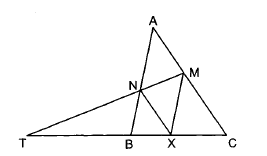
To prove: TX2 = TB {tex}\times{/tex} TC
Proof: In {tex}\Delta MTX ,{/tex}
{tex} X M \| B N{/tex} {given}
{tex} \therefore \quad \frac { T B } { T X } = \frac { T N } { T M }{/tex} ...............(i) [by basic proportionality theorem]
In {tex} \Delta{/tex} TMC, we have
{tex} X N \| C M{/tex}{ given}
{tex} \therefore \quad \frac { T X } { T C } = \frac { T N } { T M }{/tex} ..............(ii) [by basic proportionality theorem]
From equations (i) and (ii), we get,
{tex}\Rightarrow{/tex}{tex} \frac { T B } { T X } = \frac { T X } { T C }{/tex}
{tex} \Rightarrow \quad T X ^ { 2 } = T B \times T C{/tex}
Hence proved.
Posted by Ashutosh Tiwari 6 years, 10 months ago
- 1 answers
Raman Kethoriya 6 years, 10 months ago
Posted by Thalesh Sahu 6 years, 10 months ago
- 0 answers
Posted by Piyush Jorwal 6 years, 10 months ago
- 5 answers
Posted by Mayank Joshi 6 years, 10 months ago
- 0 answers
Posted by Musu Kaushal 6 years, 10 months ago
- 1 answers
Posted by Sangee Rani 6 years, 10 months ago
- 1 answers
Mayank Joshi 6 years, 10 months ago
Posted by Lakshya Rawat 6 years, 4 months ago
- 1 answers
Sia ? 6 years, 4 months ago
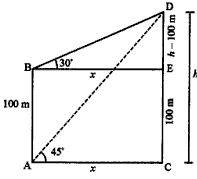
Height of tower = 100 m
Let height of rock = h m = CD
Let distance between them = xm = AC
Using {tex}\triangle {/tex} ACD,{tex}\frac{x}{h} = \cot {45^ \circ }{/tex}
{tex}\Rightarrow {/tex} {tex}\frac{x}{h} = 1 \Rightarrow x = h{/tex}.........(i)
In {tex}\triangle {/tex} BED,{tex}\frac{x}{{h - 100}} = \cot {30^ \circ }{/tex} (since DE = DC - EC)
= DC - AB
= (h-100m)
{tex}\Rightarrow {/tex} {tex}\frac{x}{{h - 100}} = \sqrt 3 {/tex}
x = {tex}\sqrt 3 h - 100\sqrt 3 {/tex}
From (i) and (ii), we get
{tex}\sqrt 3 h - 100\sqrt 3 = h{/tex}
{tex}\Rightarrow {/tex} {tex}\sqrt 3 h - h = 100\sqrt 3 {/tex}
{tex}\Rightarrow {/tex} {tex}\left( {\sqrt 3 - 1} \right)h = 100\sqrt 3 {/tex}
{tex}\Rightarrow {/tex} {tex}h = \frac{{100\sqrt 3 }}{{\sqrt 3 - 1}} = \frac{{100\sqrt 3 }}{{\sqrt 3 - 1}} \times \frac{{\sqrt 3 + 1}}{{\sqrt 3 + 1}}{/tex}
= {tex}\frac{{300 + 100\sqrt 3 }}{{3 - 1}} = \frac{{300 + 100 \times 1.73}}{2}{/tex}
h = {tex}\frac{{300 + 173}}{2} = \frac{{473}}{2} = 236.5\,m{/tex}
Hence, the height of rock is 236.5 m.
Posted by Harsheen Kaur 6 years, 10 months ago
- 1 answers
Kiara D'Cruz 6 years, 10 months ago
Posted by Zakeer Hussain 6 years, 10 months ago
- 2 answers
Esha Pal 6 years, 10 months ago
Aliya Qureshi 6 years, 10 months ago

myCBSEguide
Trusted by 1 Crore+ Students

Test Generator
Create papers online. It's FREE.

CUET Mock Tests
75,000+ questions to practice only on myCBSEguide app

Aman Sharma 6 years, 10 months ago
1Thank You