
Ask questions which are clear, concise and easy to understand.
Ask QuestionPosted by Amit Shinde 6 years, 10 months ago
- 3 answers
Posted by Rahul Kumar 6 years, 10 months ago
- 1 answers
Posted by Vaishikha A. P 6 years, 10 months ago
- 2 answers
Posted by Mr. King ??? 6 years, 10 months ago
- 1 answers
Posted by Apoorva Sharma 6 years, 10 months ago
- 1 answers
Shubhi Tyagi 6 years, 10 months ago
Posted by Aman Sharma 6 years, 10 months ago
- 2 answers
Ram Kushwah 6 years, 10 months ago
3x2-kx+3=0
a=3,b=-k,c=3
b2-4ac=(-k)2-4x(3)(3)
=k2-36
For not having real roots
b2-4ac<0
so k2-36<0
k2 < 36
k < 6
or k > -6
Posted by Deepu Singh 6 years, 10 months ago
- 2 answers
Shubhi Tyagi 6 years, 10 months ago
Posted by Avi Tiwari 6 years, 10 months ago
- 1 answers
Mehak Rathore 6 years, 10 months ago
Posted by Yash Preet 6 years, 10 months ago
- 1 answers
Ram Kushwah 6 years, 10 months ago
Given ratio of sum of n terms of two AP’s = (7n+1):(4n+27)....(1)
Let’s consider the ratio these two AP’s mth terms as am : a’m →(2)
The nth term of AP formula, an = a + (n – 1)d
Hence equation (2) becomes,
am : a’m =[ a + (m – 1)d] :[ a’ + (m – 1)d’]
On multiplying by 2, we get
am : a’m = [2a + 2(m – 1)d] : [2a’ + 2(m – 1)d’]
= [2a + {(2m – 1) – 1}d] : [2a’ + {(2m – 1) – 1}d’]
= S2m – 1 : S’2m – 1
= [7(2m – 1) + 1] : [4(2m – 1) +27] [from (1)]
= [14m – 7 +1] : [8m – 4 + 27]
= [14m – 6] : [8m + 23]
Thus the ratio of mth terms of two AP’s is {tex}\frac{14m-6}{8m+23}{/tex}
Posted by Bhupendra Sarode 6 years, 10 months ago
- 0 answers
Posted by Aanchal Sharma 6 years, 10 months ago
- 2 answers
Anurag Gupta 6 years, 10 months ago
Mayank ... 6 years, 10 months ago
Posted by Priya Raju 6 years, 10 months ago
- 4 answers
Aman Sharma 6 years, 10 months ago
Posted by Sammy'S K 6 years, 10 months ago
- 3 answers
Ashwini Ramteke 6 years, 10 months ago
Affu 😊 6 years, 10 months ago
Posted by Wajahat Wani 6 years, 10 months ago
- 0 answers
Posted by Ashwin Sharma 6 years, 10 months ago
- 1 answers
Posted by Pranav Attre 6 years, 4 months ago
- 1 answers
Sia ? 6 years, 4 months ago
Given: ABC is an isosceles triangle right angled at C.
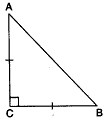
To prove: AB2 = 2AC2
Proof : ABC is an isosceles triangle right angle at C.
{tex}\therefore {/tex} AC = BC........(1)
and {tex}\angle{/tex}C = 90o.......(2)
In view of (2) in {tex}\vartriangle {/tex} ABC,
AB2 = AC2 + BC2........By Pythagoras theorem.
AC2 + AC2 ........Frrom(1)
= 2Ac2
Posted by Moon Sidana 6 years, 10 months ago
- 1 answers
Aman Sharma 6 years, 10 months ago
Posted by Jyoti Singh 6 years, 10 months ago
- 0 answers
Posted by Devi Chandana 6 years, 10 months ago
- 1 answers
Posted by Data Ram Shankar Lal 6 years, 10 months ago
- 1 answers
Posted by Sonia Dua 6 years, 10 months ago
- 1 answers
Aliya Qureshi 6 years, 10 months ago
Posted by Amar Konwar 6 years, 10 months ago
- 1 answers
Aliya Qureshi 6 years, 10 months ago
Posted by Kiran Mallannavar 6 years, 10 months ago
- 1 answers
Posted by Daksh Dubey 5 years, 8 months ago
- 1 answers
Google User 6 years, 10 months ago
Posted by Nandini Sharma 6 years, 10 months ago
- 0 answers
Posted by Shubham Bhatt 6 years, 4 months ago
- 1 answers
Sia ? 6 years, 4 months ago
Given,
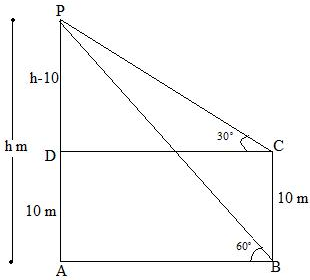
Let the height of the tower be h cm.
Now, In {tex}\triangle{/tex}PAB,
{tex}\tan 60^{\circ}=\frac{A P}{A B}{/tex}
{tex}\Rightarrow \sqrt{3}=\frac{h}{A B}{/tex}
{tex}\Rightarrow A B=\frac{h}{\sqrt{3}}{/tex} .....(i)
And, In {tex}\triangle{/tex}PCD,
{tex}\tan 30^{\circ}=\frac{P D}{C D}{/tex}
{tex}\Rightarrow \frac{1}{\sqrt{3}}=\frac{h-10}{C D}{/tex}
{tex}\Rightarrow{/tex} CD = {tex}\sqrt{3}(h-10){/tex} ...(ii)
Since, AB = CD, so equation (ii) becomes,
{tex}A B=\sqrt{3}(h-10){/tex} ....(iii)
Equating equation (i) and (iii), we get,
{tex}\frac{h}{\sqrt{3}}=\sqrt{3}(h-10){/tex}
{tex}\Rightarrow h=3(h-10){/tex}
{tex}\Rightarrow{/tex} {tex}2h = 30 {/tex}
{tex}\Rightarrow{/tex} {tex}h = 15 cm{/tex}

myCBSEguide
Trusted by 1 Crore+ Students

Test Generator
Create papers online. It's FREE.

CUET Mock Tests
75,000+ questions to practice only on myCBSEguide app

Chhaya Gond 6 years, 10 months ago
0Thank You