
Ask questions which are clear, concise and easy to understand.
Ask QuestionPosted by Deepanshu Nuwal 6 years, 10 months ago
- 2 answers
Posted by Shivam Smarty 6 years, 10 months ago
- 0 answers
Posted by Karan Saini 6 years, 10 months ago
- 1 answers
Posted by Shivam Bhati 6 years, 10 months ago
- 1 answers
Posted by Kiran Yadav 6 years, 10 months ago
- 3 answers
Posted by Jyoti Tiwari 6 years, 10 months ago
- 2 answers
Posted by Mohit Singh 6 years, 10 months ago
- 6 answers
Posted by Rohit Yadav 6 years, 4 months ago
- 1 answers
Sia ? 6 years, 4 months ago
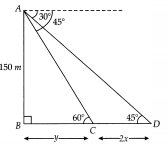
Let the speed of the boat be x m/min.
{tex}\therefore{/tex}Distance covered in 2 minutes = 2x
{tex}\therefore{/tex} CD = 2x
Let BC = y
In {tex}\triangle{/tex}ABD,
{tex}\frac { A B } { B C } = \tan 60 ^ { \circ }{/tex}
{tex}\Rightarrow \quad \frac { 150 } { y } = \sqrt { 3 }{/tex}
{tex}\Rightarrow \quad y = \frac { 150 } { \sqrt { 3 } }{/tex}
{tex}\Rightarrow \quad y = 50 \sqrt { 3 }{/tex}.......(i)
In {tex}\triangle{/tex}ABD,
{tex}\frac { A B } { B D } = \tan 45 ^ { \circ }{/tex}
{tex}\Rightarrow \quad \frac { 150 } { y + 2 x } = 1{/tex}
{tex}\Rightarrow \quad y + 2 x = 150{/tex}........(ii)
Substituting the value of y from (i) in (ii) we get
50√3 + 2x = 150
x = 75 - 25√3 = 25(3 - √3) m/sec
{tex}=\frac{25(3-√3)×60}{1000}=\frac{3}{2}×(3-√3){/tex} km/min
Posted by Akshat Bhatt 6 years, 10 months ago
- 3 answers
H@Rdik K@Shy@P. Csk Is Best 6 years, 10 months ago
Posted by Fathima Bv 6 years, 10 months ago
- 1 answers
Posted by Puja Tamang 6 years, 10 months ago
- 1 answers
Posted by Lustig Yashu? 6 years, 10 months ago
- 1 answers
Posted by Shruti Sharma 6 years, 10 months ago
- 1 answers
Honey ??? 6 years, 10 months ago
Posted by Biswqcycychcjf Cufjcjcjv 6 years, 10 months ago
- 1 answers
Posted by Munish Joshi 6 years, 10 months ago
- 0 answers
Posted by Mehak Arya 6 years, 10 months ago
- 1 answers
Posted by Khushi Rawat 6 years, 10 months ago
- 0 answers
Posted by Pavankumar Pavankumar 6 years, 10 months ago
- 2 answers
Posted by Apurwa Pandey 6 years, 10 months ago
- 3 answers
Posted by Dev Agrawal 6 years, 7 months ago
- 1 answers
Sia ? 6 years, 7 months ago
Given, {tex}x^2+5x-(a^2+a-6)=0{/tex}
splitting {tex}a^2+a-6{/tex}
{tex}\Rightarrow{/tex} x2 + 5x - (a2 + 3a - 2a - 6) = 0
{tex}\Rightarrow{/tex} x2 + 5x - [ a(a + 3) - 2 (a + 3) ] = 0
{tex}\Rightarrow{/tex} x2 + 5x - (a + 3)(a - 2) = 0
Now splitting the middle term
{tex}\Rightarrow{/tex} x2 + (a + 3)x -(a - 2)x - (a + 3) (a - 2) = 0
{tex}\Rightarrow{/tex} x [x + ( a + 3)] - ( a - 2)[ x + (a + 3)] = 0
{tex}\Rightarrow{/tex} [x + ( a + 3) ] [ x - (a - 2)] = 0
{tex}\Rightarrow{/tex} x + ( a + 3) = 0 or x - ( a - 2) = 0
{tex}{/tex} Therefore, {tex}x=-(a+3) \ {or} \ (a-2){/tex}
Posted by Dolma Lhamo 6 years, 10 months ago
- 4 answers
Posted by Kunal Chirania 6 years, 4 months ago
- 1 answers
Sia ? 6 years, 4 months ago
Let P be the position of the pole and A & B be the opposite fixed gates. Let, BP= x metres.
{tex}\therefore{/tex} AP = x + 7
In right triangle APB,
AP2 + BP2 = AB2
{tex}\Rightarrow{/tex}(x + 7)2 + x2 = 132
{tex}\Rightarrow{/tex}x2 + 49 + 14x + x2 = 169
{tex}\Rightarrow{/tex} 2x2 + 14x + 49 - 169 = 0
{tex}\Rightarrow{/tex}2x2 + 14x - 120 = 0
{tex}\Rightarrow{/tex}2(x2 + 7x - 60) = 0
{tex}\Rightarrow{/tex} x2 + 7x - 60 = 0
{tex}\Rightarrow{/tex}x2 + 12x - 5x - 60 = 0
{tex}\Rightarrow{/tex} x(x + 12) - 5(x + 12) = 0
{tex}\Rightarrow{/tex} (x + 12)(x - 5) = 0
{tex}\Rightarrow x=5 \ or \ -12{/tex}
As x can not be negative. So, x = 5.
Therefore, AP = 7+5 = 12
Hence, AP = 12 m and BP = 5 m
Posted by Lustig Yashu? 6 years, 10 months ago
- 0 answers
Posted by Shobha Ray 6 years, 10 months ago
- 1 answers
Devanshu Sharma 6 years, 10 months ago
Posted by Kavya Saraiya 6 years, 10 months ago
- 0 answers
Posted by Aniket Kumar 6 years, 4 months ago
- 1 answers
Sia ? 6 years, 4 months ago
Let S be the total surface area of the decorative block. Then,
S = Total surface area of the cube - Base area of hemisphere + Curved surface area of hemisphere
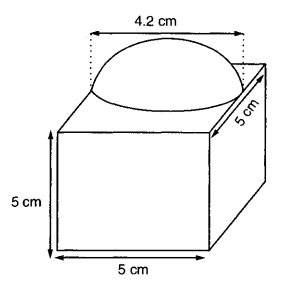
{tex}\Rightarrow S = \left( 6 \times 5 \times 5 - \pi r ^ { 2 } + 2 \pi r ^ { 2 } \right) \mathrm { cm } ^ { 2 }{/tex}
{tex}\Rightarrow S = \left( 150 + \pi r ^ { 2 } \right) \mathrm { cm } ^ { 2 }{/tex}
{tex}\Rightarrow S = \left\{ 150 + \frac { 22 } { 7 } \times ( 2.1 ) ^ { 2 } \right\} \mathrm { cm } ^ { 2 }{/tex}
{tex}\Rightarrow S = \{ 150 + 22 \times 0.3 \times 2.1 \} \mathrm { cm } ^ { 2 }{/tex}
{tex}\Rightarrow{/tex} S = (150 + 13.86) cm2 = 163.86 cm2
Posted by Dubey Prakash 6 years, 4 months ago
- 1 answers
Sia ? 6 years, 4 months ago
Point P(x, 0) is equidistant from point A(- 2, 0) and B(6, 0) i.e. AP = BP
{tex}\Rightarrow AP^2=BP^2{/tex}
{tex}\Rightarrow (-2-x)^2+(0-0)^2=(6-x)^2+ (0-0)^2{/tex}(by distance formula)
{tex}\Rightarrow [(-1)(2+x)]^2=(6-x)^2{/tex}
{tex}\Rightarrow 4+4x+x^2=36- 12x +x^2{/tex}
{tex}\Rightarrow 4+4x=36- 12x {/tex}
{tex}\Rightarrow 36- 12x -4-4x=0{/tex}
{tex}\Rightarrow 32- 16x =0{/tex}
{tex}\Rightarrow 32= 16x {/tex}
{tex}\Rightarrow x=2{/tex}
Hence, point P(2,0) is equidistant from point A(- 2, 0) and B(6, 0).

myCBSEguide
Trusted by 1 Crore+ Students

Test Generator
Create papers online. It's FREE.

CUET Mock Tests
75,000+ questions to practice only on myCBSEguide app

Lekshmy Iyer 6 years, 10 months ago
0Thank You