
Ask questions which are clear, concise and easy to understand.
Ask QuestionPosted by Souvik Roy 6 years, 8 months ago
- 1 answers
Posted by Kiran Dahal 6 years, 7 months ago
- 1 answers
Sia ? 6 years, 7 months ago
Given numbers are 657 and 963 .
Here, 657 < 963
By using Euclid's Division algorithmm , we get
963 = (657 × 1) + 306
Here , remainder = 306 .
So, On taking 657 as new dividend and 306 as the new divisor and then apply Euclid's Division lemma, we get
657 = (306 × 2) + 45
Here, remainder = 45
So, On taking 306 as new dividend and 45 as the new divisor and then apply Euclid's Division lemma, we get
306 = (45 × 6) + 36
Here, remainder = 36
So, On taking 45 as new dividend and 36 as the new divisor and then apply Euclid's Division lemma, we get
45 = (36 × 1) + 9
Here, remainder = 9
So, On taking 36 as new dividend and 9 as the new divisor and then apply Euclid's Division lemma, we get
36 = (9 × 4) + 0
Here , remainder = 0 and last divisor is 9.
Hence, HCF of 657 and 963 = 9.
Posted by Pratik Gupta 6 years, 7 months ago
- 1 answers
Sia ? 6 years, 7 months ago
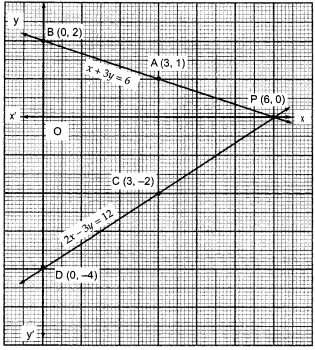
Graph of the equation {tex}x + 3y = 6{/tex}:
We have, {tex}x + 3y = 6{/tex} {tex} \Rightarrow {/tex} {tex}x = 6 - 3y{/tex}
When y = 1, we have x = 6 - 3 =3
When y = 2, we have x = 6 - 6 = 0
Thus, we have the following table:
| x | 3 | 0 |
| y | 1 | 2 |
Plotting the points {tex}A(3,1)\ and\ B(0,2){/tex} and drawing a line joining them, we get the graph of the equation x + 3y = 6 as shown in Fig.
Graph of the equation {tex}2x - 3y = 12{/tex} :
We have, {tex} 2 x - 3 y = 12 \Rightarrow y = \frac { 2 x - 12 } { 3 }{/tex}
When x=3, we have {tex}y = \frac { 2 \times 3 - 12 } { 3 } = - 2{/tex}
When x=0, we have {tex}y = \frac { 0 - 12 } { 3 } = - 4{/tex}
| x | 3 | 0 |
| y | -2 | -4 |
Plotting the points {tex}C(3,-2)\ and\ D(0, - 4){/tex} on the same graph paper and drawing a line joining them, we obtain the graph of the equation {tex}2x - 3y = 12{/tex} as shown in Fig.
Clearly, two lines intersect at P(6, 0).
Hence, {tex}x = 6, y = 0{/tex} is the solution of the given system of equations.
Putting x = 6, y = 0 in {tex}a = 4x + 3y{/tex}, we get
a = (4 {tex}\times{/tex} 6) + (3 {tex}\times{/tex} 0) = 24
Posted by Honey ???? 6 years, 8 months ago
- 5 answers
Posted by Akhilesh Kumar 6 years, 8 months ago
- 0 answers
Posted by Akhilesh Pandey 6 years, 8 months ago
- 2 answers
Posted by ?Pretty? Girl.?? 6 years, 8 months ago
- 3 answers
Posted by Mayank Mishra 6 years, 8 months ago
- 1 answers
Gaurav Seth 6 years, 8 months ago
Sol: Let n be a positive integer then, n can be odd or even. (i) If n is odd, it is not divisible by 2. Therefore, n can be written as = 1 x n = 20 x n = product of a non-negative power of 2 and an odd number . (ii) If n is even, it is divisible by 2. Then m = n / 2 is an integer. If m is odd, it cannot be divided by 2. Because of m = n / 2 ⇒ n = 2m = 21 x m = product of a non-negative power of 2 and an odd number. If m is even, it is divisible by 2. Then p = m / 2 is an integer. If p is odd, it cannot be divided by 2. Because p = m / 2 and m = n / 2, we obtain p = n / 4 ⇒ n = 4p = 22 x p = product of a non-negative power of 2 and an odd number If p is even, it is further divisible by 2, and the above steps can be repeated until we arrive at an integer which is no longer divisible by 2, i.e., it is odd. Hence every positive integer different from 1 can be expressed as a product of non-negative power of 2 and an odd number.
Posted by Tushar Verma 6 years, 8 months ago
- 2 answers
Ca Dipesh Arora 6 years, 8 months ago
x2 -3x - 10
x2 - 3x -10 + 9/4 -9/4 (we square the term obtained by dividing the coefficient of x by 2, after that we add and subtract the same in to the equation)
now, (x2 -3x + 9/4) -10-9/4
(x-3/2)2 - 49/4 = 0
(x-3/2)2 - (7/2)2 = 0
(x-3/2-7/2) (x-3/2 +7/2) = 0
(x-10/2) (x + 4/2)
x=5, -2 is the solution
Posted by Aman Kumar 6 years, 8 months ago
- 3 answers
Gagan Offficial 6 years, 8 months ago
Posted by Aranya Aditya 6 years, 7 months ago
- 1 answers
Sia ? 6 years, 7 months ago
n3 - n = n (n2 - 1) = n (n - 1) (n + 1)
Whenever a number is divided by 3, the remainder obtained is either 0 or 1 or 2.
∴ n = 3p or 3p + 1 or 3p + 2, where p is some integer.
If n = 3p, then n is divisible by 3.
If n = 3p + 1, then n – 1 = 3p + 1 –1 = 3p is divisible by 3.
If n = 3p + 2, then n + 1 = 3p + 2 + 1 = 3p + 3 = 3(p + 1) is divisible by 3.
So, we can say that one of the numbers among n, n – 1 and n + 1 is always divisible by 3.
⇒ n (n – 1) (n + 1) is divisible by 3.
Similarly, whenever a number is divided by 2, the remainder obtained is 0 or 1.
∴ n = 2q or 2q + 1, where q is some integer.
If n = 2q, then n is divisible by 2.
If n = 2q + 1, then n – 1 = 2q + 1 – 1 = 2q is divisible by 2 and n + 1 = 2q + 1 + 1 = 2q + 2 = 2 (q + 1) is divisible by 2.
So, we can say that one of the numbers among n, n – 1 and n + 1 is always divisible by 2.
⇒ n (n – 1) (n + 1) is divisible by 2.
Since, n (n – 1) (n + 1) is divisible by 2 and 3.
∴ n (n-1) (n+1) = n3 - n is divisible by 6.( If a number is divisible by both 2 and 3 , then it is divisible by 6)
Posted by Harsh Sooda 6 years, 8 months ago
- 2 answers
Gagan Offficial 6 years, 8 months ago
Posted by Satya Ojha 6 years, 7 months ago
- 1 answers
Sia ? 6 years, 7 months ago
Let n = 4q + 1 (an odd integer)
{tex}\therefore \quad n ^ { 2 } - 1 = ( 4 q + 1 ) ^ { 2 } - 1{/tex}
{tex}= 16 q ^ { 2 } + 1 + 8 q - 1 \quad \text { Using Identity } ( a + b ) ^ { 2 } = a ^ { 2 } + 2 a b + b ^ { 2 }{/tex}
{tex}= 16{q^2} + 8q{/tex}
{tex}= 8 \left( 2 q ^ { 2 } + q \right){/tex}
= 8m, which is divisible by 8.
Posted by Rachit Tomar 6 years, 8 months ago
- 2 answers
Posted by Anurag Rai 2019 Boy 6 years, 8 months ago
- 1 answers
Hemant Garg 6 years, 8 months ago
Posted by Amritpal Kaur 6 years, 6 months ago
- 1 answers
Sia ? 6 years, 6 months ago
We have, α and β are the roots of the quadratic polynomial. f(x) =x2 - 5x + 4
Sum of zeros: {tex}\alpha+\beta=-\frac{b}{a}=-\frac{\text { coefficient of } x}{\text { coefficient of } x^{2}}{/tex}
product of zeros: {tex}\alpha \beta=\frac{c}{a}=\frac{\text { constant term }}{\text { coefficient of } x^{2}}{/tex}
We have a=1,b=-5 and c= 4.
Sum of the roots = α + β = 5
Product of the roots = αβ = 4
So,
{tex}\frac{1}{\alpha } + \frac{1}{\beta } - 2\alpha \beta = \frac{{\beta + \alpha }}{{\alpha \beta }} - 2\alpha \beta{/tex}
{tex}5/4-2\times4=5/4-8{/tex} ={tex}\left(5-32\right)/4{/tex}={tex}-27/4{/tex}
Hence,we get the result of {tex}\frac{{ 1 }}{\alpha} + \frac{{ 1 }}{\beta} - 2\alpha\beta{/tex} = {tex}-\frac{{ 27 }}{ 4}{/tex}
Posted by Josu Joby 6 years, 8 months ago
- 0 answers
Posted by ?Pretty? Girl.?? 6 years, 8 months ago
- 4 answers
Posted by Amritpal Kaur 6 years, 8 months ago
- 1 answers
Posted by Aditya Tiwari 6 years, 8 months ago
- 1 answers
Posted by Amritpal Kaur 6 years, 7 months ago
- 1 answers
Sia ? 6 years, 7 months ago
f(x) = 6x2 + x - 2
a = 6, b = 1, c = -2
Let zeroes be {tex}\alpha{/tex} and β.Then
Sum of zeroes= {tex}\alpha{/tex} + β {tex}=\;-\frac ba\;=-\frac16{/tex}
Product of zeroes {tex}\alpha{/tex}× β {tex}=\;\;\frac ca\;=\;\frac{-2}6\;=\;-\frac13{/tex}
{tex}\frac { \alpha } { \beta } + \frac { \beta } { \alpha } = \frac { \alpha ^ { 2 } + \beta ^ { 2 } } { \alpha \beta }{/tex}
{tex}= \frac { ( \alpha + \beta ) ^ { 2 } - 2 \alpha \beta } { \alpha \beta } \left[ \because ( \alpha + \beta ) ^ { 2 } = \alpha ^ { 2 } + \beta ^ { 2 } + 2 \alpha \beta \right]{/tex}
{tex}= \frac { \left[- \frac { 1 } { 6 } \right] ^ { 2 } - 2 \left[ - \frac { 1 } { 3 } \right] } { \left[ - \frac { 1 } { 3 } \right] }{/tex}
{tex}= \frac { \frac { 1 } { 36 } + \frac { 2 } { 3 } } { - \frac { 1 } { 3 } }{/tex}
{tex}= \frac { \frac { 1 + 24 } { 36 } } { - \frac { 1 } { 3 } }{/tex}
{tex}= \frac { 25 } { 36 } \times \frac { - 3 } { 1 }{/tex}
{tex}= \frac { - 25 } { 12 }{/tex}
Posted by Awngmai Lazum 6 years, 8 months ago
- 0 answers
Posted by Aish _.._.. 6 years, 8 months ago
- 1 answers
Posted by ?Pretty? Girl.?? 6 years, 8 months ago
- 5 answers
Yash ? 6 years, 8 months ago
Posted by Piyush Rai 6 years, 8 months ago
- 1 answers
Posted by Rohit Sahani? 6 years, 8 months ago
- 4 answers
Posted by Mr Sahil Boss 6 years, 8 months ago
- 2 answers
Posted by ?Pretty? Girl.?? 6 years, 8 months ago
- 3 answers

myCBSEguide
Trusted by 1 Crore+ Students

Test Generator
Create papers online. It's FREE.

CUET Mock Tests
75,000+ questions to practice only on myCBSEguide app

Ayasha Verma 6 years, 8 months ago
1Thank You