
Ask questions which are clear, concise and easy to understand.
Ask QuestionPosted by Tannu Bhadana 6 years, 8 months ago
- 0 answers
Posted by Rahul Delu 6 years, 8 months ago
- 1 answers
Prashant Yadav 6 years, 8 months ago
Posted by Reeja Shaj 6 years, 8 months ago
- 0 answers
Posted by Ansh Rathoure 6 years, 8 months ago
- 0 answers
Posted by Jaani Kaur? 6 years, 7 months ago
- 1 answers
Sia ? 6 years, 7 months ago
117 = 13 {tex}\times{/tex} 3 {tex}\times{/tex} 3
65 = 13 {tex}\times{/tex} 5
HCF (117, 65) = 13
LCM(117,65) = 13 {tex}\times{/tex} 5 {tex}\times{/tex} 3 {tex}\times{/tex} 3 = 585
Here is given that:
{tex}HCF =65m-117 {/tex}
{tex}13=65m-117{/tex}
{tex}65m=130{/tex}
m = {tex}\frac { 130 } { 6 5 } ={/tex}2
Posted by Brightlander... ?????? 6 years, 8 months ago
- 2 answers
Posted by Vishal Kumar 6 years, 7 months ago
- 1 answers
Sia ? 6 years, 7 months ago
Here, {tex}\frac{AB}{DF}=\frac{4}{6}=\frac{2}{3}{/tex} , {tex}\frac{BC}{EF}=\frac{5}{7.5}=\frac{2}{3}{/tex} , {tex}\frac{AC}{DE}=\frac{3}{4.5}=\frac{2}{3}{/tex}
As, {tex}\frac{AB}{DF}=\frac{BC}{EF}=\frac{AC}{DE}{/tex}
So, {tex}\Delta ABC \sim \Delta DFE{/tex} [by SSS similarity criterion]
Hence ABC and DFE are similar triangles, but no other pairs of triangles in the given figure are similar.
Posted by Mehak Sharma 6 years, 8 months ago
- 1 answers
Posted by Palak Bansal 6 years, 8 months ago
- 6 answers
Posted by Surjan Singh Shekhawat 6 years, 7 months ago
- 1 answers
Sia ? 6 years, 7 months ago
D = b2 - 4ac
{tex}= ( - 9 ( a + b ) ) ^ { 2 } - 4 \times 9 \times \left( 2 a ^ { 2 } + 5 a b + 2 a b ^ { 2 } \right){/tex}
= 81(a + b)2 - 36(2a2 + 5ab + 2b2)
= 9[9(a2 + b2 + 2ab - 8a2 - 20ab - 8b2)]
= 9[a2 + b2 - 2ab]
= 9(a - b)2
{tex}x = \frac { - b \pm \sqrt { D } } { 2 a } = \frac { 9 ( a + b ) \pm \sqrt { 9 ( a - b ) ^ { 2 } } } { 2 \times 9 }{/tex}
{tex}{ \Rightarrow x = 3 \frac { [ 3 ( a + b ) \pm ( a - b ) ] } { 2 \times 9 } }{/tex}
{tex}{ \Rightarrow x = \frac { ( 3 a + 3 b ) \pm ( a - b ) } { 6 } }{/tex}
{tex}\Rightarrow x = \frac { 3 a + 3 b + a - b } { 6 } \text { or } x = \frac { 3 a + 3 b - a + b } { 6 }{/tex}
{tex}\Rightarrow x = \frac { 4 a + 2 b } { 6 } \text { or } x = \frac { 2 a + 4 b } { 6 }{/tex}
{tex}\Rightarrow x = \frac { 2 a + b } { 3 } \text { or } x = \frac { a + 2 b } { 3 }{/tex}
Posted by Vaishali Kaushik 6 years, 8 months ago
- 0 answers
Posted by Sanjeev Kumar 6 years, 8 months ago
- 1 answers
Gaurav Seth 6 years, 8 months ago
LHS = ( 3 - √5 )/(3 + 2√5 )
= [(3-√5)(2√5-3)]/[(2√5+3)(2√5-3)]
= [6√5 - 9 -10 + 3√5 ]/[ ( 2√5 )² - 3² ]
= ( 9√5 - 19 )/( 20 - 9 )
= ( 9√5 - 19 )/11
= ( 9/11 )√5 - 19/11 ---( 1 )
= a√5 - b ----------( 2 ) [ RHS ]
from ( 1 ) and ( 2 ) ,
a = 9/11 ,
b = 19/11
Posted by Sanjeev Kumar 6 years, 8 months ago
- 0 answers
Posted by Aayush Mehta 6 years, 8 months ago
- 0 answers
Posted by Study For Knowledge 6 years, 8 months ago
- 0 answers
Posted by Sonu Thakur 6 years, 7 months ago
- 1 answers
Sia ? 6 years, 7 months ago
Let {tex} \alpha{/tex} and {tex} \frac { 1 } { \alpha }{/tex} be the zeros of (a2 + 9)x2 + 13x + 6a.
Then, we have
{tex} \alpha \times \frac { 1 } { \alpha } = \frac { 6 a } { a ^ { 2 } + 9 }{/tex}
⇒ 1 = {tex} \frac { 6 a } { a ^ { 2 } + 9 }{/tex}
⇒ a2 + 9 = 6a
⇒ a2 - 6a + 9 = 0
⇒ a2 - 3a - 3a + 9 = 0
⇒ a(a - 3) - 3(a - 3) = 0
⇒ (a - 3) (a - 3) = 0
⇒ (a - 3)2 = 0
⇒ a - 3 = 0
⇒ a = 3
So, the value of a in given polynomial is 3.
Posted by Nitin Gautam 6 years, 8 months ago
- 0 answers
Posted by Vishnu Ragam123 6 years, 8 months ago
- 1 answers
Posted by Lalit Chandel 6 years, 8 months ago
- 4 answers
Posted by Het Patel 6 years, 8 months ago
- 2 answers
Palak Bansal 6 years, 8 months ago
Arjun Bhatty 6 years, 8 months ago
Posted by Het Patel 6 years, 7 months ago
- 1 answers
Sia ? 6 years, 7 months ago
Let the speeds of the cars from A and B be x km/hr and y km/hr respectively.
Case I When the two cars move in the same direction:
In this case, let them meet at M after 5 hours

Then, AM = 5x km.
And, BM = 5y km.
{tex}\therefore{/tex} AM -BM = AB
{tex}\Rightarrow{/tex} 5x - 5y = 100
{tex}\Rightarrow{/tex} 5(x - y) = 100
{tex}\Rightarrow{/tex} x - y = 20 ...............(i)
Case II When the two cars move in the opposite directions:
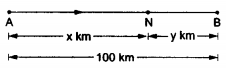
Let one car move from A to B and let the other move from B to A.
Let them meet at N after 1 hour.
Then, AN = x km and BN = y km.
{tex}\therefore{/tex} AN + BN = AB
{tex}\Rightarrow{/tex} x + y = 100. ............. (ii)
Adding (i) and (ii), we get
(x - y) + ( x + y) = 100 + 20
{tex}\Rightarrow{/tex} x - y + x + y = 120
{tex}\Rightarrow{/tex} 2x = 120
{tex}\Rightarrow{/tex} x = 60.
Putting x = 60 in (ii), we get
x+ y = 100
{tex}\Rightarrow{/tex} 60 + y = 100
{tex}\Rightarrow{/tex} y= 100 - 60
{tex}\Rightarrow{/tex} y = 40.
So, x = 60 and y = 40
Hence , speed of the car from A = 60 km/hr,
and speed of the car from B = 40 km/hr
Posted by Yasir Ali 6 years, 8 months ago
- 1 answers
Posted by Nayanika Mallick 6 years, 8 months ago
- 2 answers
Pranitha Bonala 6 years, 8 months ago
Posted by Chotu Kumar 6 years, 7 months ago
- 1 answers
Sia ? 6 years, 7 months ago
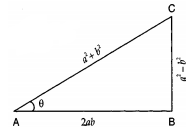
We have,
{tex}\sin \theta = \frac { \text { Perpendicular } } { \text { Hypotenuse } } = \frac { a ^ { 2 } - b ^ { 2 } } { a ^ { 2 } + b ^ { 2 } }{/tex}
So, Let us draw a right triangle ABC in which {tex}\angle B{/tex} is right angle, we have
Perpendicular = BC = a2 - b2 Hypotenuse = AC = a2 + b2 and, {tex}\angle B A C = \theta{/tex}
By Pythagoras theorem, we have
AC2 = AB2 + BC2
{tex}\Rightarrow \quad \left( a ^ { 2 } + b ^ { 2 } \right) ^ { 2 } = A B ^ { 2 } + \left( a ^ { 2 } - b ^ { 2 } \right) ^ { 2 }{/tex}
{tex}\Rightarrow \quad A B ^ { 2 } = \left( a ^ { 2 } + b ^ { 2 } \right) ^ { 2 } - \left( a ^ { 2 } - b ^ { 2 } \right) ^ { 2 }{/tex}
{tex}\Rightarrow \quad A B ^ { 2 } = \left( a ^ { 4 } + b ^ { 4 } + 2 a ^ { 2 } b ^ { 2 } \right) - \left( a ^ { 4 } + b ^ { 4 } - 2 a ^ { 2 } b ^ { 2 } \right){/tex}
{tex}\Rightarrow \quad A B ^ { 2 } = 4 a ^ { 2 } b ^ { 2 } = ( 2 a b ) ^ { 2 }{/tex}
{tex}\Rightarrow \quad A B = 2 a b{/tex}
Now, Let{tex}\angle B A C = \theta{/tex}
We have
Base = AB = 2ab, Perpendicular {tex}= \mathrm { BC } = a ^ { 2 } - b ^ { 2 }{/tex}, Hypotenuse = AC = a2 + b2
Therefore, {tex}\quad \cos \theta = \frac { \text { Base } } { \text { Hypotenuse } } = \frac { 2 a b } { a ^ { 2 } + b ^ { 2 } }{/tex}, {tex}\tan \theta = \frac { \text { Perpendicular } } { \text { Base } } = \frac { a ^ { 2 } - b ^ { 2 } } { 2 a b }{/tex}
{tex}\quad cosec \;\theta = \frac { \text { Hypotenuse } } { \text { Perpendicular } } = \frac { a ^ { 2 } + b ^ { 2 } } { a ^ { 2 } - b ^ { 2 } } , \quad \sec \theta = \frac { \text { Hypotenuse } } { \text { Base } } = \frac { a ^ { 2 } + b ^ { 2 } } { 2 a b }{/tex}
and, {tex}\cot \theta = \frac { \text { Base } } { \text { Perpendicular } } = \frac { 2 a b } { a ^ { 2 } - b ^ { 2 } }{/tex}
Posted by Vijay Vijay 6 years, 8 months ago
- 1 answers
Posted by Anuj Singh 6 years, 8 months ago
- 1 answers
Gaurav Seth 6 years, 8 months ago
Composite Numbers -
A composite number is a positive integer that has a factor other than 1 and itself. For instance, 12 is a composite number because it is a positive integer and it has factors other than 1 and itself. 2, 3, 4, 6 are its factors other than 1 and itself. All even numbers greater than 2 are composite numbers. 2 is a prime number. The smallest composite number is 4.
Prime numbers:
Numbers which have only two factors 1 and the number itself are called prime numbers.
E.g 2 ,3 ,5, 7 ,11 ,13, 17 and so on are all prime numbers.
Of the first 100 numbers 25 are prime numbers.
Only 2 is an even prime number all prime numbers are odd.
Co prime numbers:
Numbers which do not have any common factor between them other than one are called coprime numbers.
Two natural numbers( not necessarily Prime) are coprime if their HCF is 1.
For e.g
(1,2) , (1,3), (3,4), (3,10), (3,8), (5,6), (17,23)
even two composite numbers can also be Prime. for e.g
(16,25), (84,65)
Posted by Alka ?⚖️ 6 years, 8 months ago
- 1 answers
Posted by Aditi Gupta 6 years, 8 months ago
- 1 answers
Gaurav Seth 6 years, 8 months ago
Let side of first square be x and the side of another square be y.
difference in perimeter of two squares:-
4x-4y=16
4(x-y)=16
x-y=16/4
therefore, x-y=4
and x=4+y---take this(1)
sum of areas of two squares:-
x²+y²=400
Put (1) here
(4+y)²+y²=400
(4)²+(y)²+2×4×y+y²=400
16+y²+8y+y²=400
2y²+8y+16-400=0
2y²+8y-384=0
2(y²+4y-192)=0 (here we have taken 2 common and take to another side. then it becomes:-)
y²+4y-192=0
we have done with factorisation method:-
y²-12y+16y-192=0
y(y-12)+16(y-12)=0
(y+16) (y-12)=0
either:- | or:-
y+16=0 | y-12=0
y= -16 | y=12
we will take y=12 because y being side cannot be negative.
So, y=12
put y=12 in (1)
x=4+y
x=4+12
therefore, x=16
and hence, Side of first square= x = 16
and Side of another square= y = 12.

myCBSEguide
Trusted by 1 Crore+ Students

Test Generator
Create papers online. It's FREE.

CUET Mock Tests
75,000+ questions to practice only on myCBSEguide app
