
Ask questions which are clear, concise and easy to understand.
Ask QuestionPosted by Kuldeep Solanki 6 years, 5 months ago
- 0 answers
Posted by Kuldeep Solanki 6 years, 5 months ago
- 0 answers
Posted by Jaskaran Karan 5 years, 8 months ago
- 1 answers
Sia ? 6 years, 3 months ago
Let the first term of the A.P. be 'a'.
and the common difference be 'd'.
19th term of the A.P., t19 = a + (19 - 1)d = a + 18d
6th term of the A.P., t6 = a + (6 - 1)d = a + 5d
9th term of the A.P., t9 = a + (9 - 1)d = a + 8d
t19 = 3t6
{tex}\Rightarrow{/tex}a + 18d = 3(a + 5d)
{tex}\Rightarrow{/tex}a + 18d = 3a + 15d
{tex}\Rightarrow{/tex}18d - 15d = 3a - a
{tex}\Rightarrow{/tex}3d = 2a
{tex}\therefore \mathrm { a } = \frac { 3 \mathrm { d } } { 2 }{/tex}
t9 = 19
{tex}\Rightarrow \frac { 3 \mathrm { d } } { 2 } + 8 \mathrm { d } = 19{/tex}
{tex}\Rightarrow \frac { 3 d + 16 d } { 2 } = 19{/tex}
{tex}\Rightarrow \frac { 19 \mathrm { d } } { 2 } = 19{/tex}
{tex}\Rightarrow{/tex} d = 2
{tex}\Rightarrow{/tex}a = 3
t2 = 3 + (2 - 1)2 = 5
t3 = 3 + (3 - 1)2 = 7
The series will be 3, 5, 7......
Posted by Anurag Mehra 6 years, 5 months ago
- 0 answers
Posted by Shubham Pandey 6 years, 5 months ago
- 1 answers
Sia ? 6 years, 5 months ago
{tex}\frac{1}{7x}{/tex} + {tex}\frac{1}{6y}{/tex} = 3 .......(i)
and {tex}\frac{1}{2x}{/tex} - {tex}\frac{1}{3y}{/tex} = 5 ...........(ii)
Multiplying equation (ii) by {tex}\frac{1}{2}{/tex}, we get
{tex}\frac{1}{4x}{/tex} - {tex}\frac{1}{6y}{/tex} = {tex}\frac{5}{2}{/tex} ..........(iii)
Adding eq. (i) and (iii), we get
{tex}\frac{1}{4x}{/tex} + {tex}\frac{1}{7x}{/tex} = {tex}\frac{5}{2}{/tex} + 3
{tex}\Rightarrow{/tex} {tex}\frac{7 + 4}{28x}{/tex} = {tex}\frac{11}{2}{/tex}
{tex}\Rightarrow{/tex}{tex}\frac{11}{28x}{/tex} = {tex}\frac{11}{2}{/tex}
{tex}\Rightarrow{/tex} 28x = 2
{tex}\Rightarrow{/tex} x = {tex}\frac{1}{14}{/tex}
Putting the value of x in eq.(i), we get
{tex}\frac{1}{7(\frac1{14})}{/tex} + {tex}\frac{1}{6y}{/tex} = 3
y = {tex}\frac{1}{6}{/tex}
Hence x = {tex}\frac{1}{14}{/tex} and y = {tex}\frac{1}{6}{/tex} is the solution of given system of equations.
Posted by Amrita Mishra 6 years, 5 months ago
- 1 answers
Posted by Md Abbas Hussain Bhole 6 years, 5 months ago
- 0 answers
Posted by Jyoti Raj 6 years, 5 months ago
- 0 answers
Posted by Ashutosh Jaiswal 6 years, 5 months ago
- 0 answers
Posted by Suresh Gupta 6 years, 5 months ago
- 1 answers
Yogita Ingle 6 years, 5 months ago
No number of the form 4q + 2 is a perfect square because,
If q is a prime factor of a
perfect square, then q^2 must also be the factor of a perfect square.
4q + 2 = 2 (2q + 2), here 2 is a factor of (2q + 2), but 2^2 = 4 is not the factor of (4q + 2) as (4q + 2) = 2(2q + 1), which is odd and we know that all the odd numbers are not divisible by 2.
So, we can say that 4q + 2 is not divisible by 4
Hence, 4q + 2 is not a perfect
Posted by Gourang Dubey 6 years, 5 months ago
- 1 answers
Posted by Aryan Singh 6 years, 5 months ago
- 2 answers
Ꭾꮢꮛꮛꮦ Ꭾꭷꮢꮗꮧꮭ 6 years, 4 months ago
Posted by Shambhu Sangahi 6 years, 5 months ago
- 0 answers
Posted by Piyush Raj 6 years, 5 months ago
- 0 answers
Posted by Rachit Agarwal 6 years, 5 months ago
- 1 answers
Posted by [email protected] Arora 6 years, 5 months ago
- 1 answers
Sia ? 6 years, 5 months ago
Let the width of the path be x meters,
We know that, if length of rectangle = l, width of rectangle =b & width of path around it x then,
Area of path = {tex}lb\;-(l-2x)(b-2x){/tex}
{tex}\Rightarrow{/tex}16 {tex}\times{/tex} 10 - (16 - 2x)(10 - 2x) = 120
{tex}\Rightarrow{/tex} 16 {tex}\times{/tex} 10 - {160 - 32x - 20x + 4x2} = 120
{tex}\Rightarrow{/tex} 160 - 160 + 32x + 20x - 4x2 = 120
{tex}\Rightarrow{/tex} -4x2 + 52x - 120 = 0
{tex}\Rightarrow{/tex} 2x2 - 26x + 60 = 0
{tex}\Rightarrow{/tex} x2 - 13x + 30 = 0
{tex}\Rightarrow{/tex} x2 - 10x - 3x + 30 = 0 {tex}\Rightarrow{/tex} x(x - 10) - 3(x - 10) = 0
{tex}\Rightarrow{/tex} (x - 10) (x - 3) = 0
{tex}\Rightarrow{/tex} x - 10 = 0 or x - 3 = 0
But x ≠10 ,as width of path can't be greater than width of rectangle. So, x = 3m
Hence, the width of the path = 3 m
Posted by Shanthi Shanthi 6 years, 5 months ago
- 1 answers
Sia ? 6 years, 5 months ago
Let the polynomial be ax2 + bx + c,
and its zeroes be {tex}\alpha {/tex} and {tex}\beta {/tex}.
Then, {tex}\alpha + \beta = 0 = - \frac { b } { a } \text { and } Q \beta = \sqrt { 5 } = \frac { c } { a }{/tex}
If a = 1, then b = 0 and {tex}c = \sqrt { 5 }{/tex}.
So, one quadratic polynomial which fits the given conditions is {tex}x ^ { 2 } + \sqrt { 5 }{/tex} .
Posted by Rani Patil 6 years, 5 months ago
- 0 answers
Posted by Rani Patil 6 years, 5 months ago
- 1 answers
Sia ? 6 years, 5 months ago
Factors of x2 + 7x + 12 :
x2 + 7x + 12 = 0
{tex}\Rightarrow{/tex} x2 + 4x + 3x + 12 = 0
{tex}\Rightarrow{/tex} x(x + 4) + 3(x + 4) = 0
{tex}\Rightarrow{/tex}(x + 4) (x + 3) = 0
{tex}\Rightarrow{/tex} x = - 4, -3 ...(i)
Since p(x) = x4 + 7x3 + 7x2 + px + q
If p(x) is exactly divisible by x2+ 7x + 12, then x = - 4 and x = - 3 are its zeroes. So putting x = - 4 and x = - 3.
p(- 4) = (- 4)4 + 7(- 4)3 + 7(- 4)2 + p(- 4) + q
but p(- 4) = 0
{tex}\therefore{/tex} 0 = 256 - 448 + 112 - 4p + q
0 = - 4p + q - 80
{tex}\Rightarrow{/tex}4p - q = - 80 ...(i)
and p(-3) = (-3)4 + 7(-3)3 + 7(-3)2 + p(-3) + q
but p(-3) = 0
{tex}\Rightarrow{/tex}0 = 81-189 + 63 - 3p + q
{tex}\Rightarrow{/tex}0 = -3p + q -45
{tex}\Rightarrow{/tex}3p -q = -45 ..........(ii)
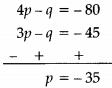
On putting the value of p in eq. (i),we get,
{tex}4(-35) - q = - 80{/tex}
{tex}\Rightarrow{/tex}{tex}-140 - q = - 80{/tex}
{tex}\Rightarrow\ {/tex}{tex}-q = 140 - 80{/tex}
{tex}\Rightarrow\ {/tex} {tex}-q = 60{/tex}
{tex}\therefore{/tex} {tex}q = -60{/tex}
Hence, p = -35, q = -60
Posted by Kumar Shubham 6 years, 5 months ago
- 1 answers
Sia ? 6 years, 5 months ago
Let take √5 as a rational number
If a and b are two co-prime number and b is not equal to 0.
We can write √5 = a/b
Multiply by b both side we get
b√5 = a
To remove root, Squaring on both sides, we get
5b2 = a2 ……………(1)
Therefore, 5 divides a2 and according to a theorem of rational number, for any prime number p which is divided 'a2' then it will divide 'a' also.
That means 5 will divide 'a'. So we can write
a = 5c
and putting the value of a in equation (1) we get
5b2 = (5c)2
5b2 = 25c2
Divide by 25 we get
b2/5 = c2
again using the same theorem we get that b will divide by 5
and we have already get that a is divided by 5
but a and b are co-prime number. so it is contradicting.
Hence √5 is an irrational number
Posted by Sawani Belhe 6 years, 5 months ago
- 3 answers
Piyush Raj 6 years, 5 months ago
Priyanjali Singh 6 years, 5 months ago
Posted by Shurti Sunny 6 years, 5 months ago
- 1 answers
Posted by Sk Kmr 6 years, 5 months ago
- 1 answers
Priyanjali Singh 6 years, 5 months ago
Posted by Sunil Joshi 6 years, 5 months ago
- 1 answers
Posted by Priti Prabhu 6 years, 5 months ago
- 1 answers
Piyush Raj 6 years, 5 months ago
Posted by Deepak Kashyap 6 years, 5 months ago
- 1 answers
Posted by 1⃣?Niket Chourasia⚡️⚡️??? 6 years, 5 months ago
- 1 answers
Ꭾꮢꮛꮛꮦ Ꭾꭷꮢꮗꮧꮭ 6 years, 5 months ago
Posted by Aranya Dutta Banik 6 years, 5 months ago
- 0 answers

myCBSEguide
Trusted by 1 Crore+ Students

Test Generator
Create papers online. It's FREE.

CUET Mock Tests
75,000+ questions to practice only on myCBSEguide app
