
Ask questions which are clear, concise and easy to understand.
Ask QuestionPosted by Abhay Rana 6 years, 4 months ago
- 1 answers
Posted by Tisha Nainani 6 years, 4 months ago
- 1 answers
Posted by Tisha Nainani 6 years, 4 months ago
- 1 answers
Posted by Tisha Nainani 6 years, 4 months ago
- 1 answers
Posted by Jeyanthi Sermaraja 6 years, 4 months ago
- 5 answers
Akshay Krishnan 6 years, 4 months ago
Santosh Kesarwani 6 years, 4 months ago
Ritik Raj 6 years, 4 months ago
Posted by Tisha Nainani 6 years, 4 months ago
- 5 answers
Raj Singh 6 years, 4 months ago
Posted by Mrinal Yash 6 years, 4 months ago
- 0 answers
Posted by Renuka Bhardwaj 6 years, 4 months ago
- 2 answers
Sia ? 6 years, 4 months ago
x + y = 5 ...(1)
2x + 2y = 10 ...(2)
Here, a1 = 1, b1 = 1, c1 = -5
a2 = 2, b2 = 2, c2 = -10
We see that {tex}\frac{{{a_1}}}{{{a_2}}} = \frac{{{b_1}}}{{{b_2}}} = \frac{{{c_1}}}{{{c_2}}}{/tex}
Hence, the lines represented by the equations (1) and (2) are coincident.
Therefore, equations (1) and (2) have infinitely many common solutions, i.e., the given pair of linear equations is consistent.
Graphical Representation, we draw the graphs of the equations (1) and (2) by finding two solutions for each if the equations. These two solutions of the equations (1) and (2) are given below in table 1 and table 2 respectively.
For equation (1) x + y = 5 {tex}\Rightarrow{/tex} y = 5 - x
Table 1 of solutions
| x | 0 | 5 |
| y | 5 | 0 |
For equations (2) x + 2y = 10
{tex}\Rightarrow{/tex} 2y = 10 - 2x
{tex}\Rightarrow y = \frac{{10 - 2x}}{2} \Rightarrow{/tex} y = 5 - x
Table 2 of solutions
| x | 1 | 2 |
| y | 4 | 3 |
We plot the points A(0, 5) and B(5, 0) on a graph paper and join these points to form the line AB representing the equation (1) as shown in the figure, Also, we plot the points C(1, 4) and D (2, 3) on the same graph paper and join these points to form the line CD representing the equation (2) as shown in the same figure.
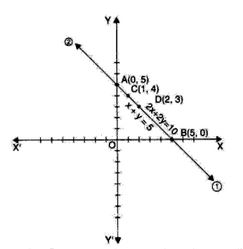
In the figure we observe that the two lines AB and CD coincide.
Posted by Alisha Vir 6 years, 4 months ago
- 1 answers
Harsh Mishra 6 years, 4 months ago
If you mean, to prove (tan²θ - sin²θ) = tan²θ × sin²θ , then the answer will Be.....
L.H.S = tan²θ - sin²θ
= sin²θ/cos²θ - sin²θ
= sin²θ [ 1/cos²θ - 1]
[ we know, sec x = 1/cos x so, 1/cos²θ = sec²θ]
= sin²θ [ sec²θ - 1]
we also know that, sec² x - tan² x=1
so,sec² θ - tan² θ=1
or,sec² θ - 1 = tan² θ
then, sin² θ [sec²θ - 1] = sin² θ × tan² θ = RHS
Hence, (tan² θ - sin² θ) = tan² θ × sin² θ.
Posted by Karan Sahu 6 years, 4 months ago
- 2 answers
Posted by Sukhdev Singh 6 years, 4 months ago
- 1 answers
Posted by Gargi Ghosh 6 years, 4 months ago
- 1 answers
Posted by Ravi Ramamoorthy 6 years, 4 months ago
- 0 answers
Posted by Aditya Bhashkar 6 years, 4 months ago
- 1 answers
Yogita Ingle 6 years, 4 months ago
Let a be the positive integer.
And, b = 4 .
Then by Euclid's division lemma,
We can write a = 4q + r ,for some integer q and 0 ≤ r < 4 .
°•° Then, possible values of r is 0, 1, 2, 3 .
Taking r = 0 .
a = 4q .
Taking r = 1 .
a = 4q + 1 .
Taking r = 2
a = 4q + 2 .
Taking r = 3 .
a = 4q + 3 .
But a is an odd positive integer, so a can't be 4q , or 4q + 2 [ As these are even ] .
•°• a can be of the form 4q + 1 or 4q + 3 for some integer q .
Hence , it is solved
Posted by Trishna Kumari 6 years, 4 months ago
- 1 answers
Iron Man 6 years, 4 months ago
Posted by Prabhat Singh Baghel 6 years, 4 months ago
- 0 answers
Posted by Pranjal Rai 6 years, 4 months ago
- 1 answers
Sia ? 6 years, 4 months ago
Let A(x,o) be any point on the X-axis , which is equidistant from points (-1,0) and (5,0).
{tex}\Rightarrow (x+1)^2=(x-5)^2{/tex}
⇒ x2 + 2x + 1 = x2 - 10x + 25
⇒ 2x + 1 = -10x + 25
⇒ 2x + 10x = 25 - 1
⇒ 12x = 24
⇒ x = 24/12
{tex}\Rightarrow x= 2{/tex}
Therefore , Required point is (2,0).
Posted by Khevna Modi 6 years, 4 months ago
- 1 answers
Posted by Parm Basra 6 years, 4 months ago
- 2 answers
Pranjal J. 6 years, 4 months ago
Posted by Neha Verma 6 years, 4 months ago
- 1 answers
Sia ? 6 years, 4 months ago
α,β are zeros of ax2+bx+c
{tex}\mathrm{Then}\;\mathrm\alpha+\mathrm\beta=-\frac{\mathrm b}{\mathrm a}\;\mathrm{and}\;\mathrm{αβ}=\frac{\mathrm c}{\mathrm a}{/tex}
α4 + β4= (α2 + β2)2 - 2α2β2
=((α + β)2 - 2αβ)2 - (2αβ)2
{tex}={\left[ {\left( { - \frac{b}{a}} \right) - 2\left( {\frac{c}{a}} \right)} \right]^2} - \left[ {2{{\left( {\frac{c}{a}} \right)}^2}} \right]{/tex}
{tex} = {\left[ {\frac{{{b^2} - 2ac}}{{{a^2}}}} \right]^2} - \frac{{2{c^2}}}{{{a^2}}}{/tex}
{tex} = \frac{{{{\left( {{b^2} - 2ac} \right)}^2} - 2{a^2}{c^2}}}{{{a^4}}}{/tex}.
Posted by Priyanshi Jain 6 years, 4 months ago
- 1 answers
Ã.P.W.B.Đ ⚡ 6 years, 4 months ago
Posted by All In One 6 years, 4 months ago
- 1 answers
Posted by Ekta Tiwari 6 years, 4 months ago
- 1 answers
Krishna Sharma 6 years, 4 months ago
Posted by Rohit Prasad 6 years, 4 months ago
- 1 answers
Sia ? 6 years, 4 months ago
Given, an = 7 - 3n
Put n = 1, a1 = 7 - 3 {tex}\times{/tex} 1 = 7 - 3 = 4
Put n = 2, a2 = 7 - 3 {tex}\times{/tex} 2 = 7 - 6 = 1
Common difference(d) = 1 - 4 = -3
Sn = {tex}\frac { n } { 2 } [ 2 a + ( n - 1 ) d ]{/tex}
S25 = {tex} \frac { 25 } { 2 } [ 2 \times 4 + ( 25 - 1 ) ( - 3 ) ]{/tex}
{tex}= \frac { 25 } { 2 } [ 8 - 72 ]{/tex}
{tex}= \frac { 25 } { 2 } \times - 64{/tex}
= -800
Posted by Priyanshi P. 6 years, 4 months ago
- 7 answers
Posted by Aadil Aadhi 6 years, 4 months ago
- 0 answers

myCBSEguide
Trusted by 1 Crore+ Students

Test Generator
Create papers online. It's FREE.

CUET Mock Tests
75,000+ questions to practice only on myCBSEguide app

Nishant Bansal 6 years, 4 months ago
3Thank You