
Ask questions which are clear, concise and easy to understand.
Ask QuestionPosted by $N€H!L J@@T ? 6 years, 4 months ago
- 4 answers
Posted by Raj Narayan Jaiswal 6 years, 4 months ago
- 4 answers
Posted by Kavya Bishnoi 6 years, 4 months ago
- 1 answers
Sia ? 6 years, 4 months ago
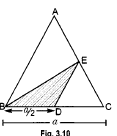
Let the side of triangle = a
{tex}\therefore{/tex} BC = a {tex}\Rightarrow{/tex} BD = {tex}\frac{a}{2}{/tex}
Now area({tex}\triangle{/tex}BDE) = {tex}\frac{\sqrt{3}}{4}{/tex}({tex}\frac{a}{2}{/tex})2 = {tex}\frac{\sqrt{3}}{4}{/tex}{tex}\frac{a^2}{4}{/tex} = {tex}\frac{1}{4}{/tex}({tex}\frac{\sqrt{3}}{4}{/tex}a2) = {tex}\frac{1}{4}{/tex}area ({tex}\triangle{/tex}ABC).
or area({tex}\triangle{/tex}BDE)/area ({tex}\triangle{/tex}ABC) = {tex}\frac{1}{4}{/tex}
Hence proved.
Posted by Sabitha D 6 years, 4 months ago
- 3 answers
Posted by Rkshivam Gupta 6 years, 4 months ago
- 1 answers
Posted by Rajendar Ray 6 years, 4 months ago
- 1 answers
Prince Raj 6 years, 4 months ago
Posted by I.A.S Ashutosh Kumar 6 years, 4 months ago
- 1 answers
Shruti Aggarwal 6 years, 4 months ago
Posted by Shrishti Upadhyay 6 years, 4 months ago
- 3 answers
Shruti Aggarwal 6 years, 4 months ago
Posted by 루너 .. 6 years, 4 months ago
- 1 answers
Ram Baran 6 years, 4 months ago
Posted by Usha Sharma 6 years, 4 months ago
- 0 answers
Posted by Ezhil Jose Prasanna 6 years, 4 months ago
- 3 answers
?Niharika Sharma ? 6 years, 4 months ago
Posted by Sujal Sharma 6 years, 4 months ago
- 0 answers
Posted by Annu Kumari 6 years, 4 months ago
- 1 answers
Posted by Kannan Vami 6 years, 4 months ago
- 1 answers
Sia ? 6 years, 4 months ago
Since the points are collinear, then,
Area of triangle = 0
{tex}\frac { 1 } { 2 } \left[ x _ { 1 } \left( y _ { 2 } - y _ { 3 } \right) + x _ { 2 } \left( y _ { 3 } - y _ { 1 } \right) + x _ { 3 } \left( y _ { 1 } - y _ { 2 } \right) \right] = 0{/tex}
{tex}\frac { 1 } { 2 } [ x ( - 4 + 5 ) + ( - 3 ) ( - 5 - 2 ) + 7 ( 2 + 4 ) ] = 0{/tex}
x + 21 + 42 = 0
x = -63
Posted by Mrudula Kundalwal 6 years, 4 months ago
- 1 answers
Ram Kushwah 6 years, 4 months ago
d=5 S9=75
So 75=9/2(2a+8*5)
150=18a+360
18a=150-360
18a=-210
a=-210/18=-11.67
an=-11.67+(n-1)*5
=-11.67+5n-5
an=5n-16.67
Posted by Kavi Kanmani 6 years, 4 months ago
- 1 answers
Sia ? 6 years, 4 months ago
ar({tex}\Delta{/tex}ABD) = {tex}\frac12{/tex}|-3(8) + 5(-6) + -5(2 - 4)|
= 22 sq units.
ar({tex}\Delta{/tex}BCD) = {tex}\frac12{/tex}|5(-2) + 7(-8) -5(10)|
= 58 sq units
ar({tex}\Delta{/tex}ABD) + ar({tex}\Delta{/tex}BCD)
= 22 sq units + 58 sq units
= 80 sq units
{tex}\therefore{/tex} ar( Quad ABCD) = 80 sq units.
Posted by Komal Rawat 6 years, 4 months ago
- 1 answers
Sia ? 6 years, 4 months ago
Given that -5 is the root of {tex}2 x^{2}+p x-15=0{/tex}
Put x = -5 in {tex}2 x^{2}+p x-15=0{/tex}
{tex}\Rightarrow{/tex} {tex}2(-5)^{2}+p(-5)-15=0{/tex}
{tex}\Rightarrow{/tex} {tex}50-5 p-15=0{/tex}
{tex}\Rightarrow{/tex} {tex}35 - 5p = 0 {/tex}
{tex}\Rightarrow{/tex} {tex}5p = 35 {/tex}
{tex}\therefore{/tex} {tex}p = 7{/tex}
Hence the quadratic equation p {tex}(x^2 + x) + k = 0{/tex} becomes, {tex}7\left(x^{2}+x\right)+k=0{/tex}
{tex}7 x^{2}+7 x+k=0{/tex}
Here {tex}a = 7,\ b = 7\ and\ c = k{/tex} Given that this quadratic equation has equal roots
{tex}\therefore{/tex} {tex}b^{2}-4 a c=0{/tex}
{tex}\Rightarrow{/tex} {tex}7^{2}-4(7)(\mathrm{k})=0{/tex}
{tex}\Rightarrow{/tex} {tex}49 - 28k = 0 {/tex}
{tex}\Rightarrow{/tex} {tex}49 = 28k {/tex}
{tex}\therefore{/tex} k = {tex}\frac{49} {28}{/tex} = {tex}\frac{7} {4}{/tex}
Posted by Gurwinder Singh 6 years, 4 months ago
- 1 answers
Posted by Aadit Kumar 6 years, 4 months ago
- 3 answers
Janu Likki 6 years, 4 months ago
Posted by Akki Akki 6 years, 4 months ago
- 2 answers
Naman Devwani 6 years, 4 months ago
Posted by Gourav Singh 6 years, 4 months ago
- 1 answers
Posted by Suman Kesarwani 6 years, 4 months ago
- 1 answers
Posted by Richhpal Mahala 6 years, 4 months ago
- 1 answers
Sia ? 6 years, 4 months ago
We have to express the trigonometric ratios sin A, sec A and tan A in terms of cot A.
For sin A,
By using identity {tex}cosec ^ { 2 } A - \cot ^ { 2 } A = 1{/tex}
{tex}\Rightarrow cosec ^ { 2 } A = 1 + \cot ^ { 2 } A{/tex}
{tex}\Rightarrow \frac { 1 } { \sin ^ { 2 } A } = 1 + \cot ^ { 2 } A{/tex}
{tex}\Rightarrow \sin ^ { 2 } A = \frac { 1 } { 1 + \cot ^ { 2 } A }{/tex}
{tex} \Rightarrow \quad \sin A = \frac { 1 } { \sqrt { 1 + \cot ^ { 2 } A } }{/tex}
For tan A,
{tex} \tan A = \frac { 1 } { \cot A }{/tex}
Posted by Kunal Nawariya 5 years, 8 months ago
- 2 answers
Posted by Ayush Shrivastava 6 years, 4 months ago
- 1 answers
Surjit Singh Kondal 6 years, 4 months ago
Posted by Murugaiyan Murugaiyan 6 years, 4 months ago
- 1 answers
Sia ? 6 years, 4 months ago
Given that -5 is the root of {tex}2 x^{2}+p x-15=0{/tex}
Put x = -5 in {tex}2 x^{2}+p x-15=0{/tex}
{tex}\Rightarrow{/tex} {tex}2(-5)^{2}+p(-5)-15=0{/tex}
{tex}\Rightarrow{/tex} {tex}50-5 p-15=0{/tex}
{tex}\Rightarrow{/tex} {tex}35 - 5p = 0 {/tex}
{tex}\Rightarrow{/tex} {tex}5p = 35 {/tex}
{tex}\therefore{/tex} {tex}p = 7{/tex}
Hence the quadratic equation p {tex}(x^2 + x) + k = 0{/tex} becomes, {tex}7\left(x^{2}+x\right)+k=0{/tex}
{tex}7 x^{2}+7 x+k=0{/tex}
Here {tex}a = 7,\ b = 7\ and\ c = k{/tex} Given that this quadratic equation has equal roots
{tex}\therefore{/tex} {tex}b^{2}-4 a c=0{/tex}
{tex}\Rightarrow{/tex} {tex}7^{2}-4(7)(\mathrm{k})=0{/tex}
{tex}\Rightarrow{/tex} {tex}49 - 28k = 0 {/tex}
{tex}\Rightarrow{/tex} {tex}49 = 28k {/tex}
{tex}\therefore{/tex} k = {tex}\frac{49} {28}{/tex} = {tex}\frac{7} {4}{/tex}
Posted by Danish Raza 6 years, 4 months ago
- 3 answers
Amit Kumar 6 years, 4 months ago
Pk . 6 years, 4 months ago
Posted by Karamjit Kaur 6 years, 4 months ago
- 0 answers

myCBSEguide
Trusted by 1 Crore+ Students

Test Generator
Create papers online. It's FREE.

CUET Mock Tests
75,000+ questions to practice only on myCBSEguide app

$N€H!L J@@T ? 6 years, 4 months ago
0Thank You