
Ask questions which are clear, concise and easy to understand.
Ask QuestionPosted by Piyush Gupta 6 years, 4 months ago
- 2 answers
Posted by Vishal Pandit 6 years, 4 months ago
- 0 answers
Posted by Aniket Kr Aniket Kr 6 years, 4 months ago
- 3 answers
Posted by #Aditi~ Angel???? 6 years, 4 months ago
- 5 answers
Posted by Akash Rajput 6 years, 4 months ago
- 2 answers
Ansuman Rathore 6 years, 4 months ago
Rani Mishra ??? 6 years, 4 months ago
Posted by Shubhham Modi 6 years, 4 months ago
- 2 answers
Yogita Ingle 6 years, 4 months ago
Equation 1: 2x + 3y = 5
Equation 2: 4x + ky = 10
Both the equations are in the form of :
a1x + b1y = c1 & a2x + b2y = c2 where a1 & a2 are the coefficients of x
b1 & b2 are the coefficients of y
c1 & c2 are the constants
For the system of linear equations to have infinitely many solutions we must have
a1/a2 = b1/b2 = c1/c2 ………(i)
According to the problem:
a1 = 2, a2 = 4, b1 = 3, b2 = k, c1 = 5, c2 = 10
Putting the above values in equation (i) and solving the extreme left and extreme right portion of the equality we get the value of a
2/4 = 3/k
⇒ 2k = 12 ⇒ k = 6
The value of k for which the system of equations has infinitely many solution is k = 6
Posted by Nancy Dsouza 6 years, 4 months ago
- 1 answers
Sia ? 6 years, 4 months ago
Let the number of students be x, then
{tex}\frac { 300 } { x } - \frac { 300 } { ( x + 10 ) } = 1 \Rightarrow \frac { 1 } { x } - \frac { 1 } { ( x + 10 ) } = \frac { 1 } { 300 }{/tex}
{tex}\Rightarrow \frac { x + 10 - x } { x ( x + 10 ) } = \frac { 1 } { 300 }{/tex}
{tex}\Rightarrow{/tex} x(x + 10) = 3000
{tex}\Rightarrow{/tex} x2 + 10x - 3000 = 0
{tex}\Rightarrow{/tex} x2 + 60x - 50x - 3000 = 0
{tex}\Rightarrow{/tex} x(x + 60) - 50(x + 60) = 0
{tex}\Rightarrow{/tex} x + 60 = 0 or x - 50 = 0
{tex}\Rightarrow{/tex} x = -60 or x = 50
x = 50 {{tex}\because{/tex} number of students cannot be negative}
Hence the number of students is 50.
Posted by Kishor Sahu 6 years, 4 months ago
- 1 answers
Sia ? 6 years, 4 months ago
Given that, Sp = a, Sq = b and Sr = c
Let A be the first term and d be the common difference. Then,
Sp = {tex}\frac { p } { 2 }{/tex} [2 A + (p - 1)d] = a
{tex}\Rightarrow{/tex} 2 A + (p - 1)d = {tex}\frac { 2 a } { p }{/tex} ...(i)
Sq = {tex}\frac { q } { 2 }{/tex} [2 A + (q - 1)d] = b
{tex}\Rightarrow{/tex} 2 A + (q - 1)d = {tex}\frac { 2 b } { q }{/tex} ...(ii)
and Sr = {tex}\frac { r } { 2 }{/tex} [2 A + (r - 1)d] = c
{tex}\Rightarrow{/tex} 2 A + (r - 1)d = {tex}\frac { 2 c } { r }{/tex} ...(iii)
On multiplying Eq. (i) by (q - r), Eq. (ii) by (r - p) and Eq. (iii) by (p - q), we get
[2 A + (p - 1)d] (q - r) = {tex}\frac { 2 a } { p }{/tex} (q - r) ...(iv)
[2 A + (q - 1)d] (r - p) = {tex}\frac { 2 b } { q }{/tex} (r - p) ...(v)
and [2 A + (r - 1)d] (p - q) = {tex}\frac { 2 c } { r }{/tex} (p - q) ...(vi
On adding Eq. (iv), Eq. (v) and Eqs. (vi), we get
{tex}\frac { 2 a } { p } ( q - r ) + \frac { 2 b } { q } ( r - p ) + \frac { 2 c } { r } ( p - q ){/tex}
= [2 A + (p - 1)d] (q - r) + [2 A + (q - 1)d] (r - p) + [2 A + (r - 1)d] (p - q)
= 2 A (q - r + r - p + p - q) + d[(p - 1) (q - r) + (q - 1) (r - p) + (r - 1) (p - q)]
= 2 A (0) + d[(pq - pr - q + r + qr - qp - r + p + rp - rq - p + q]
= 0 + d (0) = 0
{tex}\therefore{/tex} {tex}\frac { a } { p } ( q - r ) + \frac { b } { q } ( r - p ) + \frac { c } { r } ( p - q ){/tex}= 0
Hence proved.
Posted by Arpit Shukla 6 years, 4 months ago
- 4 answers
Ansuman Rathore 6 years, 4 months ago
Krishna Bharadwaj 6 years, 4 months ago
Rani Mishra ??? 6 years, 4 months ago
Posted by Gurwinder Singh 6 years, 4 months ago
- 5 answers
Ronak Choudhary 6 years, 4 months ago
Posted by Santy Kumar 6 years, 4 months ago
- 1 answers
Yogita Ingle 6 years, 4 months ago
let root 5 be rational
then it must in the form of p/q [q is not equal to 0][p and q are co-prime]
root 5=p/q
=> root 5 × q = p
squaring on both sides
=> 5×q×q = p×p ------> 1
p×p is divisible by 5
p is divisible by 5
p = 5c [c is a positive integer] [squaring on both sides ]
p×p = 25c×c --------- > 2
sub p×p in 1
5×q×q = 25×c×c
q×q = 5×c×c
=> q is divisble by 5
thus q and p have a common factor 5
there is a contradiction
as our assumsion p &q are co prime but it has a common factor
so √5 is an irrational
Posted by Agampreet Singh 6 years, 4 months ago
- 1 answers
Posted by Agampreet Singh 6 years, 4 months ago
- 2 answers
Ronak Choudhary 6 years, 4 months ago
Posted by ????? ?????? 6 years, 4 months ago
- 5 answers
? ? 6 years, 4 months ago
Posted by Khushi ?? 6 years, 4 months ago
- 1 answers
Sia ? 6 years, 4 months ago
LHS = (sin{tex}\theta{/tex} - 2sin3{tex}\theta{/tex})
= sin{tex}\theta{/tex}(1 - 2sin2{tex}\theta{/tex})
RHS = (2cos3{tex}\theta{/tex} - cos{tex}\theta{/tex})tan{tex}\theta{/tex}
= cos{tex}\theta{/tex}(2cos2{tex}\theta{/tex} - 1){tex}\frac { \sin \theta } { \cos \theta }{/tex}
= [2(1 - sin2{tex}\theta{/tex}) - 1)sin{tex}\theta{/tex}
= (2 - 2sin2{tex}\theta{/tex} -1)sin{tex}\theta{/tex}
= (1 - 2sin2{tex}\theta{/tex})sin{tex}\theta{/tex}
{tex}\Rightarrow{/tex} LHS = RHS
{tex}\therefore{/tex} (sin{tex}\theta{/tex} - 2sin3{tex}\theta{/tex}) = (2cos3{tex}\theta{/tex} - cos{tex}\theta{/tex})tan{tex}\theta{/tex}
Posted by Aakash Kumar 6 years, 4 months ago
- 6 answers
Ritika Vyas 6 years, 4 months ago
Pk . 6 years, 4 months ago
Pk . 6 years, 4 months ago
Pk . 6 years, 4 months ago
Posted by Shobha Upadhyay 6 years, 4 months ago
- 1 answers
Sia ? 6 years, 4 months ago
Given: sec x + tan x = p
As we know,
{tex}sec^2 x - tan^2 x = 1{/tex}
{tex}\therefore{/tex} {tex}(sec\ x + tan\ x)(sec\ x - tan\ x) = 1 {/tex}
{tex}\Rightarrow{/tex} {tex}p(sec\ x - tan\ x) = 1 {/tex}
{tex}\Rightarrow{/tex} {tex}sec\ x - tan\ x ={/tex} {tex}\frac{1}{p}{/tex}
Thus, we have
{tex}sec\ x + tan\ x = p{/tex} and sec x - tan x = {tex}\frac{1}{p}{/tex}
{tex}\Rightarrow{/tex} (sec x + tan x) + (sec x - tan x) = p + {tex}\frac{1}{p}{/tex} and (sec x + tan x) - (sec x - tan x) = p - {tex}\frac{1}{p}{/tex}
{tex}\Rightarrow{/tex} 2 sec x = p + {tex}\frac{1}{p}{/tex} and 2 tan x = -{tex}\frac{1}{p}{/tex} {tex}\Rightarrow{/tex} sec x = {tex}\frac{p^{2}+1}{2 p}{/tex} and tan x = {tex}\frac{p^{2}-1}{2 p}{/tex}
Posted by Fiza Siddiqui 6 years, 4 months ago
- 1 answers
Sia ? 6 years, 4 months ago
Given numbers are 657 and 963 .
Here, 657 < 963
By using Euclid's Division algorithmm , we get
963 = (657 × 1) + 306
Here , remainder = 306 .
So, On taking 657 as new dividend and 306 as the new divisor and then apply Euclid's Division lemma, we get
657 = (306 × 2) + 45
Here, remainder = 45
So, On taking 306 as new dividend and 45 as the new divisor and then apply Euclid's Division lemma, we get
306 = (45 × 6) + 36
Here, remainder = 36
So, On taking 45 as new dividend and 36 as the new divisor and then apply Euclid's Division lemma, we get
45 = (36 × 1) + 9
Here, remainder = 9
So, On taking 36 as new dividend and 9 as the new divisor and then apply Euclid's Division lemma, we get
36 = (9 × 4) + 0
Here , remainder = 0 and last divisor is 9.
Hence, HCF of 657 and 963 = 9.
∴ 9 = 657x + 963(-15)
⇒ 9 = 657x - 14445
⇒ 657x = 9 + 14445
⇒ 657x = 14454
⇒x = 14454/657
⇒ x =22
Posted by Aman Patidar 6 years, 4 months ago
- 2 answers
Rani Mishra ??? 6 years, 4 months ago
Fiza Siddiqui 6 years, 4 months ago
Posted by Wasi Ahamad 6 years, 4 months ago
- 0 answers
Posted by Yuvraj Singh 6 years, 4 months ago
- 1 answers
Posted by Ujjwal Kumar 6 years, 4 months ago
- 1 answers
Sia ? 6 years, 4 months ago
2x + 3 y = 12
3y = 12 - 2x
or, {tex}y = \frac { 12 - 2 x } { 3 }{/tex}
If x = 0, we have y = 4
If x = 6,we have y = 0
If x = 3 , we have y = 2
The solution table is as follows:
| 0 | 6 | 3 |
| 4 | 0 | 2 |
x - y = 1
or, y = x - 1
If x = 0, we have y = -1
If x = 1, we have y = 0
If x = 3, we have y = 2
The solution table is as follows:
| 0 | 1 | 3 |
| -1 | 0 | 2 |
Plotting the above points and drawing the lines joining them, we get the following graph.
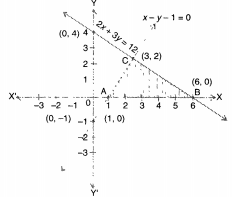
The two lines intersect each other at point (3, 2).
Hence, x = 3 and y = 2.
{tex}\triangle A B C{/tex} is the region between the two lines represented by the given equations and the X-axis.
Posted by ?????? ?? 6 years, 4 months ago
- 1 answers
Posted by Rajesh Sharma 6 years, 4 months ago
- 1 answers
Sia ? 6 years, 4 months ago
You can check the syllabus here : https://mycbseguide.com/cbse-syllabus.html
Posted by Vinay Pathak 6 years, 4 months ago
- 6 answers
Yash ? 6 years, 4 months ago
I ❤ My India??{ Diya }? 6 years, 4 months ago
Posted by #Aditi~ Angel???? 6 years, 4 months ago
- 8 answers
#Aditi~ Angel???? 6 years, 4 months ago
#Aditi~ Angel???? 6 years, 4 months ago

myCBSEguide
Trusted by 1 Crore+ Students

Test Generator
Create papers online. It's FREE.

CUET Mock Tests
75,000+ questions to practice only on myCBSEguide app

Navneet Kumar 6 years, 4 months ago
0Thank You