
Ask questions which are clear, concise and easy to understand.
Ask QuestionPosted by 621311 ?? 6 years, 6 months ago
- 1 answers
Sia ? 6 years, 6 months ago
Given:-In fig., {tex}\Delta{/tex}ABC D is the mid-point of BC and E is the mid-point of AD.
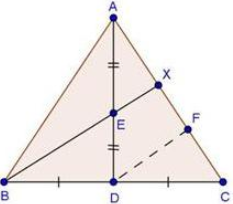
To prove:- BE : EX = 3 : 1
Construction: Through D, draw DF parallel to BX.
Proof:- In {tex}\Delta{/tex}AEX and {tex}\Delta{/tex}ADF
{tex}\angle EAX = \angle DAF{/tex} [Common]
{tex}\angle AXE = \angle AFD{/tex} [Corresponding angles]
Then, {tex}\Delta{/tex}AEX ~ {tex}\Delta{/tex}ADF [By AA similarity]
{tex}\therefore \frac{{EX}}{{DF}} = \frac{{AE}}{{AD}}{/tex} [Corresponding parts of similar {tex}Triangle{/tex}are proportional]
{tex}\Rightarrow \frac{{EX}}{{DF}} = \frac{{AE}}{{2AE}}{/tex} [AE = ED given]
{tex}\Rightarrow{/tex} DF = 2EX ....(i)
In {tex}\Delta{/tex}CDF ~ {tex}\Delta{/tex}CBX
{tex}\angle C = \angle C{/tex} [Common]
{tex}\angle CDF = \angle CBX{/tex} [Corresponding angles]
Then, {tex}\Delta{/tex}CDF ~ {tex}\Delta{/tex}CBX [By AA similarity]
Therefore ,{tex} \frac{{CD}}{{CB}} = \frac{{DF}}{{BX}}{/tex} [Corresponding parts of similar {tex}\Delta{/tex}are proportional]
{tex}\Rightarrow \frac{1}{2} = \frac{{DF}}{{BE + EX}}{/tex} [BD = DC given]
{tex}\Rightarrow{/tex} BE + EX = 2DF
{tex}\Rightarrow{/tex} BE + EX = 4EX [By using (i)]
{tex}\Rightarrow{/tex} BE = 4EX - EX
{tex}\Rightarrow{/tex} BE = 3EX{tex}{/tex}
{tex}\Rightarrow \frac{{BE}}{{EX}} = \frac{3}{1}.{/tex}
Posted by Nirankar Sharma 6 years, 6 months ago
- 1 answers
Sia ? 6 years, 6 months ago
In {tex}\triangle ABE,{/tex} we have {tex}DE||AE,{/tex}then
{tex}\frac{{BD}}{{AD}} = \frac{{BF}}{{FE}}\,{/tex} [By BPT] ...... (i)
In {tex}\triangle ABC,{/tex} we have {tex}DE||AC,{/tex} then
{tex}\frac{{BD}}{{AD}} = \frac{{BE}}{{EC}}\,{/tex} [By BPT] ...... (ii)
From (i) and (2), We get
{tex}\frac{{BF}}{{FE}} = \frac{{BE}}{{EC}}{/tex}
Posted by Mohamed Abdullah Suhaib 6 years, 6 months ago
- 1 answers
Harathi Kallem 6 years, 6 months ago
Posted by Manish Singh 6 years, 6 months ago
- 3 answers
⛩️Singh Empire? (Believe In Study) 6 years, 6 months ago
Priksha Sangwan 6 years, 6 months ago
Mayank Sharma 6 years, 6 months ago
Posted by Arvind Kumar 6 years, 6 months ago
- 0 answers
Posted by Sachin Sherawat 6 years, 6 months ago
- 2 answers
Posted by Diya Paul 6 years, 6 months ago
- 3 answers
Jatin Kumar 6 years, 6 months ago
Mayank Sharma 6 years, 6 months ago
Posted by Ashok Kumar 6 years, 6 months ago
- 1 answers
⛩️Singh Empire? (Believe In Study) 6 years, 6 months ago
Posted by Sapna Maurya 6 years, 6 months ago
- 0 answers
Posted by Anjali Balhara 6 years, 6 months ago
- 3 answers
Dheeraj Malhotra 6 years, 6 months ago
Mayank Sharma 6 years, 6 months ago
Posted by Sonal Jain 6 years, 6 months ago
- 4 answers
Posted by Aakriti Singh 6 years, 6 months ago
- 0 answers
Posted by Piyush Dev Jha 6 years, 6 months ago
- 0 answers
Posted by Jatin Kumar 6 years, 6 months ago
- 4 answers
Piyush Dev Jha 6 years, 6 months ago
Piyush Dev Jha 6 years, 6 months ago
Posted by Jatin Kumar 6 years, 6 months ago
- 0 answers
Posted by Jatin Kumar 6 years, 6 months ago
- 2 answers
Posted by Om Jee Tiwary 6 years, 6 months ago
- 1 answers
Posted by Tanishka Sharma 6 years, 6 months ago
- 0 answers
Posted by Mansi Sanpal 6 years, 6 months ago
- 1 answers
Posted by Sapna Grg 6 years, 6 months ago
- 3 answers
Yogita Ingle 6 years, 6 months ago
As we know that the degree of any polynomial is calculated based on on the the value of highest exponent of the variable. In the given question we can see there is no variable and and a constant that is root 7 is given.
For all constants the degree is always zero.
i.e. x0 = 1
Therefore the degree for the polynomial root 7 is "zero".
Posted by Jitendra Kumar 6 years, 6 months ago
- 3 answers
Shashi Kumar 6 years, 6 months ago
Posted by Kumar Nishu 6 years, 6 months ago
- 0 answers
Posted by Abhishek Singh 6 years, 6 months ago
- 1 answers
Yogita Ingle 6 years, 6 months ago
Let us assume that √5 is a rational number.
we know that the rational numbers are in the form of p/q form where p,q are integers.
so, √5 = p/q
p = √5q
we know that 'p' is a rational number. so √5 q must be rational since it equals to p
but it doesnt occurs with √5 since its not an integer
therefore, p =/= √5q
this contradicts the fact that √5 is an irrational number
hence our assumption is wrong and √5 is an irrational number.
Posted by Param Gehal 6 years, 6 months ago
- 0 answers

myCBSEguide
Trusted by 1 Crore+ Students

Test Generator
Create papers online. It's FREE.

CUET Mock Tests
75,000+ questions to practice only on myCBSEguide app
