
Ask questions which are clear, concise and easy to understand.
Ask QuestionPosted by Raman Jot 7 years, 9 months ago
- 1 answers
Posted by Blocked Mahak Yadav 7 years, 9 months ago
- 4 answers
Posted by Himanshu Khandwal 7 years, 9 months ago
- 1 answers
Posted by Nancy Rajput 7 years, 9 months ago
- 5 answers
Posted by Raman Jot 7 years, 9 months ago
- 0 answers
Posted by Raman Jot 7 years, 9 months ago
- 5 answers
Posted by Lasya Mnr 7 years, 9 months ago
- 1 answers
Lasya Mnr 7 years, 9 months ago
Posted by Sherya Sharma 6 years, 5 months ago
- 1 answers
Sia ? 6 years, 5 months ago
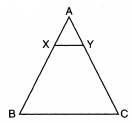
{tex}\frac { A X } { X B } = \frac { 3 } { 4 } ....(i) {/tex}
{tex}\frac{AY}{CY}=\frac{5}{9} ....(ii){/tex}
From eqn (i) and (ii)
{tex}\frac{AX}{XB} ≠ \frac{AY}{YC}{/tex}
So XY and BC are not parallel
Posted by Riya Sawalkar 7 years, 9 months ago
- 3 answers
Posted by Mansi Kukreti 6 years, 4 months ago
- 1 answers
Sia ? 6 years, 4 months ago
According to the question,we have the following information.
Water flow in 1 hr = Area of cross-section {tex}\times{/tex} Speed of water
{tex}= 5 \cdot 4 \times 1 \cdot 8 \times 25000 \mathrm { m } ^ { 3 }{/tex}=54×18×250
Water flow in 40 minutes
{tex}= 54 \times 6 \times 500 \mathrm { m } ^ { 3 }{/tex}
Irrigated area {tex}\times \frac { 10 } { 100 } = 54 \times 6 \times 500{/tex}
Irrigated area {tex}= 54 \times 6 \times 500 \times 10{/tex}
{tex}= 1620000 \mathrm { m } ^ { 2}{/tex}
Posted by Karan Singh 7 years, 9 months ago
- 4 answers
Ayush Pandey 7 years, 9 months ago
Posted by Sherya Sharma 7 years, 9 months ago
- 2 answers
Posted by Krishna Jhapate 7 years, 9 months ago
- 2 answers
Tushar Yadav 7 years, 9 months ago
Posted by Apurvi Apurvi 7 years, 9 months ago
- 3 answers
Posted by Nikita Chopra 7 years, 9 months ago
- 1 answers
Satyam Shandhilya 7 years, 9 months ago
Posted by Vaishnavi Kumari 7 years, 9 months ago
- 2 answers
Satyam Shandhilya 7 years, 9 months ago
Posted by Bhumika Kalra 6 years, 4 months ago
- 1 answers
Sia ? 6 years, 4 months ago
Let the number of sides of polygon be  The interior angles of the polygon form an A.P.
Here, a = 120o and d = 5o
Since Sum of interior angles of a polygon with n sides is {tex}( n - 2 ) \times 180 ^ { \circ }{/tex}
{tex}\therefore \mathrm { S } _ { n } = ( n - 2 ) \times 180 ^ { \circ }{/tex}
{tex}\Rightarrow \frac { n } { 2 } [ 2 \times 120 + ( n - 1 ) \times 5 ] = 180 n - 360{/tex}
{tex}\Rightarrow 120 n + \frac { 5 n ^ { 2 } - 5 n } { 2 } = 180 n - 360{/tex}
{tex}\Rightarrow{/tex} 240n + 5n2 - 5n = 360n - 720
{tex}\Rightarrow{/tex} 5n2 - 125n + 720 = 0
divide by 5, we get
{tex}\Rightarrow{/tex} n2 - 25n + 144 = 0
{tex}\Rightarrow{/tex} (n - 16) (n - 9) = 0
{tex}\Rightarrow{/tex} n = 16 or n = 9
But n = 16 not possible because a16 = a + 15d = 120 + 15 {tex}\times{/tex} 5 = 195o > 180o
Therefore, number of sides of the polygon are 9.
Posted by Ashish Bansal 7 years, 9 months ago
- 1 answers
Posted by Shivam Jaiswal 7 years, 9 months ago
- 0 answers
Posted by Ajay Ramachandran 7 years, 9 months ago
- 1 answers
Deepali Bhardwaj 7 years, 9 months ago
Posted by Paras Sonkar 7 years, 9 months ago
- 1 answers
Posted by Mohini Mohini Shukla 7 years, 9 months ago
- 1 answers
Posted by Rajbir Singh 6 years, 4 months ago
- 1 answers
Sia ? 6 years, 4 months ago
Lets suppose there are (2n + 1) stones. Clearly, one stone lies in the middle and n stones on each side of it in a row. Let P be the mid-stone and let A and B be the end stones on the left and right of P respectively.

Clearly, there are n intervals each of length 10 metres on both the sides of P. Now, suppose the man starts from A. He picks up the end stone on the left of mid-stone and goes to the mid-stone, drops it and goes to (n - 1)th stone on left, picks it up, goes to the mid-stone and drops it. This process is repeated till he collects all stones on the left of the mid-stone at the mid-stone. So, distance covered in collecting stones on the left of the mid-stones is
10 {tex} \times{/tex} n + 2 [10 {tex} \times{/tex} (n - 1) + 10 {tex} \times{/tex} (n - 2) + ... + 10 {tex} \times{/tex} 2 + 10 {tex} \times{/tex} 1].After collecting all stones on left of the mid-stone the man goes to the stone B on the right side of the mid-stone, picks it up, goes to the mid-stone and drops it. Then, he goes to (n - 1)th stone on the right and the process is repeated till he collects all stones at the mid-stone.So that distance covered in collecting the stones on the right side of the mid-stone is equal to 2 [10 {tex} \times{/tex} n + 10 {tex} \times{/tex} (n - 1) + 10 {tex} \times{/tex} (n - 2)+ ... +10 {tex} \times{/tex} 2 + 10 {tex} \times{/tex} 1].
Therefore,total distance covered
= 10 {tex} \times{/tex} n + 2 [10 {tex} \times{/tex} (n - 1) + 10 {tex} \times{/tex} (n - 2) + ... + 10 {tex} \times{/tex} 2 + 10 {tex} \times{/tex} 1]+ 2 [10 {tex} \times{/tex} n + 10 {tex} \times{/tex} (n - 1) + ... + 10 {tex} \times{/tex} 2 + 10 {tex} \times{/tex} 1]= 4 [10 {tex} \times{/tex} n + 10 {tex} \times{/tex} (n - 1) + ... +10 {tex} \times{/tex} 2 + 10 {tex} \times{/tex} 1] -10 {tex} \times{/tex} n
{tex} = 40 \{ 1 + 2 + 3 + \ldots + n \} - 10 n = 40 \left\{ \frac { n } { 2 } ( 1 + n ) \right\} - 10 n = 20 n ( n + 1 ) - 10 n = 20 n ^ { 2 } + 10 n{/tex}But, the total distance that a man covered in collecting stones is 3 km.i.e; 3000 m.
Therefore, 20 n2 + 10n = 3000
{tex} \Rightarrow{/tex} 2n2 + n - 300 = 0.{tex}\implies{2n^2+25n+24n-300=0}{/tex}
{tex} \Rightarrow{/tex} (n - 12) (2n + 25) = 0 [Therefore, 2n + 25 {tex} \neq{/tex} 0]{tex}\implies {n-12=0}{/tex}
{tex} \Rightarrow{/tex} n = 12.Hence, the number of stones is equal to 12.Which is the required answer.
Posted by Vishal Bhardwaj 7 years, 9 months ago
- 1 answers
Nishant Sharma 7 years, 9 months ago

myCBSEguide
Trusted by 1 Crore+ Students

Test Generator
Create papers online. It's FREE.

CUET Mock Tests
75,000+ questions to practice only on myCBSEguide app

Cutiepie Pravleen 7 years, 9 months ago
0Thank You