
Ask questions which are clear, concise and easy to understand.
Ask QuestionPosted by Himanshu Pal 7 years, 9 months ago
- 0 answers
Posted by Abhi Syal 7 years, 9 months ago
- 5 answers
Aurthur Strange 7 years, 9 months ago
Posted by Saina Fathima 7 years, 9 months ago
- 0 answers
Posted by Amanpreet Singh 7 years, 9 months ago
- 8 answers
Anant Vikram 7 years, 9 months ago
Posted by Vaibhav Pandey 7 years, 9 months ago
- 1 answers
Anuj Bansal 7 years, 9 months ago
Posted by Himanshu Dass 7 years, 9 months ago
- 0 answers
Posted by Jagmeet Singh 7 years, 9 months ago
- 0 answers
Posted by Suraj Sanwal 7 years, 9 months ago
- 3 answers
Keshav Bindal 7 years, 9 months ago
Posted by Sanju Sachdeva 6 years, 6 months ago
- 1 answers
Sia ? 6 years, 6 months ago
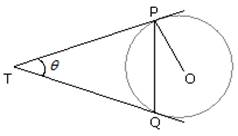
Given A circle with centre O and an external point T and two tangents TP and TQ to the circle, where P, Q are the points of contact.
To Prove: {tex}\angle{/tex}PTQ = 2{tex}\angle{/tex}OPQ
Proof: Let {tex}\angle{/tex}PTQ = {tex}\theta{/tex}
Since TP, TQ are tangents drawn from point T to the circle.
TP = TQ
{tex}\therefore{/tex} TPQ is an isoscles triangle
{tex}\therefore{/tex} {tex}\angle{/tex}TPQ = {tex}\angle{/tex}TQP = {tex}\frac12{/tex} (180o - {tex}\theta{/tex}) = 90o - {tex}\fracθ2{/tex}
Since, TP is a tangent to the circle at point of contact P
{tex}\therefore{/tex} {tex}\angle{/tex}OPT = 90o
{tex}\therefore{/tex} {tex}\angle{/tex}OPQ = {tex}\angle{/tex}OPT - {tex}\angle{/tex}TPQ = 90o - (90o - {tex}\frac12{/tex} {tex}\theta{/tex}) = {tex}\fracθ2{/tex}= {tex}\frac12{/tex}{tex}\angle{/tex}PTQ
Thus, {tex}\angle{/tex}PTQ = 2{tex}\angle{/tex}OPQ
Posted by Vaibhav Pandey 7 years, 9 months ago
- 1 answers
Posted by Me Bhawna 7 years, 9 months ago
- 2 answers
Posted by Himanshu Pal 7 years, 9 months ago
- 4 answers
Posted by Akshat Kacholia 6 years, 6 months ago
- 1 answers
Sia ? 6 years, 6 months ago
Let a,b and c be the sides of right angled {tex} \triangle ABC{/tex}, such that BC = a, CA = b and AB = c.
Let the circle touches the sides BC, CA, AB at D, E and F, respectively.
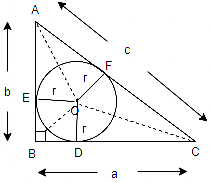
Then, {tex}AE=AF{/tex}
and {tex}BD=BF{/tex}
and {tex}CD=CE{/tex} [tangents drawn from an external point are equal in length]
In quadrilateral OECD each angle is right angle .So, OECD is a square therefore, we have
{tex}OE=EC=CD=OD=r{/tex}
{tex}\therefore AF=AE=b-r\;{/tex} and {tex}BF=BD=a-r{/tex}
{tex}\Rightarrow AF+BF=(b-r)+(a-r){/tex}
{tex}\Rightarrow AB=b-r+a-r{/tex}
{tex}\Rightarrow c=a+b-2r{/tex}
{tex}\Rightarrow\ 2r=a+b-c{/tex}
{tex}\therefore r=\frac{a+b-c}{2}{/tex}
Posted by Shakshi Singh 7 years, 9 months ago
- 2 answers
Divya Darshni 7 years, 9 months ago
Posted by Ajin Babu 7 years, 9 months ago
- 4 answers
Posted by Harshita Vatyani 7 years, 9 months ago
- 4 answers
Posted by Vansh Rathore 7 years, 9 months ago
- 1 answers
Posted by Anuj Bansal 7 years, 9 months ago
- 3 answers
Posted by Rk Soni 7 years, 9 months ago
- 8 answers
Posted by Rk Soni 7 years, 9 months ago
- 1 answers
Posted by Shubham Chakravarti 7 years, 9 months ago
- 1 answers
Bulldog Soup 7 years, 9 months ago
Posted by Aashriya Cherian 7 years, 9 months ago
- 3 answers
Posted by Sanju Sachdeva 7 years, 9 months ago
- 2 answers
Khushbu . 7 years, 9 months ago
Posted by Manya Singh 7 years, 9 months ago
- 3 answers

myCBSEguide
Trusted by 1 Crore+ Students

Test Generator
Create papers online. It's FREE.

CUET Mock Tests
75,000+ questions to practice only on myCBSEguide app
