
Ask questions which are clear, concise and easy to understand.
Ask QuestionPosted by Vinay Kumar 7 years, 9 months ago
- 1 answers
Posted by Deepanshu Parashar 7 years, 9 months ago
- 2 answers
Posted by Aditya Girdhar 6 years, 6 months ago
- 1 answers
Sia ? 6 years, 6 months ago
In right triangle ADC,
AC2 = AD2 + CD2.........[By Pythagoras theorem]
= 82 + 82 = 64 + 64 = 128
{tex}\Rightarrow {/tex} AC = {tex}\sqrt {128} {/tex} {tex}\Rightarrow {/tex} AC = {tex}8\sqrt 2 {/tex}
Draw BM {tex} \bot {/tex} AC
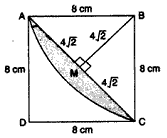
Then, AM = MC = {tex}\frac{1}{2}AC{/tex}
= {tex}\frac{1}{2}\left( {8\sqrt 2 } \right) = 4\sqrt 2 {/tex} cm
In right triangle AMB
AB2 = AM2 + BM2 ...........By Pythagoras theorem]
{tex}\Rightarrow {/tex} {tex}{\left( 8 \right)^2} = {\left( {4\sqrt 2 } \right)^2} + B{M^2}{/tex}
{tex}\Rightarrow {/tex} 64 = 32 + BM2
{tex}\Rightarrow {/tex} BM2 = 64 - 32
{tex}\Rightarrow {/tex} BM2 = 64 - 32
{tex}\Rightarrow {/tex} BM2 = 32
{tex}\Rightarrow {/tex} BM ={tex}\sqrt {32} {/tex} = {tex}4\sqrt 2 {/tex} cm
{tex}\therefore {/tex} Area of {tex}\triangle {/tex} ABC={tex}\frac{{AC \times BM}}{2}{/tex}
= {tex}\frac{{8\sqrt 2 \times 4\sqrt 2 }}{2}{/tex} = 32 cm2
{tex}\therefore {/tex} Shaded Area = {tex}\frac{{90}}{{360}}\pi {(8)^2} - 32{/tex}
= {tex}16\pi - 32{/tex}
= {tex}16 \times \frac{{22}}{7} - 32 = \frac{{352}}{7} - 32{/tex}
= {tex}\frac{{352 - 224}}{7} = \frac{{128}}{7}\,c{m^2}{/tex}
{tex}\therefore {/tex} Area of the designed region
= {tex}2 \times \frac{{128}}{7} = \frac{{256}}{7}\,c{m^2}{/tex}
Posted by Vanshika Yadav 6 years, 6 months ago
- 1 answers
Sia ? 6 years, 6 months ago
We have,
f(x) = abx2 + (b2 - ac)x - bc
= abx2 + b2x - acx - bc
= bx(ax + b ) - c(ax + b)
= (ax + b) (bx - c)
Now r(x)=0 if
ax+b=0 or bx-c=0
{tex}\style{font-family:Arial}{\begin{array}{l}\style{font-size:12px}{\mathrm i}\style{font-size:12px}.\style{font-size:12px}{\mathrm e}\style{font-size:12px}.\style{font-size:12px}\;\style{font-size:12px}{\mathrm x}\style{font-size:12px}=\style{font-size:12px}-\frac{\style{font-size:12px}{\mathrm b}}{\style{font-size:12px}{\mathrm a}}\style{font-size:12px}\;\style{font-size:12px}{\mathrm{or}}\style{font-size:12px}\;\style{font-size:12px}{\mathrm x}\style{font-size:12px}=\frac{\style{font-size:12px}{\mathrm c}}{\style{font-size:12px}{\mathrm b}}\\\end{array}}{/tex}
Thus, the zeroes of f(x) are : {tex}\style{font-family:Arial}{\style{font-size:12px}{\mathrm\alpha}\style{font-size:12px}=\style{font-size:12px}-\frac{\style{font-size:12px}{\mathrm b}}{\style{font-size:12px}{\mathrm a}}\style{font-size:12px}\;\style{font-size:12px}{\mathrm{and}}\style{font-size:12px}\;\style{font-size:12px}{\mathrm\beta}\style{font-size:12px}=\frac{\style{font-size:12px}{\mathrm c}}{\style{font-size:12px}{\mathrm b}}}{/tex}
Posted by Pooja Lakshmi 6 years, 6 months ago
- 1 answers
Sia ? 6 years, 6 months ago
In right-angled {tex}\triangle {/tex}BAC,
By using pythagoras theorem, we get
CB2 = AC2 + AB2
{tex}= 24^2 + 7^2\\= 576 + 49\\= 625{/tex}
{tex}\Rightarrow C B = \sqrt { 625 }{/tex}
{tex}= 25 \ cm{/tex}
{tex}\Rightarrow O C = \frac { 1 } { 2 } C B{/tex}
{tex}= \frac { 25 } { 2 } \mathrm { cm }{/tex}
So, radius of the circle {tex}= 12.5 cm{/tex}
Now, Area of {tex}\triangle {/tex}BAC
{tex}= \frac { 1 } { 2 } \times A C \times A B{/tex}
{tex}= \frac { 1 } { 2 } \times 24 \times 7 {/tex}
= 84 cm2
Area of the circle= {tex}3.14 \times 12.5 \times 12.5{/tex}
= 490.625 cm2
Area of quadrant COD
{tex}= \frac { 1 } { 4 } \times 3.14 \times 12.5 \times 12.5{/tex}
= 122.66 cm2
Now, area of the shaded region
= Area of the circle - Area of {tex}\triangle {/tex}BAC - Area of quadrant COD
= {tex}490.625 - 84 - 122.66{/tex}
= 283.96 cm2
Posted by Nayeem Mandal 6 years, 6 months ago
- 1 answers
Sia ? 6 years, 6 months ago
Given, {tex}\tan \theta + \sin \theta = m{/tex} and {tex}\tan \theta - \sin \theta = n{/tex}
L.H.S = {tex}m^{2}-n^{2}{/tex}
{tex}=(tan\theta+sin\theta)^{2}-(tan\theta-sin\theta)^{2}{/tex}
{tex}=tan^{2}\theta+sin^{2}\theta+2tan\theta sin\theta-[tan^{2}\theta+sin^{2}\theta-2tan\theta sin\theta]{/tex}
{tex}=tan^{2}\theta+sin^{2}\theta+2tan\theta sin\theta-tan^{2}\theta-sin^{2}\theta+2tan\theta sin\theta{/tex}
{tex}=4tan\theta sin\theta{/tex}
R.H.S = 4{tex}\sqrt{mn}{/tex}
{tex}=4\sqrt{(tan\theta+sin\theta)(tan\theta-sin\theta)}{/tex}
{tex}=4\sqrt{tan^{2}\theta-sin^{2}\theta}{/tex}
{tex}=4\sqrt{\frac{sin^{2}\theta}{cos^{2}\theta}-sin^{2}\theta}{/tex}
{tex}=4\sqrt{\frac{sin^{2}\theta-sin^{2}\theta cos^{2}\theta}{cos^{2}\theta}}{/tex}
{tex}=\frac{4}{cos\theta}\sqrt{sin^{2}\theta-sin^{2}\theta cos^{2}\theta}{/tex}
{tex}=\frac{4}{cos\theta}\sqrt{sin^{2}\theta (1-cos^{2}\theta)}{/tex}
{tex}=\frac{4}{cos\theta} \times sin\theta \times \sqrt{sin^{2}\theta}{/tex}
{tex}=4tan\theta sin\theta{/tex}
Hence, L.H.S = R.H.S
Posted by Anisha Kerketta 7 years, 9 months ago
- 0 answers
Posted by Deepika Garg 7 years, 9 months ago
- 1 answers
Sidarth Kabul 7 years, 9 months ago
Posted by Harshit Bedi 6 years, 6 months ago
- 1 answers
Sia ? 6 years, 6 months ago
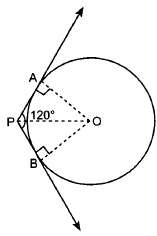
A circle C(O, r). PA and PB are tangents to the circle from point P, outside the circle such that {tex}\angle{/tex}APB = 120°.
Construction: Join OA and OB.
Proof. Consider {tex}\triangle{/tex}{tex}PAO \ and\ \triangle PBO {/tex}
{tex}PA = PB{/tex} [Tangents drawn from a point to circle are equal]
{tex} OP = OP{/tex}[Common]
{tex}\angle{/tex}OAP = {tex}\angle{/tex}OBP = 90°
{tex}\therefore{/tex}{tex}\triangle{/tex}OAP {tex}\cong{/tex} {tex}\triangle{/tex}OBP [by SAS cong.]
{tex}\therefore{/tex}{tex}\angle{/tex}OPA = {tex}\angle{/tex}OPB = {tex}\frac { 1 } { 2 } \angle \mathrm { APB } = \frac { 1 } { 2 } \times 120 ^ { \circ } = 60 ^ { \circ }{/tex}
In right angled {tex}\triangle{/tex}OAP, {tex}\frac { \mathrm { AP } } { \mathrm { OP } }{/tex}= cos 60° = {tex}\frac {1}{2}{/tex} {tex}\Rightarrow{/tex} {tex}OP = 2AP.{/tex}
Posted by Geetanjali Prajapati 7 years, 9 months ago
- 1 answers
Posted by Parth Kumthekar 6 years, 6 months ago
- 1 answers
Sia ? 6 years, 6 months ago
Given,
AB is the diameter of the circle
{tex}\angle C O B = \theta{/tex}
According to question
Area of minor segment cut off by AC = 2 {tex}\times{/tex} Area of sector BOC
{tex}\Rightarrow \quad \frac { \angle A O C } { 360 ^ { \circ } } \times \pi r ^ { 2 } - \frac { 1 } { 2 } r ^ { 2 } \sin \angle A O C = 2 \times \frac { \theta } { 360 ^ { \circ } } \times \pi r ^ { 2 }{/tex}
{tex}\Rightarrow \quad \frac { 180 - \theta } { 360 ^ { \circ } } \times \pi r ^ { 2 } - \frac { 1 } { 2 } r ^ { 2 } \sin ( 180 - \theta ) = 2 \times \frac { \theta } { 360 ^ { \circ } } \pi r ^ { 2 }{/tex}
{tex}\Rightarrow \quad \frac { 180 - \theta } { 360 ^ { \circ } } \times \pi r ^ { 2 } - 2 \times \frac { \theta } { 360 ^ { \circ } } \pi r ^ { 2 } = \frac { 1 } { 2 } r ^ { 2 } \sin \theta{/tex}
{tex}\Rightarrow \quad \pi r ^ { 2 } \left[ \frac { 180 - \theta } { 360 ^ { \circ } } - \frac { 2 \theta } { 360 ^ { \circ } } \right] = \frac { 1 } { 2 } r ^ { 2 } \sin \theta{/tex}
{tex}\Rightarrow \quad \pi r ^ { 2 } \left[ \frac { 180 - \theta - 2 \theta } { 360 ^ { \circ } } \right] = \frac { 1 } { 2 } r ^ { 2 } \sin \theta{/tex}
{tex}\Rightarrow \quad \pi \left[ \frac { 180 - 3 \theta } { 360 ^ { \circ } } \right] = \frac { 1 } { 2 } \sin \theta{/tex} [Cancel r2 from both side]
{tex}\Rightarrow \quad \pi \left[ \frac { 180 } { 360 ^ { \circ } } - \frac { 3 \theta } { 360 ^ { \circ } } \right] = \frac { 1 } { 2 } \times 2 \sin \frac { \theta } { 2 } \cdot \cos \frac { \theta } { 2 }{/tex} [We know that {tex}\sin 2 \theta = 2 \sin \theta \cos \theta{/tex}]
{tex}\Rightarrow \quad \pi \left[ \frac { 1 } { 2 } - \frac { \theta } { 120 ^ { \circ } } \right] = \sin \frac { \theta } { 2 } \cdot \cos \frac { \theta } { 2 }{/tex} Hence Proved
Posted by Garvit Mittal 7 years, 9 months ago
- 0 answers
Posted by Sakshi Joshi 7 years, 9 months ago
- 3 answers
Posted by Bharti Malvi 7 years, 9 months ago
- 1 answers
Posted by Arunaabh Maurya 7 years, 9 months ago
- 2 answers
Priya Dharshini ? 7 years, 9 months ago
Posted by Bharti Malvi 7 years, 9 months ago
- 1 answers
Posted by Anshika Ragu 7 years, 9 months ago
- 1 answers
Posted by Keerthana Devaraj 7 years, 9 months ago
- 0 answers
Posted by Sakshi Vats 7 years, 9 months ago
- 4 answers
Posted by Adarsh Adarsh 7 years, 9 months ago
- 1 answers
Posted by Aamir Khan 6 years, 6 months ago
- 1 answers
Sia ? 6 years, 6 months ago
Let AB be the surface of the lake and P be the point of observation such that {tex}AP = 100 m{/tex}. Let C be the position of the helicopter and C' be its reflection in the lake.
Then, {tex}CB = C'B.{/tex}
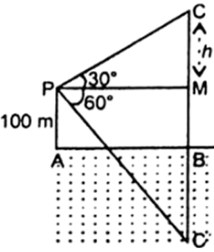
Let PM be perpendicular from P on CB.Then, {tex}\angle{/tex}{tex}CPM = 30 ^\circ{/tex}and {tex}\angle{/tex}C'PM = {tex}60^\circ{/tex}
Then, {tex}CM = h, \ CB = h + 100.{/tex}
In right {tex}\triangle{/tex}CMP
{tex}\tan 30^{\circ}=\frac{\mathrm{C} \mathrm{M}}{\mathrm{PM}} \Rightarrow{\frac{1}{ \sqrt{3}}}=\frac{h}{\mathrm{PM}}{/tex}
{tex}\Rightarrow PM =\sqrt3 h{/tex}...(i)
In right {tex}\triangle{/tex}PMC'
{tex}\tan 60^{\circ}=\frac{\mathrm{C}^{\prime} \mathrm{M}}{\mathrm{PM}} \Rightarrow \sqrt{3}=\frac{\mathrm{C}^{\prime} \mathrm{B}+\mathrm{BM}}{\mathrm{PM}}{/tex}
{tex}\Rightarrow \sqrt{3}=\frac{h+100+100}{P M}{/tex}
{tex}\Rightarrow P M=\frac{h+200}{\sqrt{3}}{/tex} ...(ii)
From (i) and (ii), we get
{tex} \sqrt{3} h=\frac{h+200}{\sqrt{3}}{/tex}
{tex} 3h = h + 200 \\ 2h = 200\\ h = 100{/tex}
Now,
{tex}CB = CM + MB\\ = h + 100\\ = 100 + 100\\ = 200\\{/tex}
Hence, the height of the helicopter from the surface of the lake = 200 m
Posted by Vibuhi Khajuria 7 years, 9 months ago
- 5 answers
Posted by Siya Pandey 7 years, 9 months ago
- 0 answers
Posted by Sumit . 7 years, 9 months ago
- 1 answers
Posted by Kuldeep Jain 7 years, 9 months ago
- 0 answers
Posted by Charu Vatsal 7 years, 9 months ago
- 2 answers

myCBSEguide
Trusted by 1 Crore+ Students

Test Generator
Create papers online. It's FREE.

CUET Mock Tests
75,000+ questions to practice only on myCBSEguide app

Rekha Varshini 7 years, 9 months ago
0Thank You