
Ask questions which are clear, concise and easy to understand.
Ask QuestionPosted by Lucky Charan 7 years, 9 months ago
- 1 answers
Posted by Lovely Aggarwal 5 years, 8 months ago
- 4 answers
Lovely Aggarwal 7 years, 9 months ago
Tanish Duggal 7 years, 9 months ago
Posted by Jeevan Kashyap 7 years, 9 months ago
- 3 answers
Vidhan Mungad 7 years, 9 months ago
Posted by Mohd Okasha 7 years, 9 months ago
- 1 answers
Posted by Jabo Kamchi 7 years, 9 months ago
- 1 answers
Jasmeen Kaur 7 years, 9 months ago
Posted by Saumya Singh 7 years, 9 months ago
- 3 answers
Posted by Harshit Chaudhry 7 years, 9 months ago
- 0 answers
Posted by Garima Bajaj 7 years, 9 months ago
- 1 answers
Posted by Rohan Dhall 7 years, 9 months ago
- 3 answers
Teerth Raj Chaudhary 7 years, 9 months ago
Posted by Suman Kumar 7 years, 9 months ago
- 1 answers
Posted by Tanisha Badlani 7 years, 9 months ago
- 3 answers
Posted by Medhavi Anand 7 years, 9 months ago
- 0 answers
Posted by Gurman Singh 7 years, 9 months ago
- 0 answers
Posted by Sanjay Vatsyayan 7 years, 9 months ago
- 1 answers
Posted by Adarsh Tripathi 7 years, 9 months ago
- 0 answers
Posted by Chetan More 6 years, 6 months ago
- 1 answers
Sia ? 6 years, 6 months ago
By applying Euclid’s division lemma,
{tex}963 = 657\times 1 + 306.{/tex}
Since remainder ≠ 0, apply division lemma on divisor 657 and remainder 306
{tex}657 = 306\times 2 + 45.{/tex}
Since remainder ≠ 0, apply division lemma on divisor 306 and remainder 45
{tex}306 = 45\times 6 + 36.{/tex}
Since remainder ≠ 0, apply division lemma on divisor 45 and remainder 36
{tex}45 = 36\times 1 + 9.{/tex}
Since remainder ≠ 0, apply division lemma on divisor 36 and remainder 9
{tex}36 = 9 \times 4 + 0.{/tex}
Therefore, {tex}H.C.F. = 9.{/tex}
HCF of 2 numbers can be expressed as the linear combination of the numbers
{tex}\Rightarrow {/tex} 9 = 45 - 36 {tex}\times{/tex} 1
= {tex}45 - [306 - 45 \times 6] \times 1 = 45 - 306\times 1 + 45\times 6{/tex}
= {tex}45 \times 7 - 306\times 1 = [657 -306\times 2]\times 7 - 306 × 1{/tex}
= {tex}657 \times 7 - 306 \times 14 - 306 × 1{/tex}
= {tex}657\times 7 - 306\times 15{/tex}
= {tex}657\times 7 - [963 - 657 × 1] \times 15{/tex}
= 657 {tex}\times{/tex} 7 - 963 {tex}\times{/tex} 15 + 657 {tex}\times{/tex} 15
= 657 {tex}\times{/tex} 22 - 963 {tex}\times{/tex} 15.
Hence, obtained.
Posted by Daksh Raj Singh 7 years, 9 months ago
- 1 answers
Posted by Aisha Singh 7 years, 9 months ago
- 3 answers
Gaurav Kumar 7 years, 9 months ago
Posted by Vikas Sheoran 7 years, 9 months ago
- 0 answers
Posted by Deepansh Varshney 7 years, 9 months ago
- 0 answers
Posted by Aryan Rajput 7 years, 9 months ago
- 1 answers
Posted by Nikita Jain 7 years, 9 months ago
- 2 answers
Posted by Zehra Mustafa 7 years, 9 months ago
- 0 answers
Posted by Srushti Bagi 7 years, 9 months ago
- 1 answers
Posted by Gunja Kumari 7 years, 9 months ago
- 1 answers
Posted by Gurman Singh 6 years, 6 months ago
- 1 answers
Sia ? 6 years, 6 months ago
Given, AB and CD are two parallel tangents to a circle with centre O.
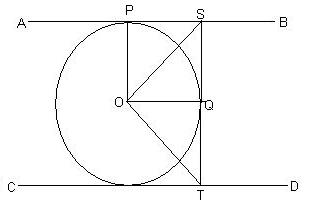
From the figure we get,
AB⊥ST then {tex}\angle{/tex}ASQ = 90° and
CD⊥TS then {tex}\angle{/tex}CTQ = 90°
{tex}\angle{/tex}ASO = {tex}\angle{/tex}QSO = {tex}90^\circ \over 2{/tex}= 45°
Similarly, {tex}\angle{/tex}OTQ = 45°
Consider ΔSOT,
{tex}\angle{/tex}OTS = 45° and {tex}\angle{/tex}OST = 45°
{tex}\angle{/tex}SOT + {tex}\angle{/tex}OTS + {tex}\angle{/tex}OST = 180° (angle sum property)
{tex}\angle{/tex}SOT = 180° - ( {tex}\angle{/tex}OTS + {tex}\angle{/tex}OST) = 180° - (45° +45° )
= 180° - 90° = 90°
{tex}\therefore{/tex} {tex}\angle{/tex}SOT = 90o

myCBSEguide
Trusted by 1 Crore+ Students

Test Generator
Create papers online. It's FREE.

CUET Mock Tests
75,000+ questions to practice only on myCBSEguide app

Nyayir Riba 7 years, 9 months ago
3Thank You